


Pine - True Woods
Description
This section is from the book "Plants And Their Uses - An Introduction To Botany", by Frederick Leroy Sargent. Also available from Amazon: Plants And Their Uses; An Introduction To Botany
Pine - True Woods
Pine (Figs. 229-232, 258) is used more extensively than any other kind of wood, and finds a place in almost every wood-working industry. The qualities which give it this pre-eminence are mainly that it works easily, is never too hard to nail (unlike oak or hickory), is for the most part very durable on account of the preservative effect of the resin it contains, and, for the same reason, is not much subject to the attack of insects. The several species which come into the market are sold either as hard or as soft pine but the difference is not always well marked. Soft pine (mainly white pine) is the principal wood used in common carpentry, and enormous quantities are consumed also in white cooperage, cabinet work, toy-making, pattern-making, and shipbuilding; and for crates, boxes, etc. Hard pine is most extensively used in heavy construction, especially for bridges and similar exposed work; and is unequaled for spars, masts, planks, ship-timbers, and heavy beams. It has especial advantages for flooring and exposed stairways on account of its durability.
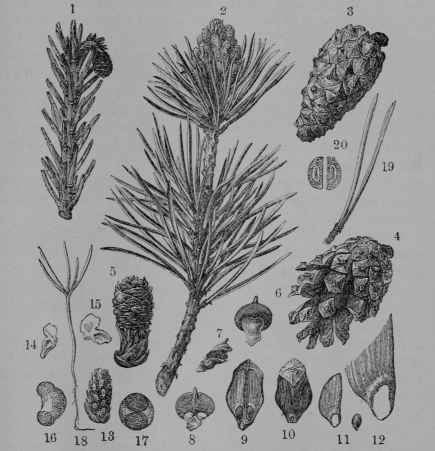
Fig. 258.-Scotch Pine. (Pinus sylvestris, Pine Family, Pinaceoe). 1, young branch bearing a pistillate flower near the tip. 2, branch bearing staminate flowers. 3, cone, still closed. 4, same open for discharge of the seeds. 5, pistillate flower, 3/2. 6-8, ovule-bearing scale, front, side and back views. 9, ripe scale with seeds attached. 10, same, back view. 11, seed and wing. 12, lower part of wing. 13, staminate flower. 14, 15, stamens. 16, 17, pollen grains, much magnified. 18, seedling. 19, branchlet bearing two foliage leaves. 20, leaves, cut across, enlarged. (Willkomm.)-Tree growing 36 m. tall; bark rough, brownish; leaves bluish-green; flowers yellowish; fruit reddish brown. Native home, Eurasia.
Continue to:


My Books

