


Ischochymia. Dilatation Of The Stomach; Gastric Insufficiency. Part 3
Description
This section is from the book "Diseases Of The Stomach", by Max Einhorn. Also available from Amazon: Diseases of the Stomach.
Ischochymia. Dilatation Of The Stomach; Gastric Insufficiency. Part 3
Benign Stenosis Of The Pylorus
Only rarely can the pylorus be palpated as a small oval tumor (of small hen's egg size); in most instances the pylorus cannot be felt. All cases reveal a long period of sickness (extending from two to fifteen years), in which the appearance of pain plays the greatest part. Although at first, either with or without therapeutic aid, there appear ameliorations, these periods of euphoria, however, are again and again interrupted by fresh attacks of sickness. They constantly become more violent and of longer duration, and the pains subside only after an artificially induced or spontaneous vomiting spell. Still later, when the ischochymia develops to a higher degree, not even vomiting brings entire relief, and the patients are subjected to the greatest pain and suffering. They emaciate quickly, and, if there is no radical intervention at this period, death from starvation inevitably eventuates.
The following two cases present good instances of a benign stenosis of the pylorus:
Case I
Louis L------, 40 years of age, lawyer, began to be troubled with his stomach in the summer of 1891. The patient was attacked with pains after meals during a period of ten days, when this symptom disappeared suddenly. There was no vomiting. For six months the patient felt well, not having any pains whatever; he noticed, however, that he became tired quicker than heretofore. In the winter of 1892 (February) he again had an attack of pain, lasting more than a month. During this attack he vomited twice. He felt well until July, when he had a fresh attack of pain extending over two to three weeks, with four vomiting spells. On account of the severe pains he could not lie quietly, but had to walk frequently to and fro in his room. In December, 1892, the patient had another attack, lasting until February, 1893. He then had to vomit frequently (nearly every other day). He had never vomited any blood. Since the beginning of the sickness his bowels were constipated.
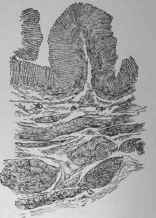
Fig. 57.- Cross-section of a Bengin Hypertrophied Pylorus. (From the writer's own observation.) x 60.
On January 27th, 1893, Dr. Charles Simmons called me in for a consultation and kindly entrusted me with the treatment of the patient.
When I first saw the patient he presented the picture of a very sick man in agonies of pain. He looked pale and emaciated; he asserted that he had lost about forty pounds in weight since the beginning of his ailment, and complained of a feeling of constriction in the abdomen and of shortness in breathing; he further complained of vomiting large quantities of fluid, and of obstinate constipation. During the last fourteen days the patient had taken large doses of opium; he was, however, very rarely entirely free from pain.
The examination of the chest organs did not reveal anything abnormal. Tongue slightly coated; pulse, 90; temperature, 98° F. The whole abdomen was more or less bloated and quite tense. In the gastric region no splashing sound could be produced. No tumor could be felt. The fluid which the patient vomited a few hours before showed many blackish flakes floating in it, contained a great quantity of free HC1. gave no reaction for lactic acid, and had an acidity = 90.
Patient was instructed to have a light meal (well-scraped meat, oysters, milk, crackers) every two hours. The quantity of liquids was reduced, and he was allowed to take only 150 c.c. at a time. Besides, oil clysmata were administered. Under this treatment the patient felt somewhat better, although his ailment, on the whole, did not change. On January 29th he was instructed not to take any food after his eight o'clock evening meal until the next morning. On January 30th, at 8 a.m., when fasting, the tube was inserted into the stomach and two quarts of liquid withdrawn. The stomach was then washed with lukewarm water. Patient felt exceedingly well after this lavage.
The withdrawn gastric liquid was analyzed; in this sample there were the blackish flakes mentioned above. The examination showed: HC1+; acidity = 88; lactic acid not present; peptone+; propep-tone +; rennet and pepsin +; erythrodextrin +.
Microscopically, no particles of meat can be found; amylaceous grains, yeast cells, and bacteria are present in considerable quantity. Teichmann's test for blood shows the absence of haemin.
Thus the withdrawn liquid consisted principally of gastric juice and of remnants of food taken the previous day.
February 1st, 1893, at 10 p.m., the stomach of the patient was thoroughly washed out. During the night he did not partake of anything, and on February 2d. at 8 a.m., the stomach was examined with the tube, and a small quantity of liquid withdrawn (150 c.c). The examination of this gastric liquid showed: HC1 +; both ferments present; acidity = 70.
The patient was treated with lavage for another week. He felt better and could walk outdoors. The pains, however, persisted, although they were less severe, and the stomach was never empty in the morning, but contained more or less liquid with food remnants.
Continue to:


My Books

