


Ischochymia. Dilatation Of The Stomach; Gastric Insufficiency. Part 5
Description
This section is from the book "Diseases Of The Stomach", by Max Einhorn. Also available from Amazon: Diseases of the Stomach.
Ischochymia. Dilatation Of The Stomach; Gastric Insufficiency. Part 5
Malignant Stenosis Of The Pylorus Or Cancerous Stenosis
Stenosis of the pylorus due to carcinoma is of frequent occurrence, and is developed sooner or later in the course of most cancers of the stomach appertaining to this region. Cases in which the diagnosis is made at an early period are most suitable for surgical interference. When possible, the tumor should be resected; otherwise gastroenterostomy should be per formed. An operation appears to me to ho always indicated when there exists ischochymia for some time, and either a tumor is felt or else the diagnosis of cancer of the pylorus can be made by other deductions - unless the tumor has assumed too extensive dimensions or the patient be too weak to stand an operation. Assuredly one can in many cases give great benefit for a more or less prolonged period of time, and the sooner the greater. Of the considerable number of cases of cancerous stenosis of the pylorus which I have seen during the past five years, eight have been operated upon. In only one was resection of the pylorus practised; in all others gastroenterostomy was performed by well-known surgeons of this city. One patient died during the first week after the operation.
The remaining seven lived from two months to a year.
1 Heinecke-Mikulicz's operation could not be done in this case . (1) on account of suspicion of cancer; (2) because the lumen was too narrow and the thickening of the walls of the pylorus too considerable.
2 The wall of the pylorus, after specimen was preserved in alcohol for about nine months, measured in thickness 1 1/2 cm.
All cases of cancerous stenosis reveal a more or less short period of illness1 (five mouths to one and a half vears at the utmost) and show considerable ischo-chyiuia. In most instances, with but few exceptions, a gastric tumor can be palpated. In some of the oases the position of the tumor can be accurately de-termined with the gastrodiaphane. By means of F. Kammerer, at the German Hospital, and the diagnosis as to position of the tumor was found to be correct. Most cases show the absence of free HC1 and the presence of lactic acid, although in some instances free HC1 is present in considerable quantities and lactic acid absent, as the following case demonstrates:
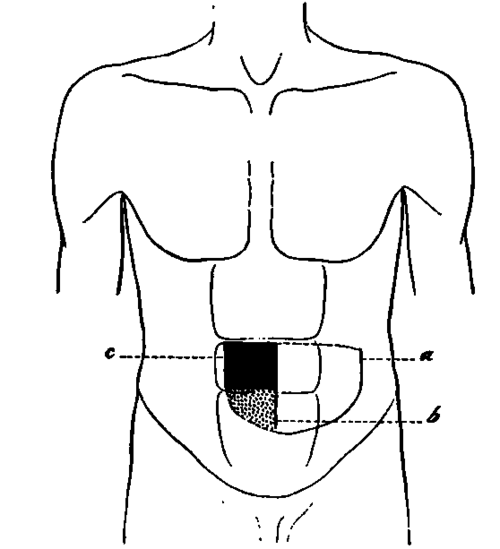
Fig. 68 - Result of Gastrodlaphany in Patient K. N-----, with Tumor in the Gastric Region, a, The transilluminated rone; b, the dotted spot slightly translucent on pressure; c, the black-colored spot remains dark even on pressure.
March 9th, 1894
Oscar F------, 32 years of age, silk manufacturer, always robust and healthy, has been suffering for the past six or seven months from digestive troubles which have been constantly increasing. They consist principally of pain, and for the last four months also of frequent spells of vomiting. Patient has lost forty pounds in weight. Bowels not stenosed. For this examination the expression method alone is not always sufficient. Whenever no chyme is withdrawn by this method, it is necessary to wash out the stomach. In these cases food is then continually found in the stomach. Dilatation of the stomach is almost always present; the organ occasionally extends from the margin of the ribs far down to the symphysis.
Differential Diagnostic Points
Benign stenosis of pylorus. | Malignant stenosis of pylorus. | |
Duration of illness. | Long duration of illness (two to fifteen years). | Short duration of illness (five months to one and one-half years). |
Course of the disease. | Long intervals without pain, or periods of perfect euphoria. | No periods of perfect euphoria, but constant and gradual aggravation of the symptoms. |
Tumor...... | As a rule absent....... | Present in most cases. |
Condition Of Gastric Contents
Benign stenosis of pylorus. | Malignant stenosis of pylorus. | |
Free HC1........ | Present in the great majority of cases. | Nearly always absent. |
Lactic acid.... | Absent in the great majority of cases. | As a rule, present. |
Acidity......... | Always increased...... | Fluctuates between 30 and 90. |
Rennet...... | Always present....... | Varies. |
Odor.... | Unpleasant, disagreeable | Very frequently fetid. |
In the following I shall describe several symptoms which, when present, are very valuable, but whose absence does not militate against the existence of pyloric stenosis. These symptoms are: be a cancer, and could not be resected on account of the numerous adhesions, principally with the colon. Gastroenterostomy was established, and in about a month's time patient was able to leave the clinic and partake of a great variety of food. Soon, however, regurgitation of bile into the stomach appeared, and a short while afterward "peristaltic restlessness", of this organ also developed. Both conditions made the patient feel very uneasy.
1. The dilated or abnormally large stomach.
2. The thickened and readily palpable pylorus.
Continue to:


My Books

