


Carcinogenic Agents For Tumor Control
Description
This section is from the book "Chemistry Of Chelation In Cancer", by Arthur Furst. Also available from amazon: Chemistry Of Chelation In Cancer.
Carcinogenic Agents For Tumor Control
It is almost more difficult to explain the tumor inhibition properties of hydrocarbons than it is to explain their carcinogenic function. Benzanthracene does inhibit tumor growth in rodents, but this is not a property of all carcinogenic hydrocarbons. 3-Methylcholanthrene has been somewhat successfully employed in human breast cancer. Some carcinogenic hydrocarbons even protect a rat from hepatoma formation after azo dye administration.
Perhaps these compounds work indirectly through some enzyme mechanism. Diethylstilbestrol increased the zinc level in the prostate of the rat. Do these compounds then act by increasing carbonic anhydrase or acid phosphatase levels?
If the mechanism of the cancer process goes via a chelation hypothesis, one would expect some compounds to be either anticancer or carcinogenic, and "Haddow's paradox" would be logical. A few azo dyes do act as growth inhibitors in experimental tumors. A combination of dimethylaminophenol with its diazo-tized derivative, coupled with benzoic acid to make 2-hydroxy-4,5-dimethyl-4'-carboxyazobenzene, did inhibit transplanted mammary carcinomas in mice. Note both compounds are chelating agents, and in contrast to the requirements for a free 2-position for carcinogenic azo dyes, this anticancer compound does have a 2-hydroxy group. Other 2-hydroxy derivatives of azo dyes inhibited the growth of Ehrlich ascites carcinoma. An azo dye coupled with 8-hydroxyquinoline was effective against mouse mammary carcinoma, but not against a myeloid leukemia.
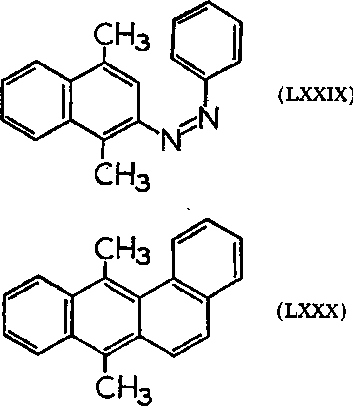
Of the non-chelating azo dyes that are reported to be inhibitory to the Walker rat carcinoma, most of them resemble a carcinogenic hydrocarbon in spatial arrangements of the rings. In fact cis azo dyes (LXXIX), which are almost "open chain models" of known carcinogenic hydrocarbons (LXXX), are the most effective. Here both a free "K-region" is apparent, and also a non-reactive "L-region" is present.
Unclassified Group
The vast majority of synthetic compounds reported as having anti-tumor effects in one or more of experimental neoplasms can chelate or complex with transition element ions. In no other way do these diverse chemicals resemble each other. As no logical classification is possible, groups will be selected at random.
Vitamin analogs of a series of compounds resembling riboflavin (258, 501) may act like antagonists, or they may be effective because they are chelating agents. The isonicotinic hydra-zide, in spite of being reported carcinogenic, does prevent the takes of the Ehrlich ascites tumor. This compound may have anti-vitamin B6 activity; it is an established chelating agent. Aliphatic acid hydrazides may also show carcinostatic activity (74,172, 376). Many malonates, too, can complex with metals, and many malonates affect rodent tumors. All carbohydrates can complex with metal ions; these include 2-desoxy-D-glucose, inositol, and the mustard derivative of mannitol (493, 563). Phenoxyacetic acid derivatives can also chelate metals, and these, too, show activity in retarding the growth of spontaneous mammary carcinomas in mice.
N-Methylformamide does not have a chelating structure, but it can form colored complexes at least with iron. It is active against a number of experimental tumors. Urethane, one of the earliest antileukemic agents for man, also complexes metals. Phenylthiourea, a copper catalyst blocking agent, caused regressions in Rous sarcoma in chickens.
Other chelating or metal ion complexing agents reported active include the bisepoxides and trioxymethylene glycol. More recently ortho-phenylenediamine was found effective in mouse melanoma; it is similar in structure to the dimethylaminophenol.
The question then to be asked is: What does EDTA do to a tumor? A study was inaugurated to find the effect of EDTA on the host bearing a Walker-256 tumor. It was found that EDTA suppressed tumor growth!. Evidence that this chelating agent acts on the host rather than the tumor has also been reported. No histological changes were found in Broun-Pearce carcinoma cells after sodium EDTA treatment. Calcium-tetracetate* bicarbonate caused a sixteen-day-old Guer-in's carcinoma to disappear.
Other active agents include the 2,2'-bipyridyl and o-phenan-throline. Compounds with this same spacing of two nitrogens separated by two carbons include derivatives of thiosemi-carbazides; all can complex metals. These are also antiviral agents. Anti-tumor activity of these chelating agents has also been reported. Of the isomers of pyridine carboxaldehyde thiosemicarbazones tested, only the 2-isomer (LXXXI) is active, and this compound is the only one which can include the basic nuclear nitrogen of the ring in forming a tridentate. This is not possible with the 3-isomer (LXXXII).


Specific chelates along these lines have already been designed, made, and found effective not only in experimental rodent tumor systems but also in the clinic. An antiviral agent, 2-keto-3-ethoxybutyraldehyde (LXXXIII), was considered by the author to have chelation possibilities. It was thus tested in his laboratory in a whole spectrum of tumors, and found equally as effective as HN2 against the Ehrlich ascites tumor. Investigators in another laboratory found that this agent prolonged the life span of mice with leukemia L1210. Following this observation a variety of chelating derivatives of 1,2-dicarbonyl compounds were synthesized and found carcinostatic (175,176,
178). The most active were the bisguanyl hydrazones (LXXXTV) now in clinical trial. This class of compounds does not function as antimetabolites as far as is known; however, the glyoxylase systems are now being studied.
* Is this a misprint, and does the author mean Ca EDTA? Original reference not seen by A. F.


A chelating agent, known for many years as a complexer of zinc, diphenylthiocarbazone (dithizone), is also being evaluated as a therapeutic agent. It has been tested for effect on canine and human prostate cancer with some positive results. These chelating agents are non-specific, and thus toxic side effects were found. A high level of carbonic anhydrase, a zinc-dependent enzyme, is found in the eye, and one would expect some ocular pathology if a zinc chelating agent were used. Dogs have a higher than usual zinc content in eye fluid; this species suffered blindness on this therapy. Rabbits with a lower choroidal zinc level did not go blind.
Continue to:


My Books

