


Hydroxy Steroid Dehydrogenases
Description
This section is from the book "The Scientific Contributions Of The Ben May Laboratory For Cancer Research", by The University of Chicago. Also available from Amazon: The Scientific Contributions Of The Ben May Laboratory For Cancer Research.
Hydroxy Steroid Dehydrogenases
The first enzymatic reaction to be demonstrated with cell-free preparations of steroid-induced P. testosteroni was the diphosphopyridine nucleotide-dependent oxidation of testosterone to 4-androstene-3,17-dione (170,172):
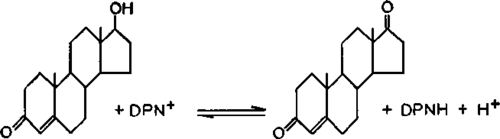
Further examination of this and similar reactions led to the recognition of a new class of enzymes, which were designated hydroxysteroid dehydrogenases and which catalyze oxidations of the following type (166): Steroid alcohol + DPN+(TPN+) ⇋ steroid ketone + DPNH (TPNH) + H+.
Although metabolic interconversions of various hydroxy- and keto-steroids had been recognized for many years, the specificity and properties of the enzymes responsible for these reactions have been clarified only re-cendy. Hydroxysteroid dehydrogenases are highly specific with respect to the position on the steroid nucleus or side chain at which they react and the steric course of the reactions which they promote.
Specificity
Highly purified preparations of the steroid-induced 17β-hydroxysteroid dehydrogenase of P. testosteroni promote the reversible DPN-dependent oxidations of the 17β-hydroxyl groups of testosterone, estradiol-17β, 19-nor-testosterone, as well as of various saturated steroids, such as 17β-hydroxy-5α-androstan-3-one and 17β-hydroxy-5β-androstan-3-one, to the corresponding ketones. The same (or a closely associated) protein catalyzes the DPN-dependent oxidation of various saturated and unsaturated 3 β-hydroxysteroids (139, 172, 177), namely:

Fig. 18.-Colonics of Pseudomonas testosteroni growing on an agar medium containing inorganic salts and testosterone as the only source of organic carbon. The Petri plate is viewed by transmitted light. In the dear areas surrounding the colonies, the insoluble testosterone has been utilized (172).
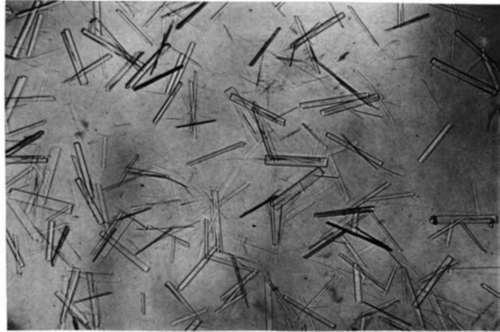

Fig. 19.-Crystalline Δ5-3-ketosteroid isomerase isolated from P. testosteroni viewed by ordinary light (above) and polarized light (below). Magnification 150X.
3β-Hydroxy-5α-androstan-3-one + DPN+⇋ 5α-androstane-3,17-dione + DPNH + H+ ;
3β-Hydroxy-5(3-androstan-3-one + DPN+⇋5β-androstane-3,17-dione + DPNH + H+ ;
3β-Hydroxy-5-androsten-3-one + DPN+⇋ 5-androstene-3, 17-dione + DPNH + H+ .
A separate, steroid-induced, 3 α-hydroxysteroid dehydrogenase has been purified from the same source (139, 177). The following are typical reactions catalyzed by the latter enzyme:
Androsterone + DPN+⇋ So-androstane-3,17-dione + DPNH + H+ ;
3α,17o,21-Trihydroxy-5β-pregnane-ll,20-dione + DPN+⇋ 17α,21-dihydroxy-5β-pregnane-3,ll,20-trione + DPNH + H+ ;
3α,7α,12α-Trihydroxy-5β-cholan-24-oic acid + DPN+⇋ 7α,12α-dihydroxy-5βcholan-3-one-24-oic acid + DPNH + H+ .
The 3 a-hydroxysteroid dehydrogenase appears to be specific for 3 α-hydroxyl groups. Steroids in which the A :B ring fusion is either cis(5 β-H) or trans(5α-H), and which belong to the C19, C21, and C24 series, may serve as substrates for this enzyme.
Kinetics And Substrate Binding
Purified hydroxysteroid dehydrogenases were the first well-characterized proteins to be available for a detailed study of the interaction of steroid hormones with specific complementary enzymatic proteins. Kinetic studies have been carried out with purified 3 α-and 17β-hydroxysteroid dehydrogenases to relate the initial velocity of oxidation of a given steroid with its concentration (138,165). Studies with many compounds of closely related structure have provided insight into the binding of the steroids to the enzyme surfaces and have clarified some of the structural and steric factors which are involved in the binding process. Whereas the enzymes are quite specific with respect to the position and steric configuration of reacting groups, they tolerate some latitude in the structural features and geometry of the remainder of the molecule. The enzymes possess very high affinities for certain of their steroidal substrates. These high affinities depend upon the interaction of the protein with large areas of the non-polar steroid nucleus, and these interactions are not merely confined to the regions of the oxygenated groups. Hence relatively minor steric or structural modifications of the substrate may profoundly influence the reaction velocity and the affinity between substrate and enzyme.
The relation between the initial rate of oxidation and the substrate concentration for many steroids deviates from the general predictions of Michaelis and Menten; profound inhibitions of reaction velocity are frequendy encountered at high-substrate concentrations. A quantitative analysis of this phenomenon (138) permitted the conclusion that the inhibitions at high-substrate concentrations could be accounted for in terms of the formation of bimolecular complexes, containing two substrate molecules per active site on the enzyme, and that these bimolecular complexes were catalytically inactive (138).
Equilibria and free energy changes-The availability of highly purified and specific pyridine nucleotide-linked hydroxysteroid dehydrogenases provided the opportunity for making accurate and simple measurements of the equilibria of interconversion of various steroid alcohols and ketones (165,174). Apart from their intrinsic interest, a knowledge of the equilibria of steroid oxido-reductions was an essential prerequisite for the development of methods for the enzymatic analysis of steroids.
The equilibrium constants for the interconversion of a variety of pairs of steroid alcohols and ketones have been determined in media of low ionic strengths and varying pH at 25. According to common practice, the equilibrium constants of these reactions may be defined as follows: KH = [ketone] [DPNH] [H+]/[alcohol] [DPN+]. Numerous determinations of KH for the oxidation of testosterone to 4-androstene-3,17-dione by 17β-hydroxysteroid dehydrogenase, under a variety of conditions, gave the average value of 37.8 X 10^-9 M at 250 (174). Hence the ratio of concentration of 17-ketosteroid to 17β-hydroxysteroid is close to unity at pH 7 if the concentrations of the reduced and oxidized pyridine nucleotides are assumed to be equal.
Enzymatic measurements of the equilibrium constants for the oxidation of several 3α- and 3β-hydroxysteroids of the 5α-androstane, 5α-pregnane, 5β-androstane and 5β-pregnane series have also been carried out (174). For the C19 steroids, the equilibrium constants ranged from 6.68 to 7.42 X 10^-9 M for the axial hydroxyl groups, and from 1.57 to 2.11 X10^-9 M for the equatorial hydroxyl groups. The difference in standard free energy between the axial and equatorial substituents in these cases amounts to about 0.8 kcal. per mole at 25°, and the observed free-energy differences are entirely consistent with the assigned conformations.
Measurements of the equilibrium constants of oxidation of various 3-hydroxypregnanes gave values in the range of 0.92 to 2.13 X10^-9 M and revealed negligible differences between the equilibrium constants of axial and equatorial alcohols. This unexpected finding suggested that either the A-ring in the pregnane compounds exists partially in the boat conformation or that solvation of the pregnane structure in aqueous systems might affect the conformations under certain circumstances (174).
Steric Specificity Of Hydrogen Transfer
The work of Vennesland and Westheimer has shown that pyridine nucleotide-linked dehydrogenases catalyze a direct and stereospecific transfer of hydrogen between the substrate and the para position of the nicotinamide moiety of the nucleotide (cf. Vennesland, B. Fed. Proc, 17:1150,1958). With the aid of deuterium-labeling, these workers were able to distinguish two classes of dehydrogenases, differing in the steric course of hydrogen transfer to the pyridine nucleotide. The two types of enzymes transferred the isotope so as to give, respectively, one or the other of the two diastereomeric forms of DPN-nicotinamide-4-d. The first three enzymes to be studied by Vennesland and colleagues (the dehydrogenases for alcohol, L-lactate and L-malate) all gave the same diastereomer of DPN-nicotinamide-4-d, which was arbitrarily designated as carrying deuterium on the a-side or side 1 (in the absence of information on the absolute configuration). The next enzyme to be studied in this respect was the 17β-hydroxysteroid dehydrogenase of P. testosteroni, which was shown to promote a direct transfer of hydrogen but to utilize the other diastereomeric form of reduced DPN-nicotina-mide-4-d, in which the reacting deuterium atom was on the β-side (or side 2) (175). From these experiments it was concluded that the DPN-dependent interconversion of 4-androstene-3,17-dione and testosterone involved a direct and stereospecific transfer of hydrogen between the 17 a position of the steroid and side 2 of the nicotinamide ring of reduced DPN.
In more recent experiments (113), tritium-labeling has been employed for the determination of enzyme stereospecificity of this type. For this purpose, oxidized DPN-nicotinamide-4-t and oxidized TPN-nicotinamide-4-t have been prepared. The experimental design is substantially simplified, since tritium may be determined by scintillation counting, and the necessity for mass spectrometer analyses is eliminated. The stereospecificity of hydrogen transfer for DPN has been established for the following reactions, catalyzed by highly purified preparations of hydroxysteroid dehydrogenases of P. testosteroni (113):
3β-Hydroxy-5α-androstan-17-one + DPN+⇋5a-androstane-3,17-dione + DPNH + H+ (β-hydroxysteroid dehydrogenase);
3a-Hydroxy-5o-androstan-17-one + DPN+⇋ 5a-androstane-3,17-dione + DPNH + H+ (3a-hydroxysteroid dehydrogenase) .
It was found that in both these reactions hydrogen was transferred to side 2 of the nicotinamide ring of DPN (113). The two substrates which are oxidized in the above reactions are diastereomeric, differing only in the configuration of a single hydroxyl group. Both enzymes use the same side of the nicotinamide ring of DPN. It may therefore be concluded that the configuration of the carbon atom of the substrate to and from which hydrogen is transferred does not dictate the steric course of hydrogen transfer to the pyridine nucleotide. Similar conclusions have been reached from studies with specific dehydrogenases for D- and L-lactate, both of which utilize side 1 (Dennis, D., and Kaplan, N. O. J. Biol. Chem., 235:810, i960).
Experiments with the partially purified 17β-hydroxysteroid dehydrogenase of human placenta, which has dual pyridine nucleotide specificity, revealed that this enzyme is specific for side 2 of the nicotinamide ring of DPN and TPN, in both of the following reactions:
Estradiol-17β + DPN+ ⇋ estrone + DPNH + H+ ; Estradiol-17β + TPN+ ⇋ estrone + TPNH + H+.
The stereospecificity of the transhydrogenase function of this placental enzyme in the presence of catalytic amounts of estradiol-17β was determined by means of the following reaction:
DPNH + 3-acetylpyridine-DPN+→DPN+ + 3-acetylpyridine-DPNH .
In agreement with the stereospecificity of its dehydrogenase function, the placental enzyme was found to remove hydrogen from side 2 of DPNH in the transhydrogenase reaction (113).
The broader functional significance of stereospecificity of hydrogen transfer in pyridine nucleotide-linked reactions has not been ascertained.
All the hydroxysteroid dehydrogenases of bacteria and animal tissues which have been studied transfer hydrogen to and from side 2 of the nicotinamide ring of the pyridine nucleotides, irrespective of their stereospecificity for steroids.
Continue to:


My Books

