


II. Experimental Mammary Cancer. Considerations
Description
This section is from the book "The Scientific Contributions Of The Ben May Laboratory For Cancer Research", by The University of Chicago. Also available from Amazon: The Scientific Contributions Of The Ben May Laboratory For Cancer Research.
II. Experimental Mammary Cancer. Considerations
Whereas advances of considerable magnitude have been made in the clinical treatment of far-advanced mammary cancer, these arose at the bedside exclusively through clinical investigation. The laboratory had contributed nothing for the therapy of disseminated cancer of the breast. Until the present studies were undertaken, no hormone-dependent mammary cancers were available in laboratory animals. Moreover, the earlier methods of induction of mammary cancer were slow, often requiring more than two years to induce cancer of the breast in a given series of animals. An additional vexation was that the incidence of mammary cancer rarely occurred in 100 per cent of the creatures. These disadvantages were overcome in the work now to be described. A method was devised for the invariable production of mammary cancer in a few weeks rather than in months or years. In addition, a considerable proportion of the cancers so induced were hormone-dependent and underwent atrophy after appropriate hormonal manifestations to be discussed.
It had been known for some years that polynuclear hydrocarbons have a propensity for the induction of mammary cancer. Wieland and Dane (1933) synthesized 3-methylcholanthrene (3-MC) by degradation of de-oxycholic acid. Maisin and Coolen (Compt. rend. soc. biol., 123:159, 1936) painted the skin of mice with 3-MC and found that, in addition to skin cancer, carcinoma of the mammary gland developed in a considerable proportion of the mice.
Mammary cancer also can develop when carcinogenic hydrocarbons are fed to rodents. The first compound found to elicit mammary cancer by this method was 2-acetylaminofluorene (2-AAF), which was incorporated in a diet that was fed to rats for many months (Wilson, R. H.; DeEds, F.; and Cox, A. S., Jr. Cancer Research, 1:595, 1941)
Methodology
A study was made of the conditions optimal for development of mammary cancer. The repeated daily administration of optimal quantities of 3-MC to young adult female rats of a special strain induced mammary cancer invariably and rapidly (46); the earliest cancer of the breast was detected by palpation 20 days after beginning the feeding, and within 8 weeks every animal had developed multiple tumors of this sort. Malignant tumors induced by oral administration of polynuclear hydrocarbons are selective in site and manifest themselves in two discontinuous series. Mammary cancer develops in a few weeks. Other neoplasms appear after 4-8 months; delayed tumors, rather commonly induced, are carcinoma of special sebaceous glands near the external auditory canal and sarcoma at the site of repeated subcutaneous injections (e.g., estradiol-17β dissolved in sesame oil; equine gonadotrophin in saline). Leukemia and other tumors are rare and also occur late. Significandy, no tumors were observed in the liver.
Whereas polynuclear hydrocarbons induced mammary cancer invariably in Sprague-Dawley rats, feeding them to guinea pigs or hamsters failed to induce cancer.
The hormonal status of the susceptible rats was critical for the induction of mammary cancer. The neoplasm was not induced by feeding carcinogens to hypophysectomized animals. Moreover, the incidence of cancer was profoundly reduced in the highly hyperplastic mammary glands of rats treated with equine gonadotrophin or large doses of estradiol-17β (52). A biphasic effect of phenolic estrogens had been observed earlier (68) with regard to the growth of transplanted mammary tumors; small doses of this steroid enhance, while large doses of these phenols block, mammary tumor growth.
Later it was shown (46, 53) that a single feeding of polynuclear hydrocarbons suffices to induce mammary cancer in susceptible rats. This phenomenon emphasizes the high importance of the alimentary tract as a portal for their entry and, indeed, of a single meal for the development of mammary cancer. This method has advantages over multiple feedings in its extreme simplicity, saving of rare or cosdy compounds, and reduction of exposure of personnel to potentially hazardous substances. Yet mammary cancer arises in every animal under appropriate conditions and within a few weeks. A stoichiometric relationship exists between the dose of effective polynuclear hydrocarbons and the rate of incidence of the cancers together with their number (Fig. 9). The carcinogen need not traverse the entire alimentary tract to induce cancer; the injection of the effective polynuclear hydrocarbons into the lumen of the cecum gives rise to mammary cancer (61). Moreover, a single intravenous injection is highly efficacious in evoking cancer of the breast. The mammary cancers arise under highly restricted conditions, but these are easily fulfilled.
The influences of age at the time of a single feeding, and of the presence of the ovaries, were investigated by feeding a single dose of 3-MC (66 mg/100 gm) to rats of various ages; half the animals were intact, while the ovaries of the others had been removed at the time of weaning. In the intact rats, mammary cancer was induced by feeding the carcinogen at age 23 days, and the incidence of tumors rose progressively with age until all rats fed 3-MC at age 50-65 days developed cancer of the breast; there was a decline in the incidence of mammary cancer in rats fed 3-MC at age 75 days or later (Fig. 10). No mammary cancer was observed in 100 rats which had been ovariectomized at age 22 days and fed a single dose of 3-MC thereafter at various ages between 30 and 100 days.

Fig. 9.-Incidence of mammary cancer in rats fed 7,12-dimethyl benzanthracene (DMBA) once only. Active centers refer to average number of cancers evoked in each rat.
Many carcinogens (2-AAF; 3-MC) were found to elicit mammary cancer following a single feeding, but the most effective polynuclear hydrocarbon was 7,12-dimethylbenz(a)anthracene (DMBA). A single feeding of DMBA, I mg., induced mammary cancer, and there was a progressive rise in the incidence of mammary cancer until the optimal dose was reached (Fig. 9). The optimal dose of DMBA (dissolved in sesame oil, 1 ml.) for the induction of mammary cancer is 20 mg. Following a single feeding at this dose level (1), every rat survived; (2) mammary cancer developed in 140 consecutively treated rats without exception; (3) the first cancer was detected by external examination at 28 days and all of the rats had visible tumors of the breast before 60 days; and (4) the tumors were multiple in every rat.

Fig. 10.-Incidence of mammary cancer in groups of 10 rats of various ages fed 3-methylcholan-threne (3-MC) once only.
The effect of the stock of the recipient rat is shown in Table 1. It will be seen that the albino rats of the Sprague-Dawley strain are highly susceptible to mammary cancer, whereas the pigmented Long-Evans rat is much more resistant. However, the relative insusceptibility of the Long-Evans rats to the induction of mammary cancer was overcome by cross-breeding with Sprague-Dawley stock (164). It will be seen that susceptibility to the induction of mammary cancer by polynuclear hydrocarbons is transmitted as a dominant factor by both male and female Sprague-Dawley rats.
A single moderately large feeding of the effective polynuclear hydrocarbons causes selective injuries in the recipient rather than total body damage. These lesions include damage to the lymphatic and hemopoietic apparatus with consequent leukopenia, hemorrhage and necrosis in the adrenal glands; the induction of cancers in mamma and in certain sebaceous glands; and spindle cell sarcoma under special circumstances. But the sexual rhythm (Fig. II) demonstrated in the wonderfully regular recurrences of estrus cycles was not delayed by feeding the carcinogen. Estrus appeared every 4.15 days, both in rats fed DMBA, 20 mg., and in untreated control rats. It was thereby proven that DMBA induced cancers, leukopenia, and caused adrenal necrosis, but it brought about no significant decrease in the production of gonadotrophin by the hypophysis or in function of the ovary. Obviously, there was selective injury, but there was not total body damage.
Table 1
Incidence of Mammary Cancer in Sprague-Dawley and Long-Evans Rats and Their F1 Hybrids (164).
No. Rats | Rats with Canceb | Time of Appearance of Mammary Cancer (Days) | ||||
No. | Per Cent | Range | Median | Mean | ||
SD♀ XSD♂.......... | 314 | 314 | 100 | 29- 92 | 53 | 53.1± 9 |
LE♀ XLE♂.......... | 71 | 22 | 31 | 70-246 | 111 | 125 ±58 |
LE♀XSD♂(F1)....... | 22 | 19 | 86 | 51-130 | 63 | 70.4±22 |
SD♀XLE♂(F1)....... | 21 | 20 | 95 | 67-137 | 89 | 97.4±23 |
SD = Sprague-Dawley; LE = Long-Evans rats.
3-mc, 10 mg. daily, was fed by gastric tube to all rats between ages 50 and 100 days.
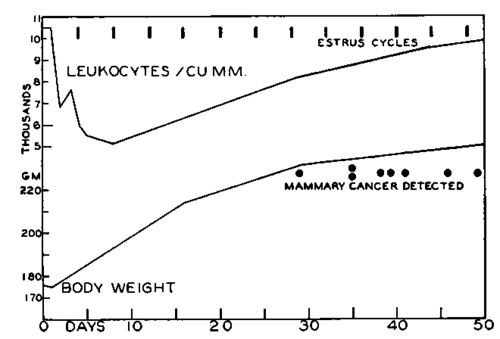
Fig. II.-DMBA, 20 mg., was fed to 8 rats on day 0.
Trace amounts of polynuclear hydrocarbons are sufficient to induce mammary cancer. Compressed cylindrical pellets of 3-MC of known weights were implanted in the spleens of 18 rats; neoplasms did not arise in the spleen, but 3 of the animals developed mammary cancer, respectively, at 105, 148, and 199 days. At necropsy the pellets were removed from the spleen, blotted, heated at ioo° for 24 hours, and reweighed. No observed decrease in weight oj the pellet took place during its long sojourn in the spleen; an amount of 3-MC too small to be detected on our balance had induced mammary cancer (53).
Continue to:


My Books

