


Mechanisms Of Hormone Action. Part 5
Description
This section is from the book "The Scientific Contributions Of The Ben May Laboratory For Cancer Research", by The University of Chicago. Also available from Amazon: The Scientific Contributions Of The Ben May Laboratory For Cancer Research.
Mechanisms Of Hormone Action. Part 5
We have recently examined the heat stability of the placental enzyme system. Purified placental 17β-hydroxysteroid dehydrogenase, stabilized with estradiol-17β, was subjected to stepwise heat inactivation by exposure to a temperature of 65° C. for as long as 35 minutes. The dehydrogenase activity at each step was measured with DPN. The transhydrogenase was estimated from the rate of reduction of the pyridine aldehyde analog of DPN by DPNH in the presence of catalytic amounts of estradiol-17β. Both activities were measured at pH 8.2 and at 25°. Table III shows that during the course of heat treatment 92% of the dehydrogenase and the same fraction of the transhydrogenase activities were lost. The ratio of the dehydrogenase to transhydrogenase activities at each step varied from 5.0 to 6.0, which represented a maximum variation of ±11% from the mean ratio. This agreement is indeed remarkably close when it is considered that it depends upon two measurements each of which has an estimated uncertainty of about 5%. Thus, we are unable to substantiate the claims that the two activities can be separated by heat inactivation (39, 40).
4. Interconversion Of Hydroxy- And Ketosteroids
If the estrogen-stimulated transhydrogenation is mediated by the 17β-hydroxysteroid dehydrogenase, the interconversion of estradiol-17β and estrone is obligatory for this reaction. This question has been examined with the aid of radioactive estradiol-17β-6,7t, which was prepared by the catalytic hydrogenation of Δ6-estradiol-17β with tritium gas and kindly donated by Dr. E. V. Jensen of this laboratory. The transfer of hydrogen from DPNH to the acetylpyridine analog of DPN by the purified placental
Table III. Heat Denaturation Of Placental Enzyme
Heat treatment of enzyme at 65° C. (minutes) | Dehydrogenase | Transhydrogenase | Ratio of dehydrogenase activity to transhydrogenase activity | ||
Activity (µmoles/ min./ml.) | % Activity retained | Activity (µmoles/ min./ml.) | % Activity retained | ||
None | 1.30 | 100 | 0.232 | 100 | 5.6 |
10 | 0.99 | 76 | 0.167 | 72 | 5.9 |
20 | 0.48 | 37 | 0.097 | 42 | 5.0 |
35 | 0.10 | 8 | 0.017 | 8 | 6.0 |
Mean = 5.6 | |||||
° The purified placental 17β-hydroxysteroid dehydrogenase had an initial specific activity of 112 units per milligram protein. The enzyme solution contained the following: ethylenediamine tetraacetate (0.001 M), ammonium sulfate (0.39M), Tris (0.01 If), cysteine (0.005 M), and estradiol-178 (5 ug- per milliliter).
The assay system for dehydrogenase activity contained in a final volume of 3.0 ml.: 300 (imoles Tris of pH 8.2; 25 mg. crystalline serum albumin; 80ug. estradiol-178 in 0.04 ml. acetone; 1.3 (imole DPN; and enzyme. The measured final pH varied from 8.13 to 8.22. The observed rates fell in the range of optical density changes of 0.004 to 0.027 per minute at 340 mu and 25° C.
The transhydrogenase was measured in systems of final volume of 3.0 ml. containing: 300 (imoles Tris of pH 8.2; 0.4 (imoles DPNH; 4 ug. estradiol-178 in 0.01ml. acetone; 2.32 (imoles of the pyridine aldehyde analog of DPN; and appropriate quantities of enzyme. The measured values fell within the range of optical density changes of 0.016 to 0.0024 per minute at 385 m(i and 25°C. For the transhydrogenase assay, an additional control was run with each preparation. This control contained 0.01 ml. acetone in place of the estradiol-178 solution and 0.1 µmole of TPN. This control changed in absorbancy 0.002 or less in 10 minutes. The measured pH values in the cuvettes were between 8.14 and 8.20 enzyme was studied in the presence of catalytic quantities of tritium-labeled estradiol-17β. At a suitable time interval the steroids were extracted from the reaction mixture, diluted with unlabeled carrier estradiol-17β and estrone and chromatographed on paper in parallel with standards of these steroids. The papers were cut into segments perpendicular to the line of travel of the solvent; the steroids were eluted from the paper segments and counted in a liquid scintillation counter. The results and experimental details are shown in Fig. 3. Evidence for the conversion of estradiol-17β to estrone during the course of transhydrogenation was obtained. It is of interest that at the particular instant in time when the transhydrogenation was arrested, the quantity of estrone present was about four to five times greater than that of estradiol-17β.
Using estradiol-17β- 16-C14 and estrone-16-C14, Hollander et al. (48) have made simultaneous measurements of the production of DPNH and of the steroid conversion product in a transhydrogenase system which contained I umole isocitrate, 0.3 umole DPN, 0.002 umole TPN, and 3.7 mumoles of estradiol-17β-16-C14, or estrone-16-C14. In each instance, a steady state was reached when the ratio of the concentration of estrone to that of estradiol-17β was about 3.
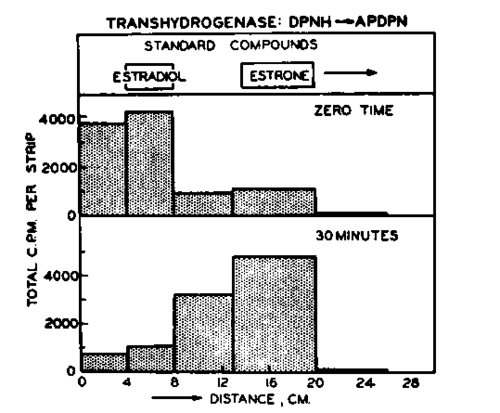
Fig. 3. The conversion of estradiol-17β to estrone during hydrogen transfer between DPNH and the acetylpyridine analog of DPN (APDPN).
Two similar glass-stoppered vessels each contained in a final volume of 12 ml.: 2 mg. DPNH (approximately 2 umoles), 8 mg. acetylpyridine analog of DPN, 1.2 mmoles Tris of pH 7.4, 21.25 µg. estradiol-17β-6,7t in 0.01 ml. dioxane with a total radioactivity of 24,740 c.p.m. and 2050 units purified placental 178-hydroxysteroid dehydrogenase (specific activity 175 units per milligram protein). One vessel was extracted immediately with ethyl acetate and served as a zero time control; the other was permitted to incubate for 30 minutes at 25° C. Carrier estradiol-178 and estrone (2.5 mg. of each) were added to the incubation mixture as well as to the zero-time controls. The vessels were extracted with three 10-ml. portions of ethyl acetate. The combined extracts were dried over anhydrous sodium sulfate, evaporated to dryness under reduced pressure, dissolved in 0.5 ml. methanol and a 0.25-ml. aliquot of this extract chroma-tographed on paper in a Bush-type system consisting of heptane and methanol (1:1 by volume) for 18 hours (22). Standard compounds, run in parallel, were located by spraying with a mixture of equal volumes of 1% FeCl3 and 1% K3Fe(CN)6. The chromato-gram was then cut into strips as shown. The steroids were eluted from the paper strips with acetone, the acetone evaporated, and the residue dissolved in a toluene scintillator containing 4.0 gm. per liter 2,5-diphenyloxazole and 0.05 gm. per liter 1,4-bis-2-(5-phenyloxazolyl)-benzene. The counting was performed in a Packard liquid scintillation spectrometer with an efficiency of about 25%. The total radioactivity of each strip is shown, the reaction mixture (below) and the zero-time control (above). The location of standard compounds (estradiol-17P and estrone) is shown at the top.
5. Stereospecificity Of Hydrogen Transfer To Pyridine Nucleotides
The classic experiments of Vennesland, Westheimer, and their colleagues (30, 78, 123) have shown that pyridine nucleotide-linked dehydrogenases catalyze direct hydrogen (probably hydride ion) transfer between substrates and position 4 of the nicotinamide moiety of the nucleotides. With the aid of isotopic (deuterium) labeling, it was shown that each enzyme added and removed hydrogen stereospecifically at position 4 of the nicotinamide ring, and that two diastereomeric forms of DPN-nicotinamide-4-d exist. The many enzymes which have been studied in this regard fall into two groups: those which utilize side I (or a) of the pyridine ring (e.g., ethanol dehydrogenase) and those which transfer hydrogen to and from side II (or β) of the ring (e.g., glyceraldehyde-3-phosphate dehydrogenase, Pseudotnonas fiuorescens transhydrogenase). We have examined the stereospecificity of the placental dehydrogenase and transhydrogenase systems, using DPN-nicotinamide-4-t and TPN-nicotinamide-4-t (59). The dehydrogenation of estradiol-17β to estrone occurs with transfer of hydrogen to side II of the nicotinamide moiety of DPN and of TPN. The transhydrogenation from DPNH to the acetylpyridine analog of DPN in the presence of catalytic quantities of estradiol-17β likewise involves hydrogen removal from side II of the DPNH. These results are compatible with the view that dehydrogenase and transhydrogenase activities are reflections of the same catalytic process.
Continue to:


My Books

