


The Isolation Of Radioactive Phosphoserine. Part 2
Description
This section is from the book "The Scientific Contributions Of The Ben May Laboratory For Cancer Research", by The University of Chicago. Also available from Amazon: The Scientific Contributions Of The Ben May Laboratory For Cancer Research.
The Isolation Of Radioactive Phosphoserine. Part 2
About 60 to 67 per cent of the radioactivity of the hydrolysate was found to be present as esterified phosphorus compounds after removal of inorganic phosphate. Furthermore, the specific activity of the esterified phosphorus was 2 to 3 times higher than that of the inorganic phosphate.
These results show that the radioactivity of the "phosphoprotein" fraction is not the result of adsorption of inorganic orthophosphate of high specific activity, nor can it be due to the presence of pyrophosphate or metaphos-phate which would be hydrolyzed under these conditions to orthophosphate.
Table I. Incorporation Of P" Into Ehrlich Ascites Tumor Cells
Specific activity, counts per µM P | |||
Substrate | |||
Phospholipids | Nucleic acid | "Phosphoprotein" | |
Anaerobic | |||
Glucose.................. | 3780 | 2080 | 58,600 |
None.................... | 155 | 62 | 3,290 |
Aerobic | |||
Glucose.................. | 1640 | 1025 | 44,000 |
None.................... | 2670 | 1700 | 47,600 |
The conditions of incubation with P32 were similar to those described in the text. In the anaerobic experiment, the gas phase was 95 per cent N25 + 5 per cent CO2.
Table II. Effect Of Acid Hydrolysis On "Phosphoprotein" Fraction
Experiment 46 | Experiment 48 | |
Total inorganic P,µm | 53 | 83 |
" " PM, counts X 10^6 | 1.53 | 2.02 |
Specific activity of inorganic P, counts per µM P | 28,900 | 23,300 |
Total esterified P, µM | 46 | 54 |
P32, counts X 10^6 | 3.24 | 3.06 |
Specific activity of esterified P, counts per µM P | 70,500 | 56,700 |
The values were obtained by analysis of the clarified hydrolysate after treatment with acid as described in the text.
It is clear that the "phosphoprotein" residue as obtained by the method of Schneider is by no means homogeneous, but consists of a mixture of components of low specific activity, which are labile to acid hydrolysis, and components of high specific activity, which are relatively stable under these conditions. It is for this reason that the crude fraction is described within quotation marks. Davidson and coworkers (3) have presented similar evidence based on treatment of the "phosphoprotein" fraction with alkali under the conditions of the Schmidt and Thannhauser fractionation (9).
Fractionation on Dowex 1 Chloride Resin-The crude hydrolysate, after removal of inorganic orthophosphate, was diluted with 20 volumes of distilled water to reduce the chloride ion concentration and passed over a column of Dowex 1 chloride resin (4 cm. high and 2 cm. in diameter) at a rate of 1 to 2 ml. per minute. This operation was performed in a cold room at 5° to minimize breakdown of phosphate esters during the rather prolonged time necessary to pass the dilute solution over the column. About 80 to 90 per cent of the radioactivity was adsorbed on the column. After washing the column with distilled water and 0.001 n HC1, the radioactivity was eluted with 0.01 n HC1 in fractions of about 6 ml. each with the aid of an automatic fraction collector. Details of this chromatographic step for one experiment are given in Table III. Nearly all of the adsorbed radioactivity was collected in a single band, which showed no resolution of separate components, but represented a very high degree of purification, since most of the ninhydrin-reacting material of the hydrolysate was removed.
Table III. Fractionation Of Acid Hydrolysate Of "Phosphoprotein" On Dowex 1 Chloride Resin
Volume | Total P32 | |
ml. | counts x I0^6 | |
1. Hydrolysate after removal of inorganic ortho- | ||
phosphate ................................... | 4000 | 3.06 |
2. Eluate from (1)................................ | 4000 | 0.49 |
3. Wash with H2O................................ | 100 | 0 |
4. " " 0.001 n HC1........................ | 100 | 0 |
5. Eluate with 0.01 " " | ||
Tubes 34-55................................... | 134 | 2.4 |
All other tubes................................ | 443 | 0.26 |
Fractionation on Dowex 1 Acetate Resin-A column of Dowex 1 acetate resin, 45 cm. high by 9 mm. in diameter, was prepared by washing the chloride form of the resin with 1.0 m sodium acetate until no chloride ion could be detected in the effluent. The column was then washed with water prior to use. The elution of phosphorylated amino acids from this column was carried out under carefully standardized conditions, with a continuously increasing concentration of acetate buffer. An arrangement of apparatus similar to that described by Busch, Hurlbert, and Potter (18) was used. The mixing chamber, consisting of a 500 ml. flask equipped with a magnetic stirrer, was initially filled with distilled water. The reservoir was a large separatory funnel containing 1000 ml. of 0.4 m sodium acetate-acetic acid buffer at pH 4.8. The column was eluted at the rate of 20 ml. per hour. By this technique, mixtures of synthetic phospho-L-se-rine, phospho-L-tyrosine, phospho-L-threonine, and phospho-L-hydroxypro-line could be successfully resolved. Phospho-L-hydroxyproline appeared first in the eluate (310 to 360 ml. of eluate), followed by phosphothreonine (370 to 395), phosphoserine (500 to 525), and phosphotyroeine (580 to

Fig. 1. The radioactive band from a column of Dowex 1 chloride was rechromato-graphed over a column of Dowex 1 acetate resin as described in the text.
630). The position of these compounds in the eluate was satisfactorily constant and predictable. When known amounts of the synthetic phosphorylated amino acids were subjected to these chromatographic procedures, recoveries of the compounds were close to quantitative.
The radioactive band from the Dowex 1 chloride column was neutralized with ammonia, adsorbed on a column of Dowex 1 acetate, and eluted according to the technique described. No carrier material was added. Fig. 1 shows the distribution of radioactivity in the eluate for one such experiment. About 30 per cent of the radioactivity of the original crude hydrolysate after removal of inorganic orthophosphate could be recovered in a well defined peak in the position expected for phosphoserine in this chromate-graphic procedure. Material taken from tubes in the middle of this peak and rechromatographed either on Dowex 1 chloride or Dowex 1 acetate exhibited only a single sharp peak.
The specific activity of the phosphoserine fraction obtained by these procedures is compared with that of the crude "phosphoprotein" fraction and of other stages in the fractionation procedure in Table IV. It will be seen that the specific activity of the phosphoserine fraction is about 3 to 5 times higher than that of the crude "phosphoprotein" and is also significantly higher than that observed in any of the previous fractionation steps. It is important to note that the specific activity of the phosphoserine is very much higher than that of the inorganic phosphate removed after the acid hydrolysis, thus eliminating the possibility that radioactive phosphoserine arises from a purely chemical reaction between serine and orthophosphoric acid during hydrolysis.
Table IV. Specific Activity Of Phosphoserine Isolated From "Phosphoprotein"
Specific activity, counts per µM P | ||
Experiment 46 | Experiment 48 | |
1. Total "phosphoprotein" P..................... | 44,400 | 45,000 |
2. After acid hydrolysis, inorganic P.............. | 28,900 | 23,300 |
esterified " ............. | 70,500 | 56,700 |
3. " fractionation on Dowex 1 chloride resin.. | 100,000 | 73,000 |
4. Phosphoserine................................. | 211,000 | 113,000 |
Chromatography on Filter Paper-In order to check the identity of the radioactive phosphate ester obtained by chromatography on Dowex 1 acetate resin, a portion of the phosphoserine fraction was passed over Amber-lite IR-120 resin (hydrogen form) to remove sodium ions, concentrated to a small volume, and run on Whatman No. 43 filter paper. A solvent mixture of 75 parts by volume of absolute ethanol and 50 parts of 0.1 m acetate buffer, pH 4.6, was used. A single ninhydrin-positive spot was found with an Rr of 0.35. Synthetic phosphoserine run on the same paper as the control showed an R, of 0.34. The filter paper was cut into small sections, eluted with water, and the distribution of radioactivity was measured. The results are presented in Fig. 2. Practically all of the radioactivity was found in a large peak in the exact position of the ninhydrin spot. A smaller, faster component moves at the same RF as inorganic phosphate, which may be present as the result of a small amount of breakdown during the course of concentration of the sample for paper chromatography.
Isolation of Radioactive Crystalline Phospho-L-Serine-To obtain further proof of the presence of radioactive phosphoserine in the hydrolysate of Ehrlich ascites "phosphoprotein," an experiment was performed in which unlabeled carrier phosphoserine was added to the crude hydrolysate and reisolated in crystalline form. To the hydrolysate of the "phosphoprotein" fraction after removal of inorganic orthophosphate were added 100 mg. of the barium salt of phospho-L-serine. The hydrolysate was concentrated to a small volume and barium phospho-L-serine precipitated by the addition of several volumes of alcohol. The crude precipitate was washed several times with 50 per cent alcohol and chromatographed on Dowex 1 acetate resin. The band of phosphoserine was located by the ninhydrin reaction and was rechromatographed on Dowex 1 chloride. The column was eluted with 0.02 n HC1, and the phosphoserine again located by means of the ninhydrin reaction. The tubes containing the phosphorylated amino acid were pooled and concentrated to a volume of about 0.50 ml. Several volumes of cold ethanol were added, and phospho-L-serine was obtained as a crystalline precipitate in a yield of 28.5 mg., corresponding to an over-all recovery of about 55 per cent. The purified material was extremely radioactive (specific activity 1040 counts per µM). It could be calculated from this specific activity that 29 per cent of the radioactivity of the original crude hydrolysate after removal of inorganic phosphate must have been present as phosphoserine, a value in excellent agreement with the recoveries described above when no carrier material was added.
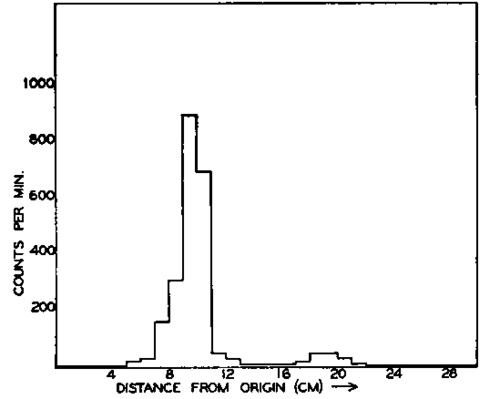
Fig. 2. Paper chromatogram of phosphoserine fraction isolated by chromatography on Dowex 1 acetate.
Continue to:


My Books

