


School And Health Reports. Part 2
Description
This section is from the "Civics and Health" book, by William H. Allen. Also available from Amazon: Civics and Health.
School And Health Reports. Part 2
The mere reporting of facts will stimulate teachers, principals, and parents to give attention. For example, assume a table:
Field of Inspection
| Total number of public schools | 7 |
| Public schools under inspection | 3 |
| Public schools not under inspection | 4 |
The reader wonders why four schools are neglected and which particular schools they are. Let the next table read:
Examination
| Total registration in all schools | 1500 |
| Number of children examined | 500 |
| Number of children not examined | 1000 |
Parents begin to wonder whether or not their children were examined, and why the taxes spent for school examination of all children go to one third of the children. The next table arrests attention:
Treatment
| Number needing treatment | 200 |
| Number known to have been treated | 50 |
| Number not known to have been treated | 150 |
We ask, at once, if examination is worth while, and if treatment really corrects the defects, saves the pupil's time and teacher's time, discovers many defects; and we want to find out whether the one hundred and fifty reported not treated have since been attended to.

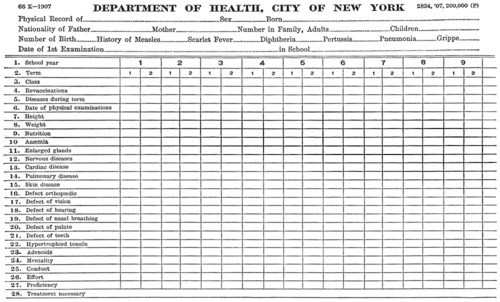
Again, if three out of five of those examined need treatment, people will wonder whether among the thousand not examined there is the same proportion—three out of five, or six hundred—who have some trouble that needs attention. Having begun to wonder, they will ask questions, and will expect the board of health or the school physicians to see that the questions are answered. As has been proved in New York, taxpayers and the press will go farther and will demand that the annual budget provide for making general next year the benefits found to result last year from a test of health policies.
The story of the prevalence of contagious diseases in school children could be told by a table such as is now in use by New York's department of health:
Table XII
Prevalence of Contagious Diseases in School Children
(Case rate schools)
| School | General Communicable Diseases 1 | Communicable Diseases of Eye and Skin2 | ||||||||
| Number | Number per 1000 Registered in Schools Inspected | Number found by Inspectors and Nurses | Number per 1000 Registered in Schools Inspected | |||||||
| Found by Inspectors | Reported by Attending Physician | Total | ||||||||
| In School | Among Absentee | |||||||||
| A | ||||||||||
| B | ||||||||||
| C | ||||||||||
| 1 Smallpox, diphtheria, scarlet fever, measles, chicken pox, mumps, and whooping cough; excluded when found. | ||||||||||
| 2 Trachoma and other contagious eye diseases, ringworm, impetigo, scabies, favus, and pediculosis; excluded only for persistent nontreatment. | ||||||||||
Another table shows the following facts for each disease:
Table XIII
Contagious Diseases Found in Schools by Inspectors and Nurses
(Number and disposition of cases)
| General Communicable Diseases | ||||||||
| Diphtheria | Scarlet fever | Measles | Smallpox | Chicken pox | Whooping cough | Mumps | Total | |
| Cases found in school | ||||||||
| Cases excluded from school | ||||||||
| Cases treated in school | ||||||||
| Cases instructed in school or evidence of treatment furnished | ||||||||
| Number of treatments | ||||||||
| Number of instructions | ||||||||
| Communicable Diseases of Eye and Skin | |||||||||
| Eye | Skin | ||||||||
| Trachoma | Other | Ringworm | Impetigo | Scabies | Favus | Pediculosis | Misc. | Total | |
| Cases found in school | |||||||||
| Cases excluded from school | |||||||||
| Cases treated in school | |||||||||
| Cases instructed in school or evidence of treatment furnished | |||||||||
| Number of treatments | |||||||||
| Number of instructions | |||||||||
Continue to:


My Books

