


Nat. Order. Combretaceae. Terminalia Chebula, Retz. Sans
Description
This section is from the book "The Materia Medica Of The Hindus", by Udoy Chand Dutt. Also available from Amazon: The Materia Medica Of The Hindus.
Nat. Order. Combretaceae. Terminalia Chebula, Retz. Sans

Haritaki.

Abhaya.

Pathya.
Vern. Har. Hind. Haritaki. Beng.
The chebulic myrobalan was highly extolled by the ancient Hindus as a powerful alterative and tonic. It has received the names of Prάnadά, or life-giver, Sudhά or nectar, Bhishakpriya or physician's favourite and so forth. So highly esteemed was this plant by the ancient Hindus, that a mythological origin has been attributed to it. It is said that when Indra was drinking nectar in heaven, a drop of the fluid fell on the earth and produced the haritaki plant. Seven varieties of haritaki are described by Sanskrit writers, the distinctions being founded upon the shape, colour and marks on the outer covering of the fruits. At the present day, however, two varieties only are recognised, namely, the large ripe fruit called haritaki, and the unripe dried fruit called jangi haritaki in the vernacular. A good haritaki fit for medicinal use should be fresh, smooth, dense, heavy and rounded in shape. Thrown into water it should sink in it. Haritaki fruits weighing four tolas and upwards, are also considered fit for use, although they may not possess some of the above mentioned properties. The seeds are rejected and their coats only are used in medicine. Those fruits which have small seeds and abundant cortex are preferred.
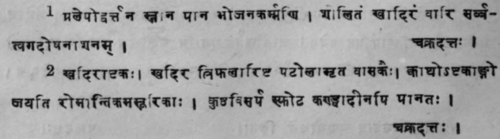
Chebulic myrobalans are described as laxative, stomachic, tonic and alterative. They are used in fevers, cough, asthma, uri-nary diseases, piles, intestinal worms, chronic diarrhoea, costive-ness, flatulence, vomiting, hiccup, heart diseases, enlarged spleen and liver, ascites, skin diseases, etc. In combination with emblic and belleric myrobalans, and under the name of triphala or the three myrobalans, they are extensively used as adjuncts to other medicines in almost all diseases.
Two or three chebulic myrobalans, rubbed into a paste and taken with a little rock salt, act as a mild laxative. The following compound decoction called Pathyadi kvatha is also much used as a purgative. Take of chebulic myrobalans, pulp of Cassia fistula (άragbadha), root of Picrorrhiza Kurroa (katuki), root of Ipomoea Turpethtm (trivrit) and emblic myrobalans, equal parts, in all two tolas, and prepare a decoction in the usual way. Dose, two to four ounces. Bengali practitioners now a days often add senna and rhubarb to the above preparation, but these last were not known to the ancient writers, and are not mentioned in their works.1
As an alterative tonic for promoting strength, preventing the effects of age and prolonging life, chebulic myrobalan is used in a peculiar way. One fruit is taken every morning with salt in the rainy season, with sugar in autumn, with ginger in the first half of the cold season, with long pepper in the second half, with honey in spring, and with treacle in the two hot months. These adjuncts are supposed to agree best with the humours that are liable to be deranged in the different seasons. This old device for prolonging life is still believed in, and acted upon, by some superstitious elderly native gentlemen.1

Numerous preparations of haritaki for special diseases are described in books, such as the Amrita haritaki for dyspepsia, Danti haritaki for enlargements in the abdomen called gulma, Bhrigu haritaki in cough, Agasti haritaki in consumption, Dasa muli haritaki in anasarca, etc.
Amrita haritaki2 is thus prepared. One hundred large sized chebulic myrobalans are boiled in butter-milk, and their seeds are taken out. Four tolas each of long pepper, black pepper, ginger, cinnamon, plumbago root, root of Piper Chaba (chavikά), the five salts, άjowan, and the seeds of Seseli Indicum, (vanayamάni), yavakshara, sarjikakshara, borax, assafcetida and cloves, are reduced to powder, and soaked for three days respectively in a decoction of tamarind and in lemon juice. This mixture is introduced within the seedless myrobalans, which are then exposed to the sun and dried. One of these prepared myrobalans is directed to be taken every morning for the relief of various sorts of dyspepsia and indigestion. Danti haritaki will be described under Baliosper-mum montanum. The other preparations of chebulic myrobalan are not much in vogue at present.
Continue to:


My Books

