


Caffeine Pharmacodynamics
Description
This section is from the book "Laboratory Manual Of Pharmacology", by A. D. Bush. Also available from Amazon: Laboratory manual of pharmacology.
Caffeine Pharmacodynamics
1. Carefully make 2 muscle preparations, place them in glass capsules, connect with weighted muscle levers, and obtain contraction records using minimum break shocks only. Fill one capsule with Locke's solution, and the other capsule with Locke's solution containing 0.1% Caffeine. Obtain comparative contraction records every half minute.
2. To a cat administer 0.120 Gm. Caffeine. Take observations of pulse, respiration, and nervous state.
3. Etherize a large female cat or rabbit. Connect up recording apparatus, and obtain normals of respiration and circulation. Into the bladder introduce a suitable catheter; distend bladder gently with normal saline; then arrange for collecting urine in centesimal metric graduate. At the rate of 1/2 mil every 15 seconds, run into the jugular vein Caffeine - 2% in Locke's solution (kept at 38 ° C). Take continuous record, and note amount of urine passed every 20 minutes. Note any symptoms that may develop.
Check this experiment by repeating it on another cat of equal weight and condition, but omitting the Caffeine.
4. With a subject in a comfortable position, obtain his normal pulse, respiration, blood-pressure, and temperature. With aesthesiometer test his forearm for tactile discrimination. Test his reaction time for sight, hearing, and feeling. Make speed tests of his mental activity, using the antonym test, the imagery and multiplication tests. Administer 2 mils of a 10% solution Caffeine Citrate subcutaneously into loose cellular tissue. Make usual graphs. Take intellection tests every 45 minutes. Measure urine excreted every hour for 8 hours.
5. Make comparative observations on three similar subjects, to one of whom is administered 0.3 Gm. Caffeine, to the second is given a cup of hot coffee, to the third is given a cup of cold coffee of the same brew. Note the several systems, including the excretory.
6. In the hospital assignment, especially study the effect on the heart of Caffeine, wherever administered.
7. From all your observations, and from your readings, write a summary of the leading effects produced by Caffeine.
Experiment No. 1
Preparation No. 1 | Preparation No. 2 | ||
Normal response | |||
Solution response | |||
Reaction A | |||
Reaction B | . | ||
Reaction C | |||
Experiment No. 2

Norm. | 10' | 20' | 30' | 40' | 50' | 60' | 10' | 20' | 30' | 40' | 50' | |
Nervous state |
Experiment No. 3
20' | 40' | 60' | 20' | 40' | 60' | 20' | 40' | 60' | |
Amt. of urine passed | |||||||||
Respiration | |||||||||
Pulse rate |
Definite symptoms.
Explanation.
Kymograph records:
Report of check experiment:...........................................................................................................................................................
...........................................................................................................................................................
...........................................................................................................................................................
...........................................................................................................................................................
...........................................................................................................................................................
...........................................................................................................................................................
Experiment No. 4. Caffeine, 0.2 Gm. To A Student
1 | 2 | 3 | 4 | |||||||||
Observation | N. | 45' | 90' | N. | 45' | 90' | N. | 45' | 90' | N. | 45' | 90' |
AEsthesia | ||||||||||||
Reaction: Sight | ||||||||||||
Sound | ||||||||||||
Touch | ||||||||||||
Antonym test | ||||||||||||
Imagery test | ||||||||||||
Multiplication test | ||||||||||||
Pulse-rate | ||||||||||||
Respiration | ||||||||||||
Blood-pressure | ||||||||||||
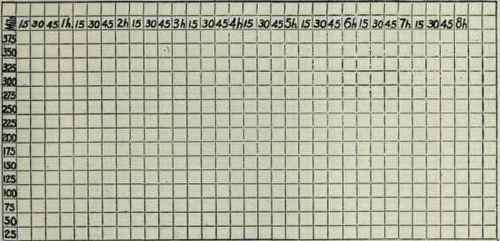
Graph of kidney activity:
Subject's initials or No..................................................................... Date......................................................................................._.
Age.................Sex................Height.................Weight.................... Medicine.........................................................................-----
Condition..........................................................................................____ Dose..........................................................................................
Thermometer............................................................................................ How administered.............................................................
Barometer................................................................................................... Remarks..................................................................................
Relative humidity................................................................................... Reporter..................................................................................

Experiment No. 5
10' | 20' | 30' | 45' | lh. | 15' | 30' | 45' | 2h. | 3h. | 4h. | 5h. | 6h. | |
Respiration | |||||||||||||
Pulse-rate | |||||||||||||
Blood-pressure | |||||||||||||
Temp. (axill.) | |||||||||||||
Strength, r. h. | |||||||||||||
Urine excreted |
Experiment No. 6
Respiration | Pulse-rate | Blood-pressure | |||||||||||||||
Case | Illness | Status | "N" | 15' | 30' | 45' | 60' | "N" | 15' | 30' | 45' | 60' | "N" | 15' | 30' | 45' | 60' |
I | |||||||||||||||||
II | |||||||||||||||||
III | |||||||||||||||||
IV | |||||||||||||||||
V | |||||||||||||||||
Experiment No. 7
Summary and evidence:______________________________________________________
_______________________________________________
_______________________________________________
_______________________________________________
Continue to:


My Books

