


Iodide. U. S. P
Description
This section is from the book "A Text-Book Of Materia Medica, Pharmacology And Therapeutics", by George F. Butler. Also available from Amazon: A text-book of materia medica, pharmacology and therapeutics.
Iodide. U. S. P
(Aristol.)
Definition. - Dithymol-diiodide, (C6H1.CH3. C3H7OI)2, obtained by the condensation of two molecules of thymol (a methylisopropylphenol) and the introduction into its phenolic group of two atoms of iodine. It contains 45 per cent. of iodine.
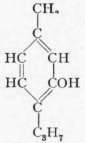
Thymol.
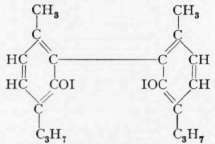
Dithymol-diiodide (thymolis iodidum).
Description and Properties. - A bright, chocolate-colored or reddish-yellow, bulky powder, almost tasteless, and having a slight aromatic odor. Insoluble in water and glycerin, soluble with difficulty in alcohol, readily soluble in fatty oils and in ether, vaseline, chloroform, and collodion.
Allied and Derived Compounds. - Many other derivatives or compounds of thymol have been suggested for therapeutic use - e. g., thymotal (thymol-carbonate), thymacetin (analogous tophenacetiti), thymoform (condensation product of thymol and formaldehyde), iodothymoform (iodized thymoform), mercury compound of thymol, thymosaloly etc.
Physiological Action. - Thymol is a powerful antiseptic, being ten times less poisonous than carbolic acid because of its slow absorption, yet as an antiseptic far superior to it. While stimulant, it is not irritant or corrosive. It is also a deodorant, disinfectant, parasiticide, and local anesthetic, as well as an antipruritic, antipyretic, and antifermentative.
Absorption and Elimination. - It is eliminated chiefly by the lungs and kidneys, producing some irritation at the points of elimination. The urine is increased in quantity, often assuming a dark-greenish hue, due to dioxybenzols.
Untoward Action. - The following symptoms have been produced by the administration of large doses: burning sensation in the mouth and stomach, persisting in some instances for days, accompanied by pain and tenderness under pressure. According to Balz, "perspiration is sometimes observed, and occasionally a transient buzzing in the ears and deafness."
Poisoning. - In addition to untoward manifestations, there may be nausea and vomiting, profuse sweating, great reduction of temperature, dizziness, violent delirium, and collapse.
Therapeutics. - Externally and Locally. - The applications of thymol in surgery are identical with those of carbolic acid.
Crocker in 1878 introduced it as an efficient remedy in certain skin diseases. It probably owes its value in these cases to its antipruritic and antiparasitic properties.
It is also extensively used in diseases of the nose, throat, and ear, and in certain disorders of the genito-urinary tract. Thymol is also administered by inhalation in certain broncho-pulmonary disorders.
Internally. - Thymol is used for the same purposes as other antiseptics, such as carbolic acid, resorcin, beta-naphtol, etc.
Martini highly recommends it as an intestinal antiseptic in the treatment of diarrhea, dysentery, and typhoid fever.
It has been employed with some success in limiting fermentation during a proteid diet in the treatment of diabetes. It has also been favorably recommended in phthisis, vesical catarrh, stomatitis, and diphtheria. Thymol is the most efficient anthelmintic for the hook-worm, Uncinaria duodenale and Uncinaria americana, in doses of 5-20 grains. For the action of aristol see iodine.
Administration. - It may be applied externally in solution (1: 1000), as an ointment (1-10 per cent.), or in the form of thymol gauze as a surgical dressing (1 per cent. of thymol).
Continue to:


My Books

