


Sulphonmethanum - Sulphonmethane - Sulphonal. U. S. P
Description
This section is from the book "A Text-Book Of Materia Medica, Pharmacology And Therapeutics", by George F. Butler. Also available from Amazon: A text-book of materia medica, pharmacology and therapeutics.
Sulphonmethanum - Sulphonmethane - Sulphonal. U. S. P
This substance, diethylsulphondimethylmethane,
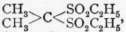
is the product of the oxidation of the mercaptol obtained by the condensation of acetone with ethylmercaptan.
Description and Properties. - It occurs as colorless, odorless, nearly tasteless prismatic crystals; soluble in 360 parts of cold water, in 15 parts of boiling water, and in 65 parts of cold or 2 parts of boiling alcohol. It is a very stable substance, being unaffected by concentrated acids or alkalies.
Dose. - 15-30 grains (1.0-2.0 Gm.) [15 grains (1 Gm.), U. S. P.], Antagonists and Incompatibles. - There are none of importance.
Synergists. - Morphine and conium intensify its hypnotic action.
Circulatory System. - It has no depressing action on the heart; on the contrary, it slightly accelerates the pulse by depressing the inhibitory center.
Nervous System. - Like chloral, it depresses the cerebral cortex, but has less influence on the motor and sensory nerves. Its soporific action is very much slower than that of chloral, requiring from three to eight hours to produce sleep, which averages about seven hours.
Respiratory System. - In medicinal doses it is much less depressing to the respiratory center than chloral.
Physiological Action. - Externally and locally, sulphonal has no influence.
Internally. - Digestive System. - In medicinal doses it has no effect on the digestive tract. Toxic doses may result in nausea, vomiting, and gastric pain.
Its action on the nervous system, on the circulation, and on respiration is like that of alcohol. The sulphon radicals do not seem to enter into the cerebral action to any great extent.
Absorption and Elimination. - Being relatively insoluble, its absorption is slow, usually requiring several hours to exert its hypnotic action. It seems to be broken up in the body, only traces being eliminated unchanged. Traces of methylene and diethylene sulphonic acid appear in the urine. The sulphates of the urine have been said to be increased under its continued use, and in its passage through the blood it exerts a marked action on the red blood-cells, giving rise to a peculiar type of poisoning.
The untoward action and poisoning resulting from the use of sulphonal present symptoms of so varied a character that the drug seems to possess no properties of a uniformly toxic nature. Moreover, in the cases of poisoning recorded the condition of the patient and the quality of the drug have been such as to require considerable variation in the amount given. In one case 30 grains (2.0 Gm.) produced death in forty hours (Med. News, lv., p. 166); while in another a man swallowed 3 ounces (96.0 Gm., of sulphonal, which, although resulting in a condition of coma lasting six days, terminated in recovery (Jour. Amer. Med. Assn., iv., p. 21).
In general, however, the poisonous effects of sulphonal are exerted on the blood and on the nervous system. When large doses are taken unconsciousness, which may persist for long intervals, is the most prominent symptom. Paralyses, but rarely convulsions, have been noted. Respiration is at first unaltered, but later may become stertorous, shallow, and slow. Cyanosis develops; the pulse is small and irregular. A preliminary fall of temperature is followed by a rise, perhaps to 40 C. (104 F.). The kidneys may or may not be affected. There may be constipation, or, if paralysis of the intestinal musculature has occurred, a diarrhea may supervene. Papular exanthemata are not uncommon.
In individuals who may be taking any of this type of hypnotics for any considerable period of time irregular toxic symptoms are noted. These consist for the most part of hebetude, sleepiness, stupidity, loss of appetite, and muscular weakness; the frequency of the pulse is diminished, and if the poisoning is more pronounced, there may be dizziness, ataxia, and, rarely, hallucinations and delirium. The most important symptom is the presence of hematopor-phyrinuria, produced by the breaking up of the blood-pigment in the red corpuscles and its appearance in the urine as hematoporphyrin, a reduction product of hemoglobin. This gives this fluid a peculiar cherry-red color. Its appearance is a signal to cease the use of the drug.
Of the three drugs of this class, trional is perhaps to be preferred. Tetronal is not to be recommended. Very persistent habits may be contracted by takers of these drugs.
Treatment of Poisoning. - Discontinuance of the drug; elimina-tive and symptomatic treatment.
Therapeutics. - Sulphonal is never used externally, and internally it is chiefly valuable as a hypnotic - in insomnia unaccompanied by pain, and particularly to produce sleep and quiet the intense excitement of the insane. When insomnia is accompanied by considerable motor restlessness, combinations of sulphonal, of trional, or of veronal with old vegetable narcotics, like hyoscyamus, conium, etc., are frequently beneficial to produce sleep and quiet the motor disturbance. The following is an excellent formula:
R. Sulphonal, | gr. xviij (1.12 Cc.); |
Fluidextracti conii, | m xviii (1.12 Gm.). |
Ft. caps. No. VI. Sig. Take two at 6 p. M., two at 8 P. M., and two at 10 P. M. The next night half this quantity will probably suffice.
The author has used this prescription with good results in hiccough and noctural cramps. It should prove efficacious in other spasmodic affections, such as chorea, epilepsy, and the spasm of fractures. Sulphonal has been recommended as a sexual sedative in chordee and spermatorrhea, and as a useful remedy in colliquative night-sweats. When used for a long time, it has a deleterious action on the heart, and should not be employed in cases of insomnia from cardiac disease.
Sulphonal is of no value in insomnia due to pain.
Wood recommends the drug as an intestinal antiseptic when given an hour after meals.
Administration. - Sulphonal should be given in powder or capsules or in hot whiskey. Owing to its insolubility, it should not be administered in the form of compressed tablets.
Sulphonethylmethanum - Sulphonethylmethane -
Continue to:


My Books

