


Magnetism
Description
This section is from the "A Practical Treatise On Materia Medica And Therapeutics" book, by Roberts Bartholow. Also available from Amazon: A Practical Treatise On Materia Medica And Therapeutics
Magnetism
Magnets are natural or artificial. The former consist of a native iron-ore possessed of the magnetic property ; the latter are pieces of steel in which the magnetic property has been induced. This magnetic property consists in the power to attract pieces of iron and steel, in maintaining a certain fixed position when suspended to move freely, and in attracting or repelling the extremities of other similar magnets. A magnet suspended, free to move, always points in a certain direction, north and south. That end pointing north is the "marked" extremity, because it has a mark, notch, or groove, or the letter N, to indicate it. Because of this property, the magnet is said to have "poles," or polarity. The poles behave toward each other in a certain definite way : Unlike poles attract ; like poles repel, is the law. When a bar-magnet is made to approach a magnetic needle moving on a pivot or suspended, there ensues attraction or repulsion, according to the polarity of the extremities approximated. When a certain proximity is attained, yet some distance short of actual contact, the magnetic influence is exerted, and attraction or repulsion, according to the pole, takes place. If a bar of soft iron, not magnetized, is suspended, on the approach of a permanent magnet, the former is seen to move toward the latter when they are approximated. The magnetic force is thus exerted through an intervening space : inversely as the square of the distance, is the law, which expresses this action in mathematical form. To this property is applied the term magnetic induction. When the soft iron is acted on by a sufficiently powerful magnet, it ceases to be in a neutral or unexcited state, the magnetic property is induced in it, and for the time being it assumes the polar condition ; but not possessing the coercitive property—i. e., the property to retain the magnetism induced in it—soon returns to its former neutral condition. Steel, having the coercitive property, is the material out of which permanent magnets are made. The magnetic property is induced in such pieces of steel by the contact of other permanent magnets. When once induced, the magnetic property may be readily destroyed by a powerful blow, by repeated scratching, and by heating. When a magnet is broken into several fragments, each piece has the same polarity. The forms of magnets are the bar and horseshoe, chiefly—the latter being more convenient, and also better retaining its power, because an armature can be kept in position. A compound horseshoe magnet is usually preferred for medical use, because of the proximity of the poles, but the straight form (Fig. 2) is also used.
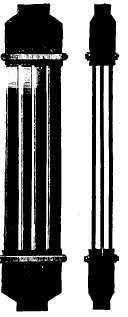
Fig. 2. Compound Magnet.
Continue to:
Books by Roberts Bartholow:


My Books

