


Treatment Of The Naevus Vascularis Superficial Form
Description
This section is from the book "A Treatise On The Materia Medica And Therapeutics Of The Skin", by Henry G. Piffard. Also available from Amazon: A Treatise On The Materia Medica And Therapeutics Of The Skin.
Treatment Of The Naevus Vascularis Superficial Form
The object of treatment is to lessen the deformity by removing the high color, and bleaching it down to a normal hue. This can, of course, only be done by destroying the continuity of the enlarged capillary Teasels, so that the excessive amount of blood shall not flow through them, and the means of accomplishing this must be such that the bleached por-tions do not become the sites of cicatrices that would be more disfiguring than the original lesion itself. A number of methods have been proposed with this end in view. The writer has treated two small wine-marks with fairly good result by means of electrolysis employed in the fol-lowing manner: A Carroll's Vaccinator (Fig. 16) was attached to the negative pole of a constant current battery, the positive pole being brought into contact with the integument near the naevus through the medium of a moistened sponge. The needles were then introduced in a slanting direction, and quite superficially, into the affected part of the akin and a curreut of moderate intensity permitted to flow for a few moments. As soon as it was perceived that electrolytic action had fairly taken place, the needles were withdrawn and introduced in a fresh place. The operation is somewhat painful, and the number of operations required will depend on the size of the lesion and the sensitiveness of the patient.
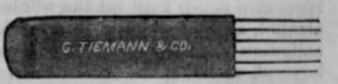
Fig. 16. - Carroll's vaccinator.
he moat widely heralded operation of late years, is that proposed by Squire, and consists in linear scarifications, accomplished with the aid of a knife having a large number of parallel blades (Fig. 12). The operation consists in making with the knife, the parts being previously frozen, a number of oblique incisions through the integument. A week later the incisions are repeated in the opposite direction, and the operation is repeated as often as may be necessary, until the mark is sufficiently bleached. As far as I am aware, this operation has not been followed by satisfactory results in this country, or in Europe, except, perhaps, at the hands of its author.
A method in which I have more confidence is that proposed some years ago by De Smet (163, Nov. 2, '73), who operated on a small superficial naevus as follows: Fifteen sewing-needles were passed through a cork so as to allow their points to project about one line; the points were so arranged as to represent, as nearly as possible, the form of the naevus, and the direction of its chief vessels. The cork was then dipped in croton-oil, and having been applied exactly over the naevus, the points of the needles were quickly forced into the part. Though painful at the moment, this inoculation only left after it a slight sense of heat and pricking.
Sherwell has modified this process and adapted it to more extensive marks. He describes his procedure as follows (110, 3: 215): "I take a number (say eight) of common No. 6 or No. 5 sewing needles, first sharpening and somewhat roughening their cutting edges with a fine flat file at and for a short distance from their points, and then by means of heavy sewing-machine silk, well waxed, wrapped around the upper two-thirds of each in turn, and all together, form a fasces-like bundle, the points being somewhat less than one-sixteenth of an inch apart; thus prepared, take either a saturated or a fifty per cent. solution of carbolic acid, or a twenty-five to forty per cent. solution of chromic acid, in a shallow vessel, and dipping the points of the needles therein, make a series of punctures into the skin of the affected region.....After the usually very slight bleeding ceases, which it does all the quicker for pressure, and also the sanious oozing which sometimes takes a little longer (pressure being kept up the whole time), I wipe the place off with a little alcohol, and apply quickly a thick layer, or rather two or three layers, of collodion over the whole surface treated, and over a moderate margin beyond, as being the best means, by its contraction, for keeping up permanent compression. I am convinced that it does this the better on account of the natural tendency of the treated parts to become swollen, so that we have, as it were, a strangulation of the pierced and irritated vessels occasioned by the pressure from within as well as from without, which leads to their more certain obliteration from the adhesive inflammation sure to follow."
Sherwei.l has more recently (143, Jan. 3, '80) employed an instrument specially designed for the purpose and shown in the following cut (Fig. 17).
The needles are the ordinary straight saddler's needle of small size, but grooved far down on each of the three sides. The degree of desired penetration being decided on, this is regulated by the screw collar, then I have not as yet employed Dr. Sherwell's instrument, but have devised another for the same purpose, consisting of a bundle of nine hypodermic syringe points firmly imbedded in metal. The form of the instrument is shown in the cut (Fig. 18).
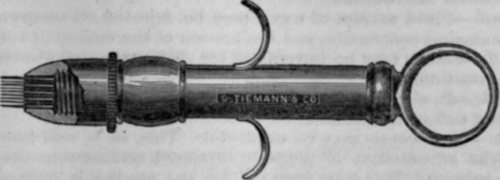
Fig. 17. - Sherwell's cutipunctor. (The instrument itself is much larger than shown in the cut) the needles being drawn up, and the instrument firmly pressed against the skin, the spring is released and the needles quickly penetrate the skin, carrying with them the fluid with which they have been previously charged.
This instrument is intended not only for the treatment of naevus, but for all other occasions in which it is desirable to carry medicated fluids beneath the surface. The needles being dipped in the chosen solution, take up, by capillarity, a small quantity of it, which, after insertion, they yield up to tissues. A considerable quantity of fluid can be introduced if the operator adjusts a rubber tube to the end of the instrument and sucks up some of the flu which can afterward be blown into the part that is operated on. The operation is facilitated and rendered painless by the use of ether spray.
The following method is said to have been successful at the hands of Mr. Williams (116, 1/80, 674). The aim of the treatment was to induce stasis in the dilated capillaries, plastic effusion, and consequent contraction sufficient to induce obliteration of the mark without producing a scar. A mixture of carbolic acid and glycerine, in the proportion of three to one, was painted over the mark with a bristle brush; the destroyed epidermis was rubbed off with the end of the wooden handle, and the painting repeated. A cornified scale soon covered the mark, and separated in about eight days; after which the process was repeated three or four times.
Continue to:


My Books

