


Cuts Of Meat
Description
This section is from the book "Practical Dietetics: With Reference To Diet In Disease", by Alida Frances Pattee. Also available from Amazon: Practical Dietetics: With Reference to Diet in Disease.
Cuts Of Meat
1 The methods of cutting sides of beef, veal, mutton, and pork into parts, and the terms used for the different "cuts," as these parts are commonly called, vary in different localities. The diagrams show the positions of the different cuts, both in the live animal and in the dressed car-cass, as found in the markets. The lines of division between the different cuts will vary slightly, according to the usage of the local market, even where the general method of cutting is as here indicated. The names of the same cuts likewise vary in different parts of the country.
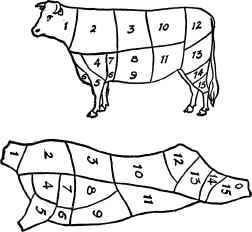
Fig. 5. Cuts of Beef.
Fig. 5. - Diagrams of cuts of beef: 1, Neck; 2, chuck; 3, ribs; 4, shoulder-clod; 5, fore-shank; 6, brisket; 7, cross-ribs; 8, plate; 9, navel; 10, loin; 11, flank; 12, rump; 13, round; 14, second-cut round; 15, hind-shank. - (Atwater and Bryant, Bulletin No. 28, Office of Experiment Stations, United States Department of Agriculture.) Send for Bulletin for cuts of Veal and Pork.
1 This section is quoted from Atwater and Bryant, Bulletin No. 28, Office of Experiment Stations, United States Department of Agriculture, Washington. D. C.
The general method of cutting up a side of beef is illustrated in Fig. 5, which shows the relative position of the cuts in the animal and in a dressed side. The neck piece is frequently cut so as to include more of the chuck than is represented by the diagrams. The shoulder-clod is usually cut without bone, while the shoulder (not included in diagram) would include more or less of the shoulder blade and of the upper end of the fore-shank. Shoulder steak is cut from the chuck. In many localities the plate is made to include all the parts of the fore-quarter designated on the diagrams as brisket, cross-ribs, plate, and navel, and different portions of the plate, as thus cut, are spoken of as the "brisket end of plate" and "navel end of plate." This part of the animal is largely used for corning. The ribs are frequently divided into first, second, and third cuts, the latter lying nearest the chuck and being slightly less desirable than the former. The chuck is sometimes sub-divided in a similar manner, the third cut of the chuck being nearest the neck. The names applied to different portions of the loin vary considerably in different localities. The part nearest the ribs is frequently called "small end of loin" or "short steak." The other end of the loin is called "hip sirloin" or "sirloin." Between the short steak and the sirloin is a portion quite generally called the "tenderloin," for the reason that the real tenderloin, the very tender strip of meat lying inside the loin, is found most fully developed in this cut. Porterhouse steak is a term most frequently applied either to the short steak or the tenderloin. It is not uncommon to find the flank cut so as to include more of the loin than is indicated in the figures, in which case the upper portion is called "flank steak." The larger part of the flank is, however, very frequently corned, as is also the case with the rump. In some markets the rump is cut so as to include a portion of the loin, which is then sold as "rump steak." The portion of the round on the inside of the leg is regarded as more tender than that on the outside, and is frequently preferred to the latter. As the leg lies upon the butcher's table, this inside of the round is usually on the upper or top side, and is therefore called "top round." Occasionally the plate is called the "rattle".
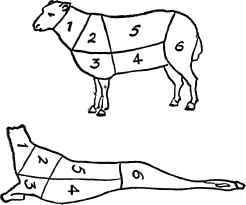
Fig. 7. Cuts of Lamb and Mutton.
Fig. 7. - Diagrams of cuts of lamb and mutton: 1, Neck; 2. chuck; 3, shoulder; 4, flank; 5, loin; 6, leg.- (Atwater and Bryant, Bulletin No. 28, Office of Experiment Stations, United States Department of Agriculture).
Fig. 7 shows the relative position of the cuts in a dressed side of mutton or lamb and in a live animal. The cuts in a side of lamb and mutton number but six, three in each quarter. The chuck includes the ribs as far as the end of the shoulder blades, beyond which comes the loin. The flank is made to include all the under side of the animal. Some butchers, however, make a large number of cuts in the fore-quarter, including a portion of the cuts marked "loin" and "chuck" in Fig. 7, to make a cut designated as "rib," and a portion of the "flank" and "shoulder" to make a cut desigrated as "brisket." The term "chops" is ordinarily used to designate portions of either the loin, ribs, chuck or shoulder, which are either cut or "chopped " by the butcher into pieces suitable for frying or boiling. The chuck and ribs are sometimes called the "rack".
Continue to:


My Books

