


Part Three. Diet In Health. Chapter IX. Fuel Value Of Foods
Description
This section is from the book "Nutrition And Dietetics", by Winfield S. Hall. Also available from Amazon: Nutrition And Dietetics.
Part Three. Diet In Health. Chapter IX. Fuel Value Of Foods
In the preceding pages reference has been frequently made to the fuel values of food and an analogy drawn between the use of fuel foods in the animal body and the use of fuels in an engine. It is a well-known fact that the energy liberated by an engine is simply the latent energy of the fuel burned in the furnace of the engine. If all of this energy latent in the fuel of an engine could be accurately measured when it is oxidized in the furnace, the summed-up energy expenditure in heat, motion, and other forms would exactly equal the latent energy of the fuel. Such an observation would be accepted as a proof of the law of conservation of energy. It is a general law universally recognized that energy may be transformed into many forms without being actually lost. Of course, it must be recognized that in this transformation some of the energy appears in a form that cannot be utilized; hence it may be commercially lost. For example, the heat that radiates from the surface of the furnace heating the surrounding air instead of the water in the boiler, while commercially lost, is not destroyed.
The law of the conservation of energy holds good for the animal kingdom as it does for the locomotive. The total amount of energy leaving the body is, without reference to its numerous transformations, exactly equal to the amount received by the body. A very small part of the energy received from the body comes direct from the sun, or from artificial heating appliances in the form of heat, but a vast preponderance of the heat of the body' comes from the food.
A. Measurement Of Fuel Values
The unit of measurement of fuel value is the calory, already defined above as that amount of heat required to raise the temperature of one kilogram of water to 1° centigrade.
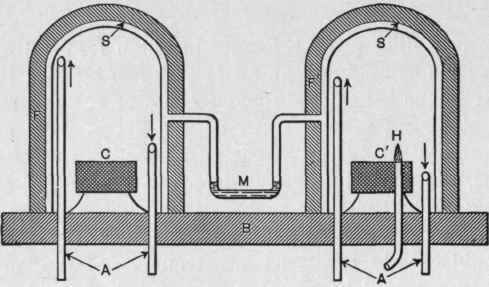
Fig. 7. - Diagram of the Air Calorimeter. B, base; F, layer of felt; C, cage; A ventilation tubes; S, air space; M, mercury manometer; H, hydrogen flame. (After Haldane, White & Washburn.)
To determine the fuel value of a food, an instrument called the calorimeter (see Fig. 7) is used. Various forms of calorimeter have been devised during the last century and a quarter. One of the best recent forms of calorimeter is that devised by Haldane, White & Washburn and described in the British Medical Journal (London, 1897, vol. ii, p. 11). It consists of an animal chamber or combustion chamber, and a control chamber (see accompanying figure). The body whose heat is to be determined is put into cage 1. In the control cage (2) hydrogen is burned in quantity sufficient to keep the mercury manometer balanced. The number of cubic centimeters of hydrogen burned in an experiment is observed. The calories produced by one cubic centimeter of hydrogen are known, thus the gram-calories given off by the body to be tested becomes known. Through the aid of the calorimeter one may determine not only the heat given off by the combustion of any oxidizable material, such as carbon, fat, starch, albumin, alcohol, sugar, etc., but also the amount radiated or conducted away from any body - for example, a living animal. The following table gives the calories represented in different foods and other substances involved in nutrition:
Substance. (1 Gr. Dry.) | Heat of Combustion in Calories. |
Starch or glycogen..................... | 4.182 calories. |
Cane sugar............................ | 4.176 " |
Dextrose........................... | 3.940 " |
Lactose............................ | 4.162 " |
Carbohydrates, average..................... | 4. " |
Fat (one form)........................... | 9.686 " |
Fat (another form)........................... | 9.423 " |
Butter....................... | 7.264 " |
Fat, average................................ | 9.4 " |
Egg, white................................ | 4.896 " |
Egg, yolk............................................... | 6.460 " |
Egg average, white and yok............ | 5.678 " |
Lean beef...................................... | 5.656 " |
Casein.......................................... | 5.849 " |
Vegetable proteins...................... | 5.500 " |
Proteins, average....................... | 5.650 " |
Protein, unavailable energy............... | 1.650 " |
Proteins, available energy................... | 4. " |
Carbon, per gram............................ | 8.080 " |
Hydrogen, per gram........................ | 34.662 " |
Inasmuch as the ingested starch is reduced to dextrose before absorption, and inasmuch as a considerable portion of fruit and vegetable sugar is ingested as dextrose, the average for carbohydrates in general can be taken as very close to the average between dextrose and cane sugar, but nearer to the dextrose value. This average is so close to four calories per gram that no appreciable error will be introduced by assuming for carbohydrates the value of four calories per gram.
Of all these values given in the above table, the following will be used in the subsequent computations:
Carbohydrates............... | .4.0 calories. |
Fats............................................... | .9.4 |
Proteins............. | .4.0 |
It may be noted in passing that the unavailable energy of the proteins is that represented by the urea, urates, nitrates, sulphates, and other more or less complex substances of the urine, which are subject to further combustion, so that the animal body is only able to extract from proteins about four calories, while the calorimeter in complete combustion is able to extract 5.65 calories.
In computing the energy represented by a particular menu one deals with several carbohydrates in various proportions, similarly with several fats and several proteins. Instead of computing the different carbohydrates separately, it is customary to use the average value given in the last table, and to multiply the total amount of carbohydrates in the menu by that factor; the other foodstuffs are treated similarly. To determine the energy which any food represents, it is only necessary to find, by analysis, the percentage of protein, of fat, and of carbohydrates which the food contains, and to multiply these amounts by the factors given in the above table. For example, oatmeal contains 7.6 per cent of water, 15.5 per cent protein, 7.1 per cent fat, 68.2 per cent carbohydrates and 2 per cent salts. One hundred grams of oatmeal represent energy:
From Protein............... | 15.1X4.0= 60.40 |
From fat....................... | 7.1X9.4= 66.74 |
From carbohydrates..... | 68.2X4.0=272.80 |
Total............................. | ...........399.94 |
The energy of one pound of dry oatmeal is obtained by multiplying this quantity by 4.5.
Thus in the measurement of fuel values of food it is necessary to have before one tables showing the chemical analysis of the food in question. Knowing the amount of these foods or foodstuffs used, and utilizing the factors given in the table above, one can quickly determine the calories per 100 grams or the calories per pound.
B. Relation Of Fuel Value To Diet
Having explained the relation of fuel value to expended energy, it must be evident that this relation is a very definite and constant one. We have not, however, made any reference to the relation of fuel value to growth and repair. Foods used for these purposes, not being oxidized at the time they are so used, do not liberate their latent energy and cannot, therefore, immediately be computed. That is, the outgo will not at once balance the income. Carbonaceous foods deposited as fat reserves must be treated in a similar way, so that an energy balance cannot be struck in an individual rapidly increasing in weight, because a part of the weight, in the case of a young individual, may represent deposited proteins in body growth, and a part deposit of fats. Eventually, however, all these deposited materials, whether proteins or fats, will be oxidized, and when oxidized they yield the energy which has been held latent throughout the period of deposit. There must, therefore, exist a very definite relation between the fuel value of the diet and the work accomplished, whether this work be active labor of some kind or the laying up of reserve tissues.
Continue to:


My Books

