


The Digestion Of Food. C. The Stomach
Description
This section is from the book "Principles Of Human Nutrition A Study In Practical Dietetics", by Whitman H. Jordan. Also available from Amazon: Principles Of Human Nutrition: A Study In Practical Dietetics.
The Digestion Of Food. C. The Stomach
101. The Gastric Juice
When the food leaves the mouth, it passes down the esophagus into the stomach. The only modifications it has suffered up to this point are its reduction to a finer condition and a slight action of the mouth ferment upon the starch. After the food is swallowed, changes of another kind begin, affecting the protein compounds especially. There is at once poured upon the food the gastric juice, a liquid that is secreted in large quantity by glands located in the inner or mucous membrane of the stomach. This juice, like all the digestive fluids, is mostly water, the proportion being between 98 and 99 parts of water to less than two parts of solids. The latter consist of ferments, a certain amount of free or uncom-bined hydrochloric acid, and a variety of mineral compounds, prominent among which are calcium and magnesium phosphates and the chlorides of the alkalies, common salt being especially abundant.
102. Gastric Enzyms
Especial interest pertains to the ferments of the gastric juice, one of which, in connection with free hydroFig.2. - Position of organs of thorax and abdomen that are related to digestion and excretion. (Morrow.) chloric acid, causes a most important change in the proteins of the food, such as egg albumin and the gliadin and glutenin of the wheat kernel by reducing them to soluble forms. We know quite definitely about this action, because it can be very successfully produced in an artificially prepared liquid. If the mucous lining of a pig's stomach, after carefully cleaning without washing with water, is warmed for some hours in a very dilute solution of hydrochloric acid, an extract is obtained which has the power of dissolving lean meat, wheat gluten, and other protein substances. The active agent in causing this solution is pepsin, an unorganized ferment or enzym which is present in the gastric fluid of all animals. It changes proteins to peptones, bodies that are soluble and diffusible. This change is not a single step, for the protein passes through successive stages in the form of proteoses before it reaches the peptone form. Another ferment present in the gastric juice is the one which gives to rennet its value as a means of coagulating the casein of milk in cheese-making, and is called rennin. The action of this latter body is especially prominent in the stomach of the calf when fed exclusively on milk, and it is the calf's active stomach, the fourth in the mature animal, which is the source of commercial rennet. A similar coagulation of casein takes place in the human stomach, especially noticeable in the milk that is rejected from the stomachs of infants, this being a normal result in digestion. Some investigators do not distinguish between rennin and pepsin. Still another ferment which food meets in the-stomach is lipase (steapsin), that has the property of decomposing fats. This ferment, or similar ones, plays a prominent part in intestinal digestion, but there is no proof that the fats are acted on in the stomach to any appreciable extent when they enter the stomach in meat or other solid or liquid forms. Emulsified fats appear to be quite extensively acted on in the stomach, especially in milk, a fact important in the feeding of infants. Recent investigations, particularly those of Cannon, have brought out some very interesting facts concerning the way in which the stomach manages the food during its retention in that organ. The following diagrams1 show the general arrangement of the parts of the stomach and its changes in form during digestion. The food is introduced into the stomach through the esophagus and is lodged first in the fundus or cardiac end. From there it is moved by degrees toward the pylorus from which it enters the small intestine. It has been taught that this movement is brought about by the churning of the stomach throughout its entire length. Cannon showed the error of this conclusion. From his observations it appears that the fundus end of the stomach is quiet at first. The waves of peristaltic constriction begin at the duodenal and middle portions- and move the food toward the pylorus. In this way the constrictions that begin near the pyloric end gradually extend toward the cardiac end. The latter part of the stomach is distended after a full meal, but gradually diminishes in size during digestion. Moreover, the character of the gastric juice is not the same from the different areas of the stomach, that from the middle portion being rich in acid, and that from the cardiac and pyloric ends being neutral or nearly so. These facts show that the food remains for some time in the fundus and meets there a neutral liquid, consequently the alkalinity of the mass is maintained for a time, and the saliva acts on the starch for a much longer period than has been supposed. It is believed, too, that the length of time the food remains in the stomach varies with its kind. The digesting mass is not forced into the intestine, until it becomes well saturated with free acid at the pylorus, a result that will be reached later with a meat, than with a vegetable, diet; for it is plain that much more acid will be required to combine with the proteins of the meat than with the smaller amounts in carbohydrate foods and so free acid is longer in accumulating.
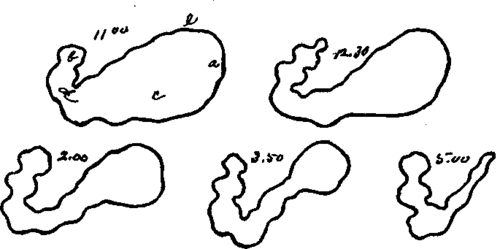
Fig. 3. - Changes in the form of the stomach during digestion. a. fundus, b. pylorus. c. middle portion. d. duodenal region.
1 Originally appearing in American Journal of Physiology, 1898, Vol. 1, p. 370.
103. Gastric Stimuli
The gastric juice is not constantly poured into the stomach to accumulate there, but is secreted as it is needed under the influence of certain stimuli. These stimuli may be classed as psychic and chemical. Appetizing odors when there is a strong desire to eat, and the agreeable taste of food in the mouth of a hungry person are important psychic or " nervous " influences that promote gastric digestion through an adequate supply of the digesting fluid. Other stimuli that may be called chemical, are the direct or indirect reaction of certain substances such as meat extracts, proteoses, sugars, adcohol, and condiments, upon the secretory activity of the stomach. This stimulus comes later than the psychic, but is more prolonged. The more recent researches indicate that the first products of digestion, reacting on the stomach inner membranes, cause the formation of a substance, a secretin, which, carried by the blood stream to the cells of the stomach glands, excites gastric secretion. It now seems possible that sometime we shall have a definite dietetic method of influencing gastric secretion rather than a medicinal, for it appears that certain food compounds may stimulate, and others, such as fats, retard, stomach activity. The psychic (nervous) factor is no less important. If this is so, it is seen how necessary it is that one shall eat with pleasure rather than through compulsion. Satisfaction with one's diet is a determinative element in good digestion. Moreover, condimental stimulation is a poor makeshift for the effect of a healthy liking for food.
Digestion is aided by movement of the ingested food mass through contractions of the walls of the stomach. It is easy to see how bad digestion occurs in a stomach that is weak muscularly or that fails to secrete gastric juice sufficient in quantity or norma! in constitution, and how difficult it is to remedy such conditions.
Continue to:


My Books

