


b. Restriction of Fats or Carbohydrates - Diet - Reduction Cures
Description
This section is from the book "Part 9. Technique Of Reduction Cures And Gout - On the Pathology and Therapy of Disorders of Metabolism and Nutrition", by Prof. Dr. Carl von Noorden. Also available from Amazon: Clinical Treatises On the Pathology and Therapy of Disorders of Metabolism and Nutrition, Part 9
b. Restriction of Fats or Carbohydrates - Diet - Reduction Cures
The diet calls for almost complete exclusion of fats; and the fat intake can be reduced without difficulty to 30 g. of fat a day. The fat ration cannot very well be reduced below this point, as otherwise articles of food must be excluded that are essential to the maintenance of proper nutrition and to the tasty preparation of the food. Even the leanest meat still contains some fat, and the same applies to eggs, skimmed milk, buttermilk, and lean cheese. Even in bread and in green vegetables a little fat is contained. On the other hand, this diet contains abundant carbohydrate (in fruit, bread, potatoes, buttermilk). During recent years I have rarely gone below 100 g. of carbohydrate a day, and as a rule I permit as much as 120 g.
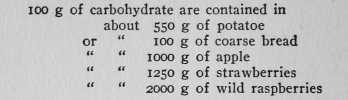
The chief advantage derived from favoring the carbohydrates is that hereby the body albumen is spared. 120 g. of carbohydrate are much more powerful in this respect than 53 g. of fat, although the latter represent the same caloric value. Another point that is almost equally important is the property of carbohydrate foods to occupy a large volume in proportion to their caloric value (see Vol. VIII) and to be very filling. It is of paramount importance that the appetite of the patients should be satisfied. A reduction cure that leaves the patients hungry is unquestionably a failure. Hunger reduces the general sense of strength and the energy that is required to carry the cure through. The complaint so commonly voiced that the reduction cure makes the patients "nervous" must practically be attributed to vague sensations of hunger. Any patient, moreover, who during the period of the reduction cure suffered continuously from hunger will promptly indulge in dietetic excesses as soon as the reins are loosened. These important prin ciples were correctly appreciated and duly emphasized by IV. Ebstein a long time ago. He was of the opinion, however, that in order to combat the sensation of hunger the carbohydrates should be greatly reduced and the fats correspondingly increased, as the ingestion of fat food decidedly impaired the appetite. I cannot agree with this. Comparative studies teach me constantly that the desired end is attained more easily if the diet is rendered rich in carbohydrates and poor in fats. There are, of course, also cases in which the reverse order (Ebstein's System) is more effective. Most fat people are naturally great fat eaters, and their appetite by no means suffers when the ingestion of fats is increased to the degree permitted by Ebstein (about no g. pro die). Besides, the benefits accruing to the albumen content of the organism from carbohydrate feeding are sacrificed if the Ebstein method is adopted.
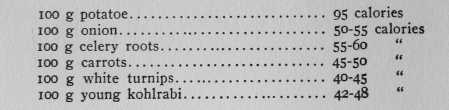
It may cause surprise to see potatoes figuring relatively so largely in the diet. Potatoes constitute a valuable article of diet in reduction cures because they combine a large volume with small caloric value. 100 g. correspond to about 95 calories. From the same standpoint certain other bulbous vegetables may be employed in place of potatoes and in order to furnish welcome variety; particularly, however, should fat-free vegetables of this character be chosen, and they should be prepared with little fat:
Continue to:


My Books

