


Special Features. Drives And Walks
Description
This section is from the book "Our Homes And Their Adornments", by Almon C. Varney. Also available from Amazon: Our Homes and Their Adornments.
Special Features. Drives And Walks
As we have before stated, the number, direction, and location of drives and walks are matters of the utmost importance, as these not only form convenient means of ingress and egress to the premises, and connect the points which must be so often visited about every house, such as the barn, gardens, out-buildings, etc., but also furnish the boundary lines for lawns, garden-patches, and other divisions of the premises. Therefore it becomes a matter of the utmost importance where these necessary features should be placed to make them at once convenient and useful, seeming to fall just where we need to go in following our daily pursuits, - a thing that no true economist should overlook. Still, they can be made "a thing of beauty," or at least, so as to enhance the more beautiful features, since they furnish a guide for correct planting, which is the most difficult of landscape work. Not that we would set our trees and shrubs in regular order along the line of the drives, as would be eminently proper in the strictly "formal style;" still, at every turn, the one must be governed and made to support the other in an informal way; hence the importance of careful study in locating our walks and drives.
No absolute rules can be laid down, since premises and their objects vary so materially.
But first of all, great care should be taken in regard to the location of the house, for this in turn must govern all else. Next to this, as few walks and drives should be made as will meet the every-day necessities; for if too numerous, they are expensive luxuries which require constant care and attention to prevent their becoming nuisances, for such they will become when overrun with weeds and grass, while at the same time they greatly mar the breadth of lawn by cutting it up into small patches like a piece-work quilt. If the lot is small, the house very near the road, - less than twenty-five feet, - and the door in front, it will hardly be possible to do more than run a straight walk from the road to the door, turning by a gentle elbow curve and passing along the side of the house to the kitchen door, leaving a narrow strip of sod between the walk and house, and thence to the out-buildings in the same formal manner.
Trees must be of small size, and planted so as to shut out views of an objectionable nature, but should never be close to the house. Use only nice flowering shrubs, such as the althea, deutzia, spirea, weigela, and nice roses on the warmer sides; and azaleas, kalmias, and rliododemdrons, all with numerous varieties, on the cold or northern exposures, near the dwelling.
If you keep a horse or cow and have no alley in the rear, it will be necessary to put next to one side of the lot a straight drive leading directly to the barn, located at the back corner on that side. A slight raise in the turf on the side of the drive next to the house, together with a judicious planting of shrubbery, either of a strictly ornamental character or of currants, gooseberries, etc., thus shutting out the view of the barn and gravel, may be desirable, thereby combining the useful with the decorative.
Flowers require such time and attention as few people are willing to devote to them; still, if the ladies can be induced to give their time, they can be made to add much to the beauty and attractiveness of the surroundings. Cultivate those that are hardy, such as peonies, petunias, phlox drummondii, asters, zinnias, etc., putting only one kind in each of the small, oval beds cut out here and there in the lawn, or else use some high-growing plants in the center and low ones around the border of the beds, which should be raised a few inches toward the center. Select such colors as blend together nicely, and care for them well. A small evergreen makes a nice center-piece.
Places of Larger Extent, with houses located as before directed, especially if the entrance is on the side, - a much more convenient plan, considering ease of access, the front door being replaced with a bay-window if frontage is favorable, - admit of a greater diversity of walks and drives; and these do not differ, only in width, the wider ones, above eight feet in width, being used for both purposes very properly.
The first thing now to take into consideration is a convenient place for an entrance. If your daily travels lead you nearly always toward a certain corner of your lot on the front, and your door is on the same side, you are fortunate; for then it will be an easy matter to make your opening in the fence somewhat to that side of the front of the house. Passing through the fence at right angles therewith, very soon bear toward the nearest corner of the house, and before reaching it, again turn in the opposite direction, passing the entrance at right angles with it; thence continue the drive toward the barn, which should be located opposite the street entrance, and toward the back corner of the lot, if not too distant; at the same time a return curve may be made, leaving the barn drive on an outward curve near the house steps and meeting the entrance drive in the same manner, having made a pear-shaped figure. If all this happens on the side opposite your best room, which should always be on the side of' your house overlooking the finest, warmest parts of your pleasure-grounds, so much the more fortunate.
Again, just where your entrance drive first turns, you can leave it in an abrupt manner in the opposite direction with a less conspicuous drive or walk which skirts that side of the premises, and makes its way to the barn, wood-yard, etc. This will obviate the necessity of passing the house when going on business, drawing feed, coal, etc. In case you have a corner lot or an alley in the rear, there will be less necessity for this last drive, since the barn may be placed on the road or alley, and easily reached from the outside.
Again, in case there is need for often going in both directions after reaching the street, and your premises are sufficiently large, the house being fifty feet or more from the road, you can have two openings into the yard, about equally distant from the house, and unite these by a curved drive which connects with the first-named drive where it turns nearest to the front corner of the house, as spoken of at first. This will make nearly a half circle of the drive connecting the entrances and passing the front of the house, which, in this case, may very properly have a front door opening into a hall, and also a veranda or open porch in place of the bay window, which would now properly fall on the side of the house next to the pleasure-grounds.
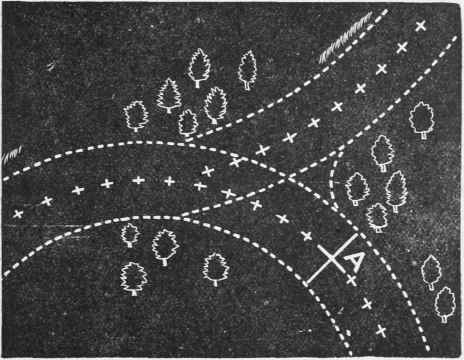
Fig. 36.
As to the details necessary to form correct and pleasing curves, (not geometric ones in all cases, as some seem to think, and even give rules for forming), space will not permit me to explain fully A correct eye will stick a row of stakes through the center of the space intended for a walk or drive, and a measuring pole as long as the drive is wide, with a short stick nailed at right angles to the measure at its center, will determine the outside line of the walk, provided the short crossing stick is kept in a line with the center row of stakes at every point measured, as shown in the figure.
The same figure will also show the arrangement of the planting, which should not be in any formal order, but so placed as to appear natural and not to obstruct any views, while at the same time furnishing a pretense for turning just as we do. There are other methods, such as using measurements and making offsets from tangent lines, for which we must refer you to the more extensive works on this subject. One more, which is very easy to put in practice if the ground is newly graded and raked, is to take your horse and carriage and start at the entrance and drive, in an easy, natural way, toward the points you wish to reach; then make the return, meeting the first track on the outward bend, merging into it in a graceful manner, and passing out. Then widen the track, by stakes stuck on each side, to the width of your drive, or let it remain as it is for a walk only. This is the easiest of all methods if you have any idea of where you ought to drive.
Continue to:


My Books

