


A Pompeiian Room. Continued
Description
This section is from the book "The Art Of Decoration", by H. R. Haweis. Also available from Amazon: The Art Of Decoration.
A Pompeiian Room. Continued
The painting is advanced enough technically to make the old story of Zeuxis deceiving the birds and Parrhasius deceiving Zeuxis quite believable. This sort of illusory painting has been dear to Italians from time immemorial, and they got it from much-vaunted Greece. In this ancient dwelling nothing is so astonishing as the likeness of its decorations to those of modern native work; and British justice must admit that the ancient Roman work is no better than good modern Roman work of the kind, pace sapient enthusiasts. Admirable as was some of it, much was bad; probably prices varied, like talent; and we find figures carelessly coloured and out of drawing, though every touch of the brush and the composition itself prove that the art of painting was as advanced as the art of sculpture; that is to say, it could deceive the eye, and skill can go no farther than that. In Pompeii and at Rome both, the bad and good mural painting alike show the alert precision of the accustomed hand.
Yes, the rooms with all their faults are charming. The panels with their false openings, thorough-shining, captivate us, and the mythic sea-scenes, wherein mermaids ride almost audibly through the waves, seem for a moment natural enough viewed through a well-painted arch. And the doorways, also arched and lined with stucco bas-reliefs like the ceiling (relics of such stucco are close at hand), are pretty, furnished, in the mind's eye, by rich hangings of broidery such as the Phrygian women made, and which came to be prized under the name of phrygioniae.
In yonder corner we seem to see a fine candelabrum of bronze, such as the Naples Museum preserves, now green with burial, or 'black with rust, then bright as gold. There, was a superb tripod of Corinthian or Sicyonian workmanship, with copper coa'pan that Tiberius as a boy may have been warned off, many a time. Few are the draperies, which might interfere with the soft passage of the welcome breeze in Rome's sultry clime, but there a small soft carpet lies before a tortoise-shell couch with ivory feet like wolves' or bulls', and parti-coloured cushions. The room is full of a soft bloom of many colours; gold, glass, and precious stones glimmer from shelf and bench. Now passes by a handsome slave bearing one of those shapely silver basins with an ewer, holding the golden wine and costly unguents to be poured upon the feet of honoured guests; on his arm hang the chaplets which will be offered to the diners when the shadow of the gnomon marks the hour of ccena. Here on a table of maplewood and bronze stand golden cups among roses whose pink petals strew the pavement beneath.
Through yonder door come the sounds of clattering dishes and the ring of silver vessels which slaves are polishing, singing and whistling the while, as what Italian would not? Further away, the tones of a flute, of a fountain, and of a boy's laughter echo through the quiet midday city, and the irrepressible sun creeps along the glowing wall, making the pictured openings, and false verandah, roof and frame, beyond the shrewdly-shaded columns, more deceptive still.
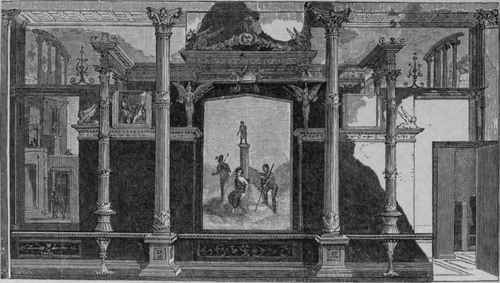
Fig. 32. - Painted wall, from the House of Germanicus, Palaces of the Caesars, Rome.
Thus we can be sure that against these bright walls, bright with the purest colours the Greek had (but not pure by our standard of mechanical distillation, otherwise blues, greens, and yellows could never have borne such violent juxtaposition), stood in Rome and Pompeii wondrous benches and chairs, cushioned with colours to correspond with the walls. The general form of these was chiefly simple, after Greek precedent, but the decoration applied in bronze repcusst work, inlaid woods, and mother-of-pearl, was most elaborate and entertaining.
Chairs of Greek form are suitable, therefore, to a modern Pornpeiian room, veneered or carved in wood and mounted with bronze claws, and here Mr. Chippendale comes in useful; small tables of marble and precious woods, inlaid with mosaics similar to the antique which afterwards inspired Boule; small stools, and vases and tazze of precious stone, and bronze or gilt statuettes of purest model. The lamps, lustres, and candlesticks ought to be in harmony with the well-known classic forms - serpents, goats, bulls; the couches should exhibit rams' heads supporting festoons of flowers, caryatides, Corinthian columns, and rich broideries. The floor, however, presents a more restful colouring; mosaics of beautiful design in marbles (whose fine colour bore no proportion to the paint on walls glowing in Italian sunlight) might be replaced in England by coloured matting and rugs of quiet tone. In a very brightly variegated room, full of minute details, some part - floor, ceiling, or hangings - must be of a quiet or self-colour, otherwise the effect will be distressingly lacking in repose for the hunted eye. In the old Pornpeiian rooms repose was found in the white mass of festive garments, or in the dark mass of shadow cast by a brilliant sun on various parts of the rooms.
Had it not been so, the artistic sense would have felt and revolted against the 'burden' of too much broken colour. A fair space of one tint, or a quiet tone in mixture, is indispensable somewhere.
Continue to:


My Books

