


Scale, Motifs And Textures As They Relate To Furnishing And Decorating. Part 5
Description
This section is from the book "Interior Decoration: Its Principles And Practice", by Frank Alvah Parsons. Also available from Amazon: Interior Decoration: Its Principles and Practice.
Scale, Motifs And Textures As They Relate To Furnishing And Decorating. Part 5
The danger came when realism demanded a perfect exposition in pictorial effect of every detail as it was, rather than as it should be to suit the conditions under which it was to be used. At times certain nations have appreciated the relation of the decorative motif to the material in which it was to be rendered. In Gothic tapestries ornament was arranged decoratively. The decadent Italian Renaissance conceived tapestries only as a picture of social life, and it lost almost entirely its decorative effect.
The translation of the rose or the lily onto the material of a carpet, wall paper, or a plate is impossible unless the rose be modified into the feeling or meaning of the material in which it is to appear. I believe it was Ruskin who said that "Conventionalization is the translation of nature into man's material." A conventionalized motif is that decorative motif which has been so modified in shape, size, colour and proportion that it is exactly suited to the material in which it is rendered.
The significant fact to grasp in this matter is the difference between a motif which attempts to picture details which are beyond its power to portray, and which are non-essential, and one that seeks to relate itself perfectly to the material in which it is expressed while it suggests rather than depicts those details which every intelligent person knows exist.
Conventionalized motifs, then, are motifs which can exist in any material but not in nature, and a desire for a perfectly naturalistic picture in these things seems unbelievable in a civilized people.
Perhaps there is no family of any culture in this country that does not believe some one Madonna to be a beautiful picture. Perhaps the Mona Lisa has as large a number of admirers as any portrait in existence. It is well to ask ourselves how many pictures of the chosen Madonna or the Mona Lisa we should be willing to have in our living-room or our bedroom at the same time. I am sure no one would choose more than one. How, then, can people consistently desire several hundred worse pictures of roses, or other flowers badly drawn, badly arranged, and badly carried out in material? It needs but a little thought to lead one to see that only in masterpieces of historic art has there been an approach to the use of nature in a realistic way so that the result is an artistic and decorative effect.
Perhaps this is the best place in this discussion to call attention to the necessity for care in the selection of different motifs that are to go into the same room. It is easy to see that varying degrees of naturalistic treatment and conventional arrangement in rugs, chairs, hangings, wall coverings, etc., would inevitably introduce into a room impossible combinations of decorative ornament.
The ornament of the rug, which is usually abstract, particularly in the Oriental types, is hard to harmonize with conventional Art Nouveau upholstery and hangings and with naturalistic wall paper. The abstract and the conventional may sometimes appear together if neither is too prominent. The very conventional and the nearly naturalistic are very ugly together. The purely naturalistic should never appear, and the abstract is rather formal.
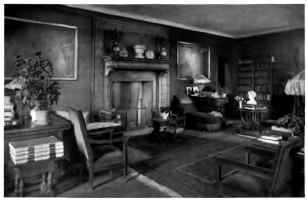
A MODERN LIBRARY-LIVING-ROOM EXPRESSING, ON A SIMPLE, WELL-SPACED BACKGROUND, EXCELLENT CHOICE IN SIZE AND PLACING OF PICTURES; TREATMENT OF MANTEL; ARRANGEMENT OF RUGS AND FURNITURE GROUPING. THE GROUPING OF THE FURNITURE SHOWS CLEARLY THE THOUGHTS OF COMFORT AND FUNCTION ALL IN AN INDIVIDUAL RESTRAINED WAY.
The scale in these motifs, so far as the room unit is concerned, is of fundamental importance. Often a room is spoiled in effect by contrasting some very tiny, insignificant and weak motif with a large, strong and prominent one. Even if the furniture and other objects are well scaled, the motifs may destroy the scale unit of the room as well as its arrangement.
The more one studies ornament the more he realizes that nations, peoples and eras have expressed new types of civilization by the source, the treatment and the application of its motifs for decorative purposes. We are living in an age when all these vast resources are at our command. The trouble with us is that we approach them with the idea that each must be good under any circumstances, and since it is an ornament it must be a decoration. Then if we approach the resources of several eras at the same time, each expressing an individual idea, and combine their products without care in a room, an inharmonious aggregate of motifs must be the result.
In this field, then, of decorative ornament there can be no harmony unless there is understanding. Better by far a perfectly plain textile, rug or wall - yes, and even china - than those in which the inharmonious use of motifs as to source, kind and treatment destroys the otherwise unified expression.
One caution more is essential. If motifs appear in the wall cover they should not appear in the hangings or the floor in any considerable prominence. If they appear in the hangings and upholstery, they should not appear in the wall. Moderation, temperance and restraint in the use of decorative motifs are the strongest correctives for ornate and badly mixed expression in house furnishing.
Continue to:


My Books

