


The Law Of Appropriateness. Part 2
Description
This section is from the book "Principles Of Home Decoration With Practical Examples", by Candace Wheeler. Also available from Amazon: Principles of Home Decoration.
The Law Of Appropriateness. Part 2
As a matter of utility the toilet service should be always of white; so that there will be no chance for the slovenly mismatching which results from breakage of any one of the different pieces, when of different colours. A handleless or mis-matched pitcher will change the entire character of a room and should never be tolerated.
If the size of the room will warrant it, a rocking-chair or easy-chair should always be part of its equipment, and the mattress and bed-springs should be of a quality to give ease to tired bones, for these things have to do with the spirit of the house.
It may be said that the colouring and furnishing of the servants' bedroom is hardly a part of house decoration, but in truth house decoration at its best is a means of happiness, and no householder can achieve permanent happiness without making the service of the family sharers in it.
What I have said with regard to painted walls in plain tints applies to bedrooms of every grade, but where something more than merely agreeable colour effect is desired a stencilled decoration from the simplest to the most elaborate can be added. There are many ways of using this method, some of which partake very largely of artistic effect; indeed a thoroughly good stencil pattern may reproduce the best instances of design, and in the hands of a skilful workman who knows how to graduate and vary contrasting or harmonising tints it becomes a very artistic method and deserves a place of high honour in the art of decoration.
Its simplest form is that of a stencilled border in flat tints used either in place of a cornice or as the border of a wall-paper is used. This, of course, is a purely mechanical performance, and one with which every house-painter is familiar. After this we come to borders of repeating design used as friezes. This can be done with the most delicate and delightful effect, although the finished wall will still be capable of withstanding the most energetic annual scrubbing. Frieze borders of this kind starting with strongly contrasting colour at the top and carried downward through gradually fading tints until they are lost in the general colour of the wall have an openwork grille effect which is very light and graceful. There are infinite possibilities in the use of stencil design without counting the introduction of gold and silver, and bronzes of various iridescent hues which are more suitable for rooms of general use than for bedrooms. Indeed in sleeping-rooms the use of metallic colour is objectionable because it will not stand washing and cleaning without defacement. The ideal bedroom is one that it the furniture were removed a stream of water from a hose might be played upon its walls and ceiling without injury. I always remember with pleasure a pink and silver room belonging to a young girl, where the salmon-pink walls were deepened in colour at the top into almost a tint of vermilion which had in it a trace of green. It was, in tact, an addition of spring green dropped into the vermilion and carelessly stirred, so that it should be mixed but not incorporated. Over this shaded and mixed colour tor the space of three feet was stencilled a fountainlike pattern in cream-white, the arches of the pattern rilled in with almost a lace-work of design. The whole upper part had an effect like carved alabaster and was indescribably light and graceful.



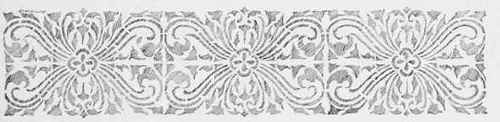

1,AND 2, STENCILED BORDERS FOR BATH-ROOM DECORATION ; 3, 4 AND 5. STENCILED BORDERS FOR HALLS (BY DUNHAM WHEELER).
The bed and curtain-rods of silver-lacquer, and the abundant silver of the dressing-table grave a frosty contrast which was necessary in a room of so warm a general tone. This is an ex-ample of very delicate and truly artistic treatment of stencil-work, and one can easily see how it can be used either in simple or elaborate fashion with great effect.
Irregularly placed foating forms of Persian or Arabic design are often admirably stencilled in colour upon a painted wall; but in this case the colours should be varied and not too strong. A group of forms floating away from a window-frame or cornice can be done in two shades of the wall colour, one of which is positively darker and one lighter than the ground. It to these two shades some delicately contrasting colour is occasionally added the effect is not only pleasing, but belongs to a thoroughly good style.
One seldom tires of a good stencilled wall; probably because it is intrinsic, and nor applied in the sense of paper or textiles. It carries an air ot permanency which discourages change or experiment, but it requires consierable experience in decoration :o execute it worthily; and not only this, there should be a strong Reeling for c rand taste and education in the selection of design, for though the form of the stencilled pattern may be graceful, and gracefully combined, it must always - to be permanently satisfactory - have a geometrical basis. It is somewhat difficult to account for the feet that what we call natural forms, of plants and flowers, which are certainly beautiful and graceful in themselves, and grow into shapes which delight us with their freedom and beauty, do not give the best satisfaction as motives for interior decoration. Construction in the architectural sense - the strength and squareness of walls, ceilings, and floors - seem to reject the yielding character of design founded upon natural forms, and demand something which answers more sympathetically to their own qualities. Perhaps it is for this reason that we find the grouping and arrangement of horizontal and perpendicular lines and blocks in the old Greek borders so everlastingly satisfactory .
Continue to:


My Books

