


American Furniture. Part 2
Description
This section is from the book "The Practical Book Of Furnishing The Small House And Apartment", by Edward Stratton Holloway. Also available from Amazon: The Practical Book Of Furnishing The Small House & Apartment.
American Furniture. Part 2
For general use in such rooms - and also as dining-tables - it is doubtful if anything better than the gate-leg table has been devised. Originating in the days of Cromwell they have ever since shown their desirability and usefulness. The Dexter gate-leg illustrated in Plate 16 is reproduced from an excellent old New England example. There are also straight-leg tables included in this line of furniture.

PLATE 16. THREE-PIECE DINING-TABLE, DEXTER TABLE AND CHAIR, WEBSTER CHAIRS.
Manufactured and Sold by William Leavens & Co., Inc., Boston, Mass.
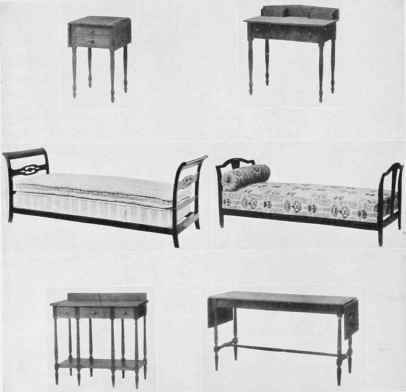
PLATE 17. TURNED-LEG FURNITURE AND DAY BEDS.
Manufactured and Sold by William Leavens & Co., Inc., Boston, Mass.
For the living-room these pieces should be stained, and not enamelled in any light tone. An individual effect is however, gained by two or three pieces in stronger hue mingled with the rest. Thus the occasional-table, used as a console, might be in grey-blue or some such colour, and a pair of the Webster side-chairs, illustrated in Plate 16 in a matching shade and decorated as there shown, or the stools, would add greatly to the appearance of the room. These chairs may advantageously be cushioned and tasselled in the way mentioned in connexion with the stools.

PLATE 18. PAINTED BREAKFAST-ROOM SUITE.
Manufactured by The Elgin A. Simons Co.. Syracuse, N Y.
In Dark Green, or Light Sea-foam Green, Parchment, or other colourings.
Buffet, Height 34 in., Width 48 in., Depth 20 in. Table, 48 x 42 in.
The stain remains to be considered. Above all things in furnishing avoid golden oak, and, so far as the writer's taste is concerned, he would add bottle-green as scarcely less undesirable.
Two matters should not be overlooked - the trim of the room, where it is of natural wood stained, and any existing furniture which must still be used. Absolute matching is not required in either case, but a general heed should be given to what the new furniture is to accompany.
The reddish brown is one of the best of the shades, and, if there is a piece or two of good mahogany which the new oak furniture is to accompany, this would be the best stain to order. There is also a mahogany stain, but the grain of oak is not a good base for a mahogany effect, and palpable and unsuccessful imitations are to be avoided.
The others which seem most generally advisable are the fumed, medium brown, dark brown, and silver grey (which is really a warm grey). It is to be noted that these often take different tones, owing to the grain over which they are applied, and the result is a desirable variety.
Where rooms communicate with a wide opening, so that the two almost constitute a single room, as often occurs with living-room and dining-room in bungalows (it is not the writer's fault that the English Language provides no exact equivalent for room and that the word must so often be repeated) it is well that the same stain should be used in both. For those who appreciate more original effects suggestions will be made when we reach actual furnishing.
So far, oak furniture only has been mentioned. Seemingly there is not a great deal of mahogany furniture of this inexpensive class supplied for living-room use; some available pieces may be purchased, and a few suitable for this purpose will also be found illustrated in the plates still to follow. These may be supplemented by very desirable bookcases and desks shown in the section on "Furnishing of Medium Expense".
To proceed to the dining-room furniture, the gate-leg table already mentioned may be employed, or the three-piece tables shown in Plates 15 and 16. Where few are to be seated, either the central oblong of the latter may be used and the semi-circular ends set against the walls here or in the living-room as consoles, or the two ends may be joined as a circular table and the oblong placed against the wall.
The Dexter chairs (Plate 16) are as excellent as the tables they match. Another touch of individuality would be given by the use of decorated Webster chairs with supplied cushions, employed with either table and a sideboard, both of which are stained. A good example of sideboard is shown to the right of the three-piece table on Plate 15. It is 48 inches long, 42 inches high and 20 inches deep and provides excellent storage space. On the illustrated sheet, it is called a "low-boy".
Before proceeding, attention should be called to the other turned-leg furniture on Plate 17 and to the decorated furniture on Plates 18 and 21. As the latter pieces are the first here shown which are to be procured through dealers, and as most of the furniture and some textiles illustrated in this book are so to be bought in case they are desired, it is to be mentioned here that for the convenience of the reader the two methods of purchase are carefully differentiated throughout. Where a name is given preceeded only by the words "Manufactured by" the goods are not sold retail by them and all inquiries should be made of, and orders given through, a dealer in one's own location. For further convenience particulars as to size and finish will often here be found supplied. Where they are absent, the writer does not know them and the local dealer should be applied to, as he can readily ascertain these details if he does not have them at hand.
Continue to:


My Books

