


III. Chests Of Drawers. Part 18
Description
This section is from the book "Colonial Furniture In America", by Luke Vincent Lockwood. Also available from Amazon: Colonial Furniture In America.
III. Chests Of Drawers. Part 18
Figure 145 shows another chest of drawers in Empire style. The top is backed and supported at the ends by short columns carved in the pineapple pattern. There are three small drawers at the top and four long ones below, a little recessed, and at the corners are columns carved in an acanthus leaf and pineapple pattern. The piece stands on carved animals' claw feet.
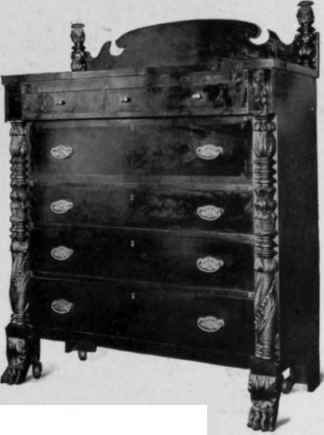
Figure 145. Chest of Drawers, Empire style, 1810-20.
Figure 146 shows another chest of drawers of the same period. On the top are two small drawers and below are four long ones. About the drawers is an inlaid border of holly. The corners are finished with columns with pineapple carving and spiral twisting.
When the high-boy had gone out of fashion and the low chests of drawers had taken its place, there was not so great demand for dressing-tables because the tops of the chests of drawers could be used for toilet articles. In sections of the country, however, where a certain degree of luxury was maintained, dainty little dressing-tables were in use.

Figure 146. Chest of Drawers, Empire style, 1810-20.
Figure 147 shows one of a pair of dressing-tables in the Hepplewhite style, the property of Mrs. James R. May, of Portsmouth. The piece resembles a miniature sideboard except that it is not so high. The front swells, and there is one long drawer at the top, one square drawer on each side, and a short drawer at the centre. The drawer fronts have inlaid panels of satin-wood and rosette handles. The centre is arched to enable a person to sit at the table. Such pieces as this were intended to have upon them small dressing-glasses similar to the one shown in the succeeding figure.
A number of these dressing-tables have been found with several drawers extending down the sides, leaving a centre section open.
Another dressing-table of a little later date is shown in Figure 148. It is made like a card-table but without the folding leaf. The front is swelled. There is one drawer in front, and on either side at the back is a lid which conceals a small receptacle occupying the sections on either side of the drawer. On the top of this piece is the original dressing-glass in the lower part of which is a shallow drawer. This dressing-table is the property of Mrs. Joseph E. Davis, of York Harbor, Maine.
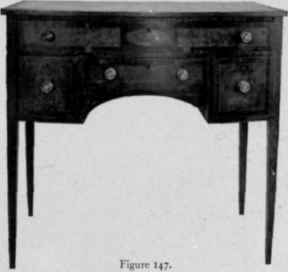
Dressing-Table, Hepplewhite style, 1790-18.0.
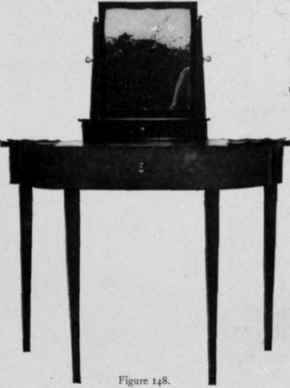
Dressing-Table, Sheraton style, about 1800.
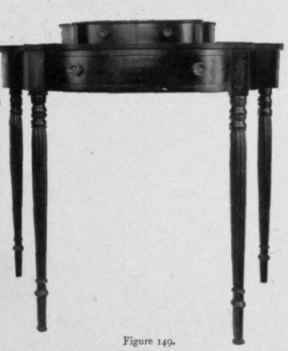
Dressing-Table, Sheraton style, 1800-10.
Figure 149 shows a dressing-table in Sheraton style. This, also, is in the form similar to a card-table. The front is reverse serpentine in form, and the sides are sections of a circle. On top of the piece is a raised section with two small drawers on which is placed the dressing-glass, which in this case was probably on a standard. The legs are turned and reeded. This dressing-table is the property of Mrs. James R. May, of Portsmouth.
Dressing-Table, 1800-10.

Stencilled Chest of Drawers, about 1820.
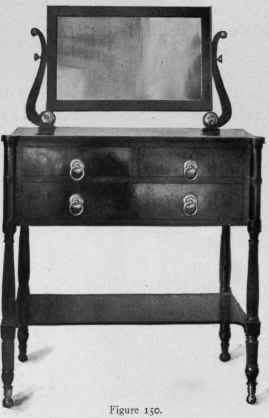
Figure 150 shows a dressing-table of a later period in the Erving Collection. A mirror is fastened to the top with scroll brackets; reeded columns extending to the top support the piece, and below the drawer is a shelf.
About this time it became fashionable to stencil furniture, and Figure 151 shows a characteristic chest of drawers in this style. On the top is fastened, with carved scroll supports, a rectangular mirror, the frame of which is stencilled. On the top are three small drawers and under the top is a cushion frieze concealing a drawer on the surface of which is stencilled a pattern of fruit and flowers and two rosettes. Below this are three drawers recessed and at the ends are columns stencilled in an acanthus-leaf pattern. The piece stands on turned feet.
Figure 152 shows a basin stand in the Pendleton Collection, owned by the Rhode Island School of Design. These stands were popular in England during the Dutch and Chippendale periods but were never common here. This piece, as is usual, stands on three legs. At the bottom is the place for the ewer. Above are two small drawers and a soap-dish, and the rim at the top is intended for the basin. A basin-stand very similar to this is shown in miniature in the doll house (Figure 1).
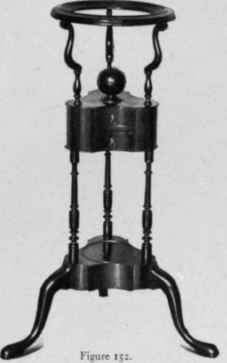
Basin-Stand, 1725-50.
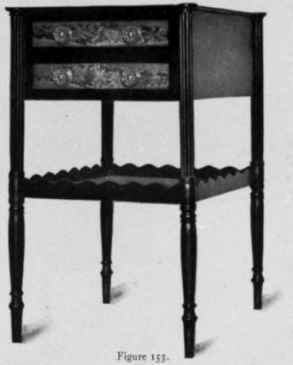
Wash-Stand, 1790-1800.
Figure 153 shows a wash-stand or night table of a later period which is in the Blaney Collection. There are two drawers with veneered panels and below is a shelf with a nicely scalloped edge. Reeded columns extending from the top form the legs and support the piece.
A well-proportioned corner wash-stand of the Hepplewhite period is shown in Figure 154 and was the property of the late William G. Boardman, of Hartford. The front is swelled. At the corners of the doors are inlaid fans and a line of inlay is on the bottom.
Figures 155 and 156 show two examples of corner wash-stands of the period. Figure 155 has the long, tapering outstanding legs of the Hepplewhite period and Figure 156 is in the Sheraton style.
As bureaus are so commonly associated with mahogany, it will perhaps be well to say something of the history of the use of that wood for furniture in general. The tradition of its introduction into England by Sir Walter Raleigh, in 1595, is quite generally accepted, and at the same time it is as generally believed that it was not used there to any extent until about 1720. It is not likely that the century which divides its discovery from its popular use was absolutely ignorant of it, and some pieces are now known to have been made of mahogany in England previous to 1700. As far as this country is concerned, there is no indication whatever that it was known or used much previous to 1700; none of the furniture, such as chairs, tables, or chests of drawers, which was made at this time, was made of mahogany, and there is no mention in the inventories or contemporary documents of any kind, that the writer has been able to find, of mahogany previous to 1700. At Philadelphia, in 1694, the inventory of a cabinet-maker named John Fellow contained the following list of material in a shop: "pyne loggs, walnutt loggs, pyne boards, walnutt planks, walnutt scantling, oak boards and cedar hoards, one case of drawers, partlie made, stuff for a side table partlie made, stuff partlie wrought for a hall table, a parcel of brass work for drawers, four sutes of locks for chests of drawers, three dressing box locks"; but in 1720 Joseph Waite, also of Philadelphia, had in his shop "a chest of mahogany drawers unfinished."

Figure 154. Wash-Stand, 1790-1800.

Figure 155, Wash-Stand, 1790-1800.
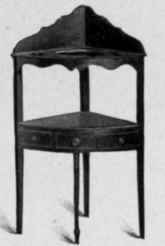
Figure 156. Wash-Stand, 1790-1800.
Continue to:


My Books

