


V. Desks And Scrutoires. Part 15
Description
This section is from the book "Colonial Furniture In America", by Luke Vincent Lockwood. Also available from Amazon: Colonial Furniture In America.
V. Desks And Scrutoires. Part 15
Figure 302 shows a still later form of scrutoire with bookcase top. The cornice mouldings are a quarter-round, a fillet, a dentil moulding, a fillet, a cove, an astragal, and a fillet, and the top is in the same form as that shown in Figure 298 except that the finials are of brass. The glass of the doors is cut in geometrical shapes. The front of the upper drawer in the lower section falls on a quadrant and discloses a desk with pigeon-holes and drawers. Below are three drawers all of which are finished with a bead moulding. The piece stands on straight bracket feet.

Figure 302. Scrutoire with bookcase top, 1800-10.

Figure 303. Chest of Drawers with desk drawer, 1800-10.
A chest of drawers, the top drawer of which contains a desk, is shown in Figure 303. Below the desk drawer are three drawers all of which have the oval brasses. This piece stands on French bracket feet and belongs to F. T. Bontecou.
Chests of drawers are comiponly called bureaus in this country, and they prob-ably derive the name from the fact that many were made with the writing-drawer.

Figure 304. Empire Writing-Table, about 1820.
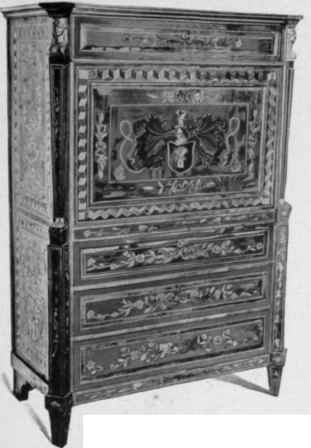
Figure 305. Empire Scrutoire, 1810-20.
Figure 304 shows a late form of scrutoire. The upper section is a small bookcase with four panes of glass with rounded tops. The top is scrolled. The writing-table folds over in the usual way. The upper drawer overlaps and is supported with twisted columns and the piece stands on turned legs.
Figure 305 shows an inlaid scrutoire of the Empire period. It will be seen that it is built on the same principle as the early ball-foot scrutoire shown in Figure 238. There is a drawer above the desk part. The writing-table is formed by the front which falls forward and is held by chains. This piece is elaborately inlaid in floral designs. The corners are chamfered and are filled in with die head and feet of a woman in brass, and there is a raised brass beading about the drawers. Another inlay of brass is about a quarter-inch from the edge.
Many pieces of this general form are found in this country. They are usually of mahogany and often have brass mounts.
Very few bookcases prior to 1790 have been found in this country. The cabinet tops of scrutoires were often used for holding books, and those with glass doors were always intended for books, and it is probable that such pieces would hold practically all of the books that the ordinary family would have, consequently there was no great need for large separate bookcases. There is, however, a very good example of an early bookcase in the Warner house in Portsmouth.
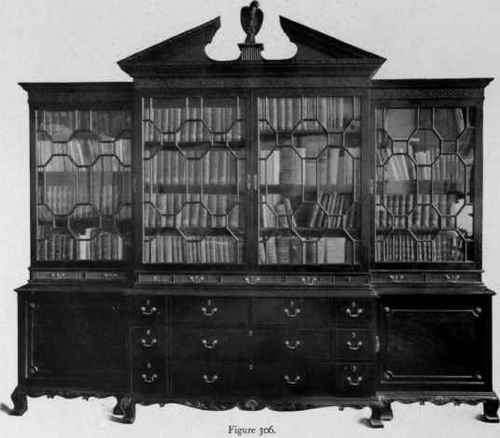
Bookcase, Chippendale style, 1760-70.
In England bookcases are common. They are usually made with a projecting central section with two wings, as is the one in the Warner house.
A very handsome mahogany bookcase in the Chippendale style is shown in Figure 306 and is the property of the Honourable Morgan G. Bulkeley, of Hartford. It is made in three sections. The central section projects and has an interrupted pediment top. The mouldings consist of a fillet, a cyma recta carved in an acanthus-leaf design, a narrow fillet, a corona, a fillet, a quarter-round, a fillet, a cove, a dentil moulding, a fillet, and a quarter-round. On the front, below the cornice on both sections, is carved a very beautiful fret design. At the centre of the top is a carved eagle. The doors are cut in geometrical designs, and below them are nine small drawers with the surface ornamented with fluting. At the ends of the lower section are cupboards and at the centre are ten drawers. The skirt flares and is carved in a scroll-and-leaf design with a shell at the centre of each section. The feet are ogee feet with acanthus-leaf carving on the legs.
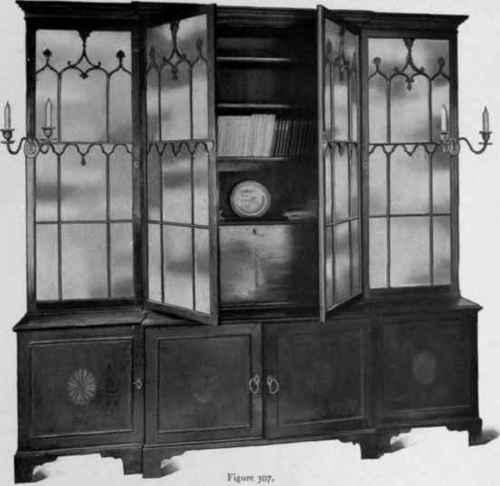
Bookcase, Shearer style, 1780-90.
Figure 307 shows a library bookcase, the property of Professor Henry T. Fowler, of Providence. The piece is made in three sections, the outer ones slightly recessed. The three doors contain looking-glass, the panes cut in Gothic form. The outer doors conceal bookcases and the centre ones, bookcases and a desk, which is disclosed by the falling of the desk front. In the lower section are cupboards and sliding shelves. In the centre of each of the lower doors is inlaid a fan medallion. The piece stands on straight bracket feet. The bookcase is very similar to a design by Shearer shown in Plate i of the "Cabinet Makers' Book of Prices." It was formerly the property of General Knox and is said to have come from the Tuileries.
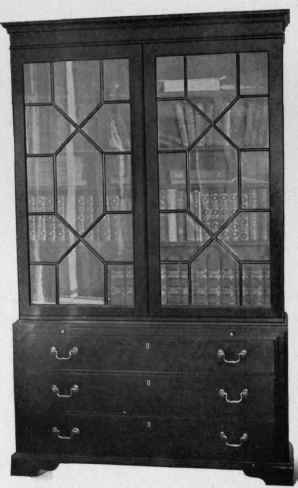
Figure 308. Bookcase, Sheraton style, 1790-1800.
Figure 308 shows a small bookcase of a little later date which belongs to the writer. The mouldings consist of a fillet, a small cyma reversa, a quarter-round, a fillet, a cove, an astragal, a fillet, and a small cove, and just above the doors is an astragal and a fillet. The doors are cut in geometrical design and in the lower section are three long drawers. Just above the drawers is a slide, which pulls out, upon which to place books. The front of this slide is supported by legs which, when the slide is closed, form part of the stiles.
Continue to:


My Books

