


Bible Box And Shovel-Boards
Description
This section is from the book "English Furniture", by Frederick S. Robinson. Also available from Amazon: English Furniture.
Bible Box And Shovel-Boards
The box upon the Montacute table is what is often called a 'Bible-box' - though, like the 'coffin stool,' it was probably often enough used for other purposes. It belongs to Sir Thomas Wardle of Leek, Staffordshire, and has its flower-work diapered so as almost to represent embroidery, an effect which is helped out by the very neat punching of the ground. A clumsily added lock and hasp interferes with the design of a particularly good example.
To return to our tables, it is worth while to remind the reader that altar-cloths in churches even now very commonly conceal good specimens of altar-tables. One of the best I have seen is in the church of Tickencote, Rutland, famous for a great Norman arch. It stands on a slab of Purbeck marble, which was probably the slab of the altar which it displaced. It has wide turned legs, and the following inscription in Roman capitals on the east and west sides: 'O precor aeternae tecum discumbere mensae Des illi hanc mensam quae tibi Christe dedit.' On the south end: 'Ex don dom Annae Beverly, 1627,' which the writer of an excellent little account of the church translates: 'O Christ, I pray thee grant to her, who gave this table to Thee, to sit down at Thine eternal table. The gift of the Lady Ann Beverly, 1627.'
In St. Andrew's Church, Sunning, is a specimen with gadrooned and acanthus-carved legs. A good authentic example of a nineteen feet long standing table may be found at Brown's Hospital, Stamford.1 One of a smaller usual type, illustrated here, belongs to Mr. E. Hockliffe, the Hall, Uppingham. It has turned legs of somewhat' cheese-moulding' shape (Plate LII.2).
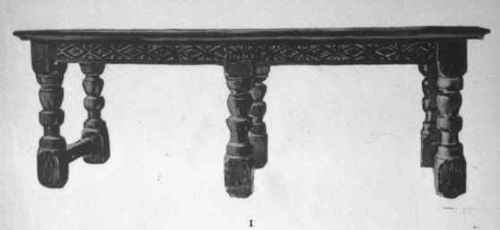

Plate LII. 1 - Table, Oak 17th Century 2 - Table, Oak Dated 1622
LII. (1) Table, oak. Seventeenth century. E. Hockliffe, Esq.
Dimensions: Length 88¼, Height 31¼, Breadth 30⅞ inches.
(2) Table, oak, dated 1622. From Montacute Church. W. R. Phelips, Esq. Upon the table is a ' Bible' box, the property of Sir Thomas Wardle.
1 This table has rather thin baluster-shaped legs, and belongs to the period of Charles I.
Akin to long tables are those rather rare objects entitled shovel-boards, without which formerly the great hall of a country house was not complete. They were sometimes as much as forty feet long, and were used to play a game resembling the modern 'squails,' heavier weights being employed. The task set was to shove the weight from one end of the table to the other, approaching as close as possible to the further edge, yet not causing the weight to fall into the trough or drawer placed to receive those overpushed. These tables were sometimes very expensively made. One at Chartley consisted of 260 pieces of wood accurately joined. It was over thirty feet long. At Birts Morton Hall, Worcestershire, is a moderate-sized one; and another, formerly the property of the Paston family, from Oxnead Hall, Norfolk, is now in the Norwich Museum. At Littlecote, Wiltshire, there is another example. Not much decoration was lavished upon these precursors of the bagatelle-board and billiard-table.
Of a much lighter type are the 'gate tables,' or, as an American writer likes to call them, 'Hundred-legged' tables (Plate L.2). The usual number of legs is eight upon tables of ordinary and moderate size, but there are very large examples, as at Penshurst, with as many as twenty legs, which may give some colour to playful exaggeration. The ordinary type is a table with oval folding top. The leaves when lifted are supported by legs joined with cross stretchers and swinging like a gate, as we have already seen is the case with the octagonal table belonging to Miss Evans. The example illustrated (No. 71 in the Victoria and Albert Museum) is perhaps a rather late one made in Derbyshire at the end of the seventeenth century. It has a small amount of incised carving, which is not common upon gate tables. Nor are the arches under the drawers a usual feature. Sometimes the main part of the legs is octagonal, as in one belonging to the writer, and spiral legs are also found, the turning increasing in size on some examples as it approaches the lower end. Those with baluster-shaped legs, as in the illustration, are perhaps the commonest, and the spiral-turned the most rare.

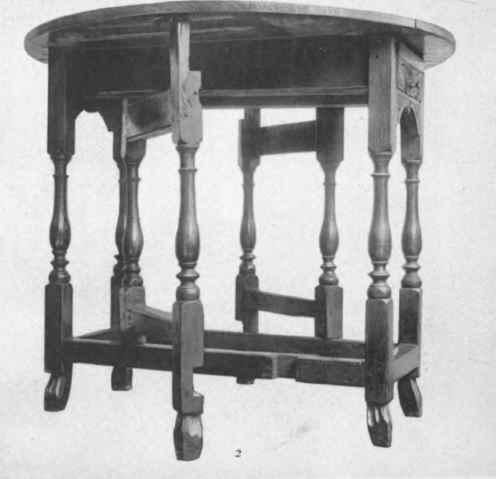
Plate L.
1 - Table, Oak About 1620
2 - Gate Table, Oak 17th Century
l. (1) Table, oak, about 1620. At Forde Abbey. Miss Evans. (2) Gate Table, oak. Seventeenth century. Derbyshire. V. & A. M.
Dimensions : Height 27¾, Breadth 38½ inches.
IX ' Drawing ' Table, oak, inlaid. Late sixteenth century. V. & A. M.
There is not much doubt that this useful form of table has continued to be made until quite recent years in the old style, the tradition being faithfully followed in out of the way country places. One has been met with by a dealer in the Midlands which appeared to be a perfect specimen of the seventeenth century. It turned out to have been made from an old pattern by the husband of the woman in whose cottage it was found. Tables in other woods than oak, with the 'gates' on either side, the writer has not met with, but at Hampton Court, in the great hall, there is a table, apparently of laburnum veneer, which has two sets of gates on one side, and is bordered with the 'herringbone' inlay, to which attention is particularly drawn in the chapter on smooth - surfaced furniture. The stretchers in this case are turned. There is also an oak table with but one gate, which resembles our illustration in so far as it is carved with a reminiscence of the 'Spanish foot' found upon the chairs of 1690 approximately.
Continue to:


My Books

