


Carpenters' Hall Table
Description
This section is from the book "English Furniture", by Frederick S. Robinson. Also available from Amazon: English Furniture.
Carpenters' Hall Table
The arch remains in certain less assuming octagonal tables, of which an admirable example is to be seen in the Hall of the Carpenters' Company. This is about three and a quarter feet only in diameter, with a round arch, toothed, between each of its legs, to give a finish and variety to the frame. The legs carved with gadroon shapes are stout, but not so proportionately heavy as those upon our later tables. Great interest and importance attaches to this table, because it bears in the spandrels of the arches the initials of the Master and Wardens of the Company for the year 1606. The date is carved in two of the spandrels, and the others bear the initials R.W., G. I., J. R.,and W.W., - Richard Wyatt, George I sack, John Reeve, and William Wilson being the names of the officials of that year. The octagonal top is answered below by stretchers between each leg and two large cross-pieces. The stretchers have each a pair of segments of a circle cut out from below, to recall the arches of the upper part of the table.
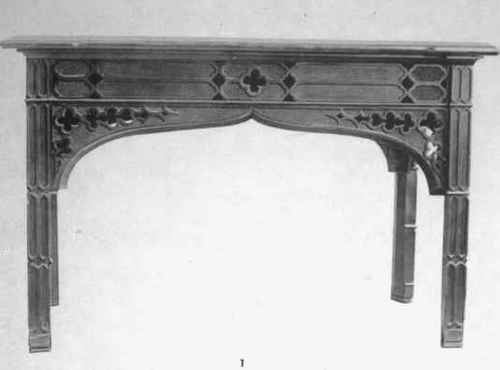
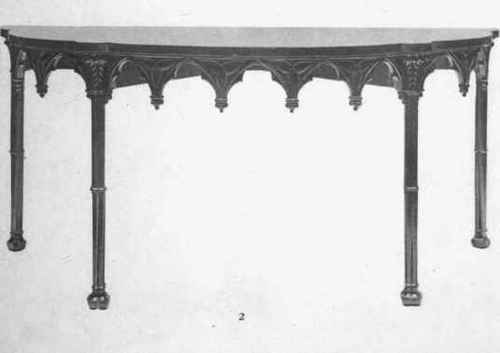
Plate CI.
I - Hall Table, Oak Chippendale
2 - Side Table In The Gothic Style Chippendale
CI. (1) Hall-table, oak. Chippendale. C. H. Talbot, Esq. Lacock Abbey.
(2) Side-table in the Gothic style, mahogany. Chippendale. Messrs. Partridge.
Altogether it is an excellent example of good design and workmanship.
The arched table illustrated on Plate l. i has certain special peculiarities. It is of oak, with a hexagonally shaped frame, and an octagonal top which folds over about a middle line. The two legs at the back swing on the cross stretcher in the manner of 'gate-tables,' to which reference is made presently. The plain shape of the turned legs would suggest that this example, which belongs to Miss Evans of Forde Abbey, is later than that at Carpenters' Hall, and may date about 1620.

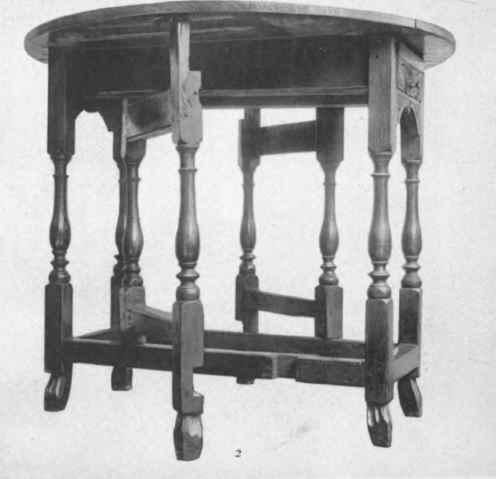
Plate L.
1 - Table, Oak About 1620
2 - Gate Table, Oak 17th Century
l. (1) Table, oak, about 1620. At Forde Abbey. Miss Evans. (2) Gate Table, oak. Seventeenth century. Derbyshire. V. & A. M.
Dimensions : Height 27¾, Breadth 38½ inches.
IX ' Drawing ' Table, oak, inlaid. Late sixteenth century. V. & A. M.
A very fine example (No. 384 in the Victoria and Albert Museum) introduces us to the solid carving-table such as our ancestors used, to place upon them those rounds of beef which by a harmless poetical convention are supposed to have been larger than they are to-day, and to have caused ' the board' to groan. Perhaps the preceding trestle arrangement was more liable to this peculiarity. At any rate this table (Plate li.) is undoubtedly of the kind which ministered to that ancient hospitality of which Evelyn makes mention as keeping open house in his brother's mansion of Wotton. The earlier trestled table was probably even narrower than this one, not more than two feet and a half wide. Some suppose that the guests who sat at the earlier 'board,' on one side of it only, with their backs to the wall, did so originally in order to be the better prepared for any sudden attack. The remembrance of those primitive days is very likely recalled by the comparative narrowness of the heavy seventeenth-century table. The times had changed when these were made, and they are not too large for a smaller room than the great hall of a country house.
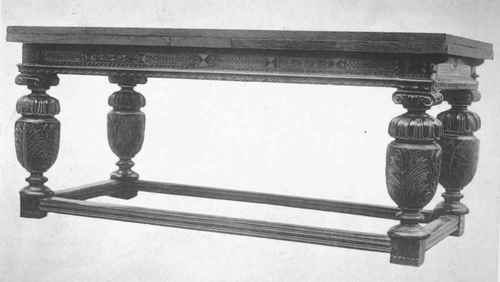
Plate LI. Drawing Table, Oak Inlaid Late 16th Century
Parlours came gradually into use at the beginning of the sixteenth century, and in these the master lived and dined instead of taking his meals in the great hall with his servants. Some say that this was due to the general disuse of feudal customs and also to religious dissensions. These led to the master's want of trust in those about him, and his consequent preference for some small room where he could speak his mind unheard save by those in his confidence. It is, I think, quite as reasonable to suppose that a desire for comfort was as strong a motive. Big rooms are cold and draughty, small ones can be more easily warmed and furnished. Therefore not too great stress should be laid upon political or religious motives, even though a bishop, fearful of a weakening in church influence, did in 1526 inveigh against dining 'in corners and secret places.'
Continue to:


My Books

