


Early Oak Chests. Part 3
Description
This section is from the book "English Furniture", by Frederick S. Robinson. Also available from Amazon: English Furniture.
Early Oak Chests. Part 3
Very similar carvings are to be found on a beautifully elaborate chest at Brancepeth, Durham, and also on one at St. Mary Magdalen's Church, Oxford.
Illustrated here is a very interesting specimen from Dersingham Church, near King's Lynn, Norfolk. This also is of the fourteenth century, and is highly elaborate in its decoration. It is noticeable that the arcading, which is the chief feature of most of the thirteenth and fourteenth centuries, Early English or Decorated period chests, usually either stretches right across the front or else across the central slab, the side pieces containing the winged beasts or whatever diversifies the design. In this case there is no arcading, but a three-lighted window with small arches on each side, on either upright slab at the two ends of the chest. The central slab is divided into four partitions with a sunk field and a raised border, which decidedly suggest the general arrangement of the panelled chests of the sixteenth and seventeenth centuries. The later these chests are in date, the less massive are the upright 'stiles,' if so we may call them. It is to be noticed that the stiles of this specimen are not nearly so broad in proportion as the Stoke d'Abernon uprights, nor as those of the chest at Haconby. The upper and lower rails bear about the same proportion to the four sunk fields of the centre of the chest front as the rails of a later panelled chest.
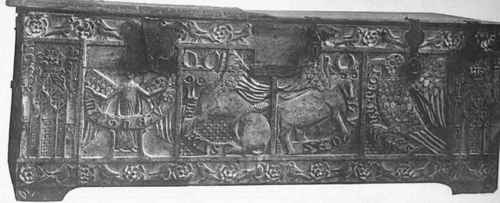
Plate V. Chest, Oak 15th Century Dersingham Church, Norfolk
v. Chest, oak. Fifteenth century. As will be seen in the text, reasons are given why this chest may be of later date, and on further consideration I have not much doubt that it is of the fifteenth century. Dersingham Church, Norfolk.
By kind permission of the Rector.

Plate XXVI. Oak Chest Late 16th Century Or Early 17th
XXVI. Chest, oak. Late sixteenth or early seventeenth century. Seymour Lucas, Esq., R.A.
Dimensions: Length 41, Height 26, Depth from front to back 24 inches.
This front is constructed of three parallel horizontal planks forming the centre part, and two upright ones for the ends. Its lid, only half of which is remaining, is not so thick as those of some chests of the same period. In the tracery of the windows at each end there is a decided ' flamboyant' feeling, such as perhaps might be expected in Norfolk, which had such close dealings with the Continent. General considerations of shape and this tracery would seem to suggest that this chest was made late in the fourteenth century. The reduction of the arcades to mere windows at the end, the imitation of panelling, and the bird and rose pattern of the upper and lower rails, render it a nearer approach in general scheme of decoration to the domestic chest of the sixteenth and seventeenth centuries than any other of the period. It is difficult, indeed perhaps impossible, to find any close link existing which shows the evolution - some might prefer to say the decadence - of the later secular chests from their more ecclesiastical forerunners. It is obvious that Gothic arcading could not easily be accommodated to a chest with stiles and panels.
Consequently with a radical change of construction there must follow a certain change of ornament, and if it were possible to date this Dersingham chest in the fifteenth century, I should be inclined to regard it as the first indication of the coming alteration. The window tracery resembles that of a window at King's Sutton Church, Northants, date 1380 circat but the shapes of some of the letters render it not impossible that they were carved in the fifteenth century. In a manuscript (Summa Bar-tholomcei Pisani Ord. Praedic. de Casibus Conscientiae) of about 1472, very similar letters occur. Matters such as this, however, require very careful verification, and the general shape of the chest, with the disposition of its ornament, is the most suggestive of a fifteenth century date.1 The lettering is a great feature. Not only are there the names of the evangelists with their curious symbols on the front, but the lid is or was quite elaborately inscribed. We have noticed that only half remains, but very fortunately there is a record preserved of the other half.
This is to be found in Cotman's Architectural Remains. Round the border run the words 'Jesus Nazarenus Crucifixsus Rex Judeorum' Within the centre of the lid are the isolated letters S A R R A arranged in a 'quincunx.' The border inscription begins on the front edge and runs round to the back, where for some odd purpose of mystification, perhaps, it has to be read backwards. Even as late as 1838, when Cotman's book was published, the etching shows that the chest had been sawn into two pieces. Whoever stole or destroyed the lost portion is deserving of reprobation. The present rector of the parish has most wisely had this interesting relic roped in to protect it from further vandalistic attacks. There is some hope that before long a restoration from Cotman's plate of the lost portion may be skilfully effected. Never was there a more suitable occasion for legitimate restoration, based on reliable evidence, as opposed to the all too common 'conjectural emendation.' In France there are to be found chests of the fifteenth and early sixteenth centuries, which show the continuity of style between early and later chests.
There may be found in M. de Champeaux's work on French furniture, Le Meuble, two or three illustrations of the sixteenth century chest panelled, and no longer of heavy and rudely joined slabs. The continuous arcading is, of course, not to be found upon these, but each panel is filled up with intricate tracery of a flamboyant character. In some cases coats of arms are the central ornament of the tracery, in others figures of ecclesiastics, both styles being found on the same chest. In one case the big uprights at each end are actually carved with the guillocne or double-entwined cable ornament with which, when we deal with the end of the sixteenth and the seventeenth centuries, we shall become exceedingly familiar. Whether upon the French chest in question it can be regarded as part of the original design could only be definitely settled by inspection of the original, the ownership of which is not stated by M. de Champeaux. Next in date to these are in all probability those objects of furniture in which heads, sometimes portrait profiles, are found under arches or enclosed in circular borders, a style which lasted certainly from the reign of Henry VII. to that of Elizabeth, as the famous Sudbury's Hutch in Louth Church, Lincolnshire, the panelling from the old house at Waltham Abbey (Plate XIV.), now in the Victoria and Albert Museum, a somewhat problematical chest (Plate xxv.) in the same place, and other examples indicate.
Continue to:


My Books

