


Early Oak Chests
Description
This section is from the book "English Furniture", by Frederick S. Robinson. Also available from Amazon: English Furniture.
Early Oak Chests
The earliest chests we have remaining were made for ecclesiastical purposes, and are still to be found in the parish churches for which they were originally constructed. They are comparatively few in number, and examples like them are of course practically impossible to be obtained by the collector. The Gothic periods to which they belong are undoubtedly those of the finest productions in oak carving, and it is necessary, even in so brief a notice as this, to give examples of their different types. I cannot do better than refer those who wish to learn almost all there is to be known about these ancient monuments of English furniture to the beautifully illustrated and altogether excellent work of Mr. Fred Roe upon Ancient Coffers and Cupboards. There the reader will find an account of almost every important example.
The early chests and coffers may be divided into four main classes: - I. Those which depend for strength and ornament largely upon ironwork. 2. Those which combine ironwork with decoration by painting. 3. Those which have fronts composed of one or more horizontal and two upright slabs of wood, and are carved with ecclesiastical architecture - such as windows and their tracery, and occasionally buttresses.
4. More secular chests, with subjects of knights tilting at each other, and other details.
To the first class very few remaining examples belong. I give an illustration of perhaps one of the very earliest relics of this kind (Plate III.). It is in Brampton Church, Northants, not far from Pitsford and Brampton Station, and, as will be seen, is by no means in perfect condition. It is, however, well cared for, as is not always the case with important relics of this description. If it were not for its ironwork it would be an almost entirely plain box. The only ornament on the woodwork is a two-inch deep band of about six lines of horizontal reeding or beading along the top rail. Traces of colour the writer was unable to find, but they might be discoverable in a strong light. The lid and sides are venerably wrinkled, scarred, and furrowed with old open worm 'quarries.' So rough is the wood from age and wear that it might almost appear in places to have been scarcely denuded of its bark. It is worth while to record these signs of age, as on at least one soi-disant fourteenth century chest they are conspicuously absent. The length of the Brampton chest is about 6 feet 5 inches, its width perhaps 19 inches, and depth about 17½ inches, so that it is considerably longer in proportion to its other dimensions than a seventeenth century chest.

Plate III. Oak Chest, I2th Or 13th Century; Decorated With Iron Brampton Church, Northants

Fig. I
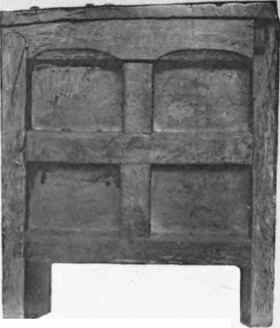
Fig. A
III. Chest, oak, twelfth or thirteenth century, decorated with iron. Brampton Church, Northants.
Approximate dimensions: Length 6 feet 5 inches, Width 19 inches, Depth 17½ inches.
The front, of one plank, is about 1⅛ inches thick at the top in the thickest place. The top is also of one plank, but has split and been mended. The sides are of from ⅝ to ¾ of an inch thick. Viollet le Due attributes to this chest the date of 1190. It has massive iron handles at the ends, and it is noticeable that the branches of the ironwork are apparently fastened together by what looks like a flat collar welded tight round the stems. This produces an appreciable enhancement of relief in the design. What remains of the hinges is stamped roughly and irregularly with a four-petalled flower. The edges have a Vandyke pattern.
The ironwork of the front is more ornamental than protective, and is nailed on with flat round-headed nails half an inch in diameter.
In the Victoria and Albert Museum is a chest, No. 733, which is said to be French, probably because it was part of the Peyre collection of French carving. Its ironwork is, however, so similar in style to that of the Brampton chest that there is every likelihood of its being English. The stems of the ironwork have the same ribbed section, the chief difference between the two chests in respect of their mountings being that the 'collar,' which projects in the Brampton chest, in the museum specimen is no higher than the stem and branches which it joins. Those junctions are incised or stamped with diamonds. The lid of the latter chest is a new one.
Our second division comprises those chests which combine ironwork with decoration by painting, which, as we have seen, some conjecture to have been the only two forms of decoration used prior to 1250. A fine example of this style is to be found at Newport Church, Essex, and has been excellently reproduced in colour by Mr. Roe in his Ancient Coffers and Cupboards. The ironwork in this case makes no pretence of decoration beyond what nail-heads set at regular intervals may supply. The decoration of the front consists of shields set side by side along the upper rail, and circles similarly placed on the lower. Between the two rows is an exceptional feature, described by Mr. Roe as 'a band of open tracery cast in lead or pewter.' The inside of the lid has five crossed arches painted with figures, the central one containing Christ on the cross. The colours are chiefly red and green. This chest is of the thirteenth century. To the fourteenth century belongs another painted one, also reproduced in colour by Mr. Roe, which was formerly in the Court of Chancery. Durham. The ironwork in this makes a nearer approach to decoration. There are two horizontal corner clamps at each end of the front, with double-tailed ends.
Arranged vertically on the front at equal distances are six flat bars, each ending at the top in the double tail. The lid is again the most ornamental part, being decorated with four heraldic shields, and a St. George attacking the dragon, in brilliant colours, chiefly red, yellow, and blue, upon a green ground.
To the third class belong most of the ancient Gothic chests which are to be found in our parish churches, and their points of divergence from the regular panelled chest of the late sixteenth and the seventeenth centuries shall be described at greater length. The front is composed of massive slabs of wood. In the centre, which is sometimes one large piece forming the main part of the front, the grain runs horizontally. The length is increased at both ends by two other slabs in which the grain runs vertically, and their lower ends project beyond the bottom of the middle piece to form the legs or feet. The earlier the chest, the more massive are these upright side-pieces. The ends of the chest are not always formed, as might be expected, by flat slabs. The slabs are there, but are strengthened on the outside by cross-bars of massive construction forming sometimes four, sometimes six 'pigeon-holes' or divisions in the end according to the number of crossing pieces.1 The lids are flat and unpanelled. Iron hinges are not used until the fourteenth century.
Continue to:


My Books

