


Nonesuch Chests
Description
This section is from the book "English Furniture", by Frederick S. Robinson. Also available from Amazon: English Furniture.
Nonesuch Chests
Not of a much later period is another chest with handsomely inlaid panels, the centre one containing a swan in light wood, which also belongs to Mr. Seymour Lucas, R.A. The carving of the framing of this chest is remarkably easy-flowing and well designed, whilst a special and rare feature is the ornamental S-curved brackets at each end of the lower rail (Plate xxviii.i).
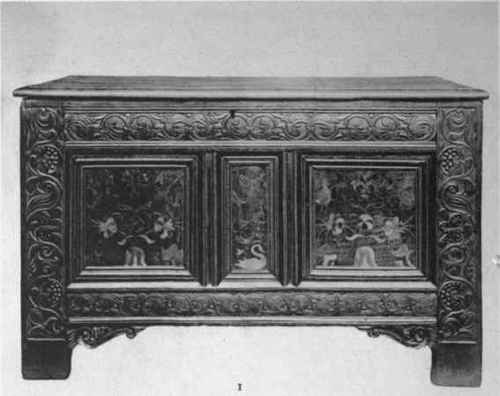
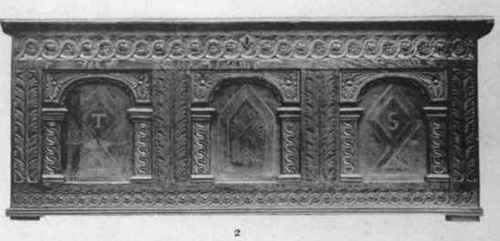
Plate XXVIII. 1 - Inlaid Oak Chest Early 17th Century 2 - Oak Chest, Inlaid With Geometrical Marquetry About 1600
XXVIII. (1) Chest, inlaid oak. Early seventeenth century. Seymour Lucas, Esq., R.A. (2) Chest, oak, inlaid with geometrical marquetry. About 1600. From Bishopthorpe, York. V. & A. M.
The date of 'about 1500' is assigned to a chest (No. 7270) in the Victoria and Albert Museum, which has curiously flattened curves to its nearly round arches. It is difficult to agree to so early a date as that assigned to it, though it is to be noticed that in the spandrels there is the familiar leafage so characteristic of English oakwork, and to be seen on those of the cupboard above mentioned at Louth, which is undoubtedly early sixteenth century, if not even late fifteenth. All the rest of the ornament of this chest is typical of the late sixteenth or early seventeenth century, the guilloche on upper and lower rails and pillars, the formal acanthus leaf upon the stiles, and the geometrical inlay, which somewhat spoils the effect of the panels. There is a double grooved line on the lower edge, which is very likely a restoration. On the two end panels are the letters T and S, and the chest is stated to have come from the Palace, Bishopthorpe, York. Its carving, though unambitious, is good and sharp, and superior to that of No. 1390, which again shows us the arch planted in.
This is a rather over-florid specimen, with panels on which are carved conventional flowers growing out of clumsily shaped vases, a motive more beautifully expressed by inlay, in which it is not uncommonly found. On the upper rail is the S-curve, whilst the lower rail has a rather too prominent turned moulding, suggestive of a date on the later side of 1650. At the bottom, above this moulding, are two doors, with a drawer between. The chest of drawers did not spring into existence, as we have it in all its varieties, on a sudden. It was the result of a tentative process which was gradually developed as it dawned upon our ancestors how inconvenient it was to rout the whole chest out in the search after some article hidden at the bottom. This chest, therefore, is interesting as an example of the development of the chest of drawers from the coffer; and the same may be said of No. 654, which has some peculiarities of its own, and is in a better style of art. It is 'a throwing back' to the early fashion of chest without panelling, but with its ornament incised on the plain plank. We have the guilloche on each side of an elegantly designed, conventional 'upright flower' pattern, whilst under the incised arches are very bold and handsome roses.
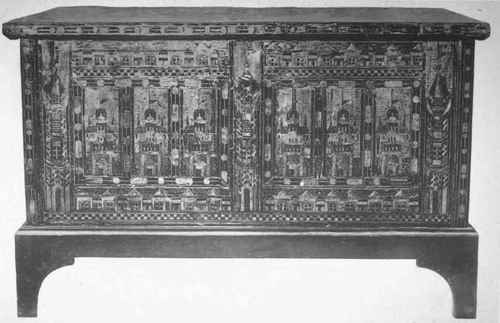
Plate XXVII. Inlaid " None-Such " Chest 16th Century
XXVII. Inlaid ' Nonesuch Chest.' Sixteenth century. Seymour Lucas, Esq., R.A.
This chest was intended perhaps to partake of the nature of a strong-box, which might account for its solid plank construction. The ends slide in grooves, and, when drawn up, show two drawers beneath a false bottom. The arches being only incised, not planted in, would tend to show that the date is well towards the middle of the seventeenth century, but the style of work makes it, for a late chest, very attractive (Plates XXVIII.2, XXIX.I and 2).
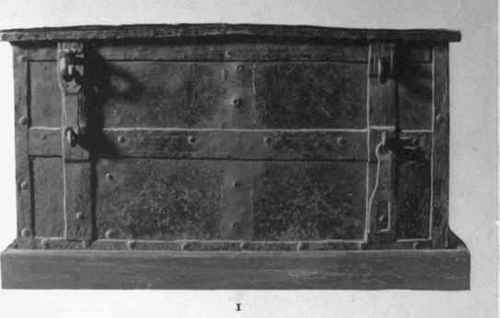
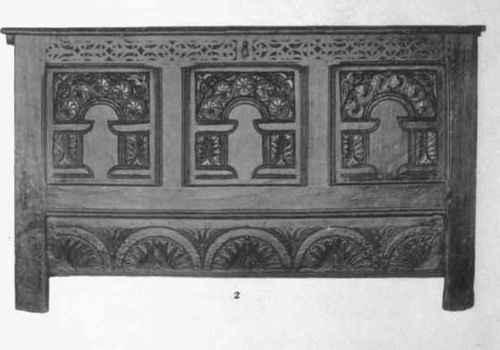
Plate XXXVI.
1 - Iron Chest, Painted 15th Century
2 - Oak Chest With Incised Arch I 7th Century
XXXVI. (1) Iron Chest, painted. Fifteenth century. At Rockingham Castle. The plinth is of wood, and later. The Rev. Canon Wentworth Watson. (2) Chest, oak, with incised arch. Seventeenth century. The Ven. Archdeacon Light-foot.
Continue to:


My Books

