


Question Of Dates
Description
This section is from the book "English Furniture", by Frederick S. Robinson. Also available from Amazon: English Furniture.
Question Of Dates
If so, they were in pretty general use in Corfe Castle in 1640, and were still more frequent, apparently, than chests of drawers. Mrs. Frances Clary Morse, in Fur-niture of the Olden Time, says that chests with drawers are mentioned in documents as existing in the American colonies as early as 1650, and that the greater number of chests found in New England have one or two drawers. We may then, perhaps, consider that the middle of the seventeenth century was the period at which the regular chest of drawers was fully evolved in England. It is impossible to assign definite dates. On the first page of his introduction to the catalogue of the exhibition of furniture at Bethnal Green in 1896, Mr. J. H. Pollen reminds us: 'As to dates, it must be noted that furniture and cabinet work, though stamped in some instances with makers' names, are not dated as hall-marked silver is. Dates are rare on cabinets, beds, or tables; if found they are suspicious, but genuine dates are too seldom met with to enable us to range these objects with such confidence as we could arrange silver spoons and cups.' The makers' names to which he refers are, of course, mostly those of France and the eighteenth century.
A maker's name on a piece of English furniture is rare indeed, and may be said never to occur except in the end of the eighteenth century and afterwards. Exception may be made in the cases of clocks and musical instruments, and in each of these instances it is the mechanism to which the attention is chiefly intended to be drawn.
It would seem that decorative freehand carving of leafage, flowers, and conventional shapes, the chief ornament of chests, is not a characteristic of the complete chest of drawers. Why this should be so it is not very easy to say, but the fact remains that incised work is not very frequently found. It is much more common to see the more numerous, but at the same time more restricted, spaces of the chest of drawers relying for their decoration upon mouldings and raised and splayed panels. Amongst our illustrations incised carving occurs on the example belonging to Mr. Seymour Lucas, R.A. (Plate lxi.). This is a remarkable specimen, and has very little carved work indeed. Its upper part is a chest, and underneath are three drawers. Bordering all the panels is inlay in rectangular shapes of small size similar to that on the heavy table (Plate li.), No. 384 in the Victoria and Albert Museum. This table is unquestionably of the very early seventeenth century, if not earlier still. The similarity of the inlay, together with the heavy gadroon moulding, with rough acanthus leaf corner-pieces, of the central upper panel upon the chest of drawers, would incline one to think it of equally early date.
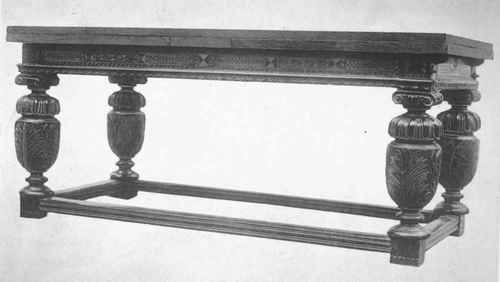
Plate LI. Drawing Table, Oak Inlaid Late 16th Century
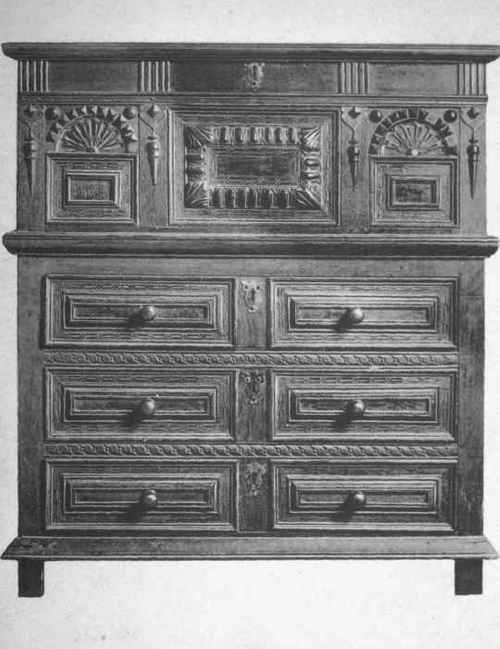
Plate LXI. Oak Chest, With Drawers Early 17th Century
LXI. Chest, oak, with drawers. Early seventeenth century. Inlaid, and with applied work. Seymour Lucas, Esq., R.A.
Yet the number of drawers, or rather the proportionate space they occupy, is somewhat excessive for a very early piece, and the carving, especially of the acanthus leaf cofhers of the gadrooned moulding, is rather rough. It might therefore be safer to attribute to this handsome specimen a date of about 1610. The turned half-pendants, bosses, and diamonds laid on thin wood indicate a Flemish influence in the design.
It seems so reasonable to expect decorative carving upon chests of drawers, which were being made contemporaneously with chests, that it would be unsafe to deny the existence of authentic specimens. But while the earlier 'chest with drawers' was turning into 'a chest of drawers,' a change was also taking place from incised decoration to decoration chiefly by means of mouldings and their arrangement. At least one incised chest of drawers made of oak, if not more, was exhibited at Bethnal Green in 1896. It had, alternately, shallow and deep drawers. In the shallow drawers the carving covered the whole of the front, in the deep drawers the fronts were boldly and broadly splayed in the usual manner of uncarved specimens, such as No. 70 in the Victoria and Albert Museum (Plate lxiii.), and the carved leaf and flower work was confined to a small rectangle in the centre. A guilloche ran up the stiles at the sides, the centre ones being florally carved. Beneath the top slab were three brackets, which, in the next example, will be found to be put to a very practical use. These were also florally carved, and there were reminiscences of classical triglyphs just as they may be seen upon Mr. Seymour Lucas's specimen.
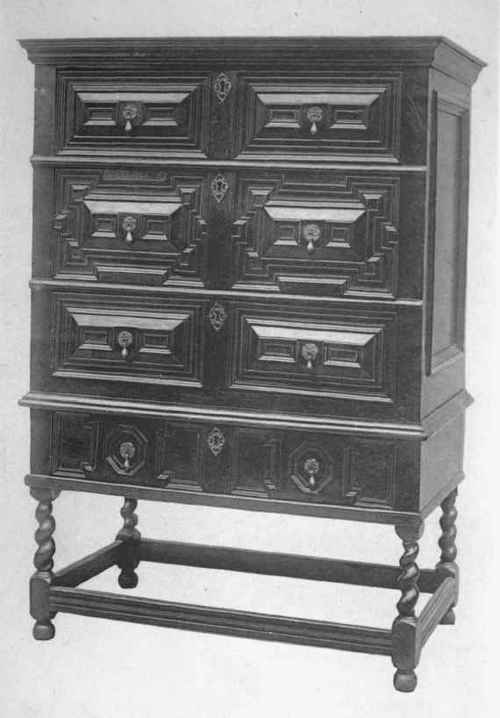
Plate LXIII. Chest Of Drawers, Oak Late 17th Century
LXIII. Chest of Drawers, oak. Late seventeenth century. V. & A. M.
Dimensions: Height 52½, Length 38, Depth from front to back 22 inches.
Originally the drawers of this chest of drawers are said to have been opened by touching a spring, and there were two secret drawers.
Continue to:


My Books

