


Reserve Ornamentation
Description
This section is from the book "English Furniture", by Frederick S. Robinson. Also available from Amazon: English Furniture.
Reserve Ornamentation
Most typical objects of furniture to which inlay or marquetry was often applied are chests of drawers and tall clocks. On both, the custom of confining the decoration to 'reserves' may be noticed. In a chest of drawers there may be two reserves on each long drawer. These reserved shapes may be described as 'ovals with flat sides,' or 'oblongs with round ends,' and contain a close-set intricate pattern. Sometimes the ground of the reserves is of light wood, and the inlay, perhaps bold acanthus-leaf scrolls following the contour of the reserves, is of various darker woods. This produces a striking result, but is artistically inferior to similar chests of drawers in which the reserves are of dark wood and the inlay light. In this case the line of demarcation between the reserves and the surrounding walnut of which these chests of drawers are made is not so sudden. Though quieter to the eye, the last arrangement seems more in keeping with the true principles of inlay, which should not be allowed to make too bold a bid for notice.
In the Victoria and Albert Museum is a very fine specimen of this class of furniture. No. 153 is a chest of drawers of oak veneered with walnut and inlaid with sycamore patterns of leafage in reserves. There are four large drawers in the front, and drop handles. It is noticeable that all the patterns are varied in size and detail - a fact which, of course, added largely to the expense of making, and also to the artistic effect. The sides are plain, but the top has an oval-shaped band in the centre, enclosing a circular one, which holds a rosette. The inlay of these bands is an oak-leaf pattern. There are also four scroll corner ornaments like the ornaments of the front. Occasionally these chests of drawers are found raised upon a lower part containing drawers and based upon cabriole legs, as is so often the case with the plainer furniture of the early eighteenth century.
There is no doubt that to the Dutch are largely owing the materials and the style of this freehand inlay, especially wherever the tulip flower enters into the composition. On the other hand, it is the custom of some to claim a certain seaweed or moss pattern as an English motive. This may be seen upon one of the long 'grandfather' clocks (Nos. 225, 331, 4618) in the Victoria and Albert Museum. Of these, No. 4618, with dial signed by 'Henry Poisson, London,' and very prettily inlaid all over, is perhaps the best. No. 225 has no dial, and its inlay consists of griffins with strap-and scroll-work. No. 331 has the spiral columns, and is by ' Mansell Bennett at Charing Cross,' and shows the Dutch tulip motive and birds in compartments. All have a circle or oval to show the pendulum, and in some cases a piece of bull's-eye glass was let in to distort the moving shape.
By the kindness of Mr. D. A. F. Wetherfield, of 8 Lansdowne Place, Blackheath, I am able to illustrate some of his beautiful series of long clocks of this period. They serve at once to show the elegance of the early slender shapes and to afford examples of veneer and inlay. The first (Plate lxxvi.i), with straight top, is by Thomas Tompion, ' Father of English clock-making,' who was buried in Westminster Abbey in 1713. It has a plain burr walnut case, and dates about 1680. Spiral turning is a great feature on the pillars of the faces on these clocks. The second (Plate lxxvi.2), with brass ball finials, is by Edward East, and shows the 'reserve' system of inlay, but not in the entirely simple form before described. The large tulip shows the Dutch provenance of the inlaid pattern. It is also of about 1680. The third (Plate LXXVI.3) is by Joseph Knibb, dates about 1690, and is veneered with laburnum and olive wood. The very pretty pediment with a central vase is a great advance on the plainer tops of the first two.
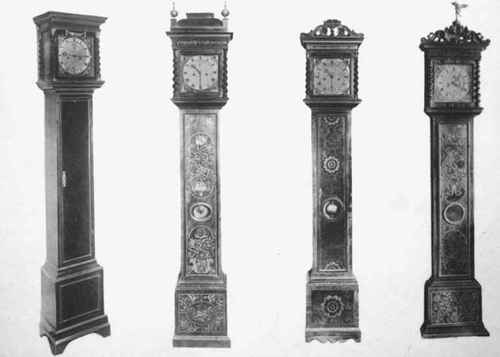
Plate LXXVI. Tall Clocks, Veneered And Inlaid From 1680-1715
LXXVI. (1) Tall Clock, by Thomas Tompion. Burr walnut case. 1680 circa.
(2) Tall Clock, by Edward East, inlaid.
1680 circa.
(3) Tall Clock, by Joseph Knibb, veneered with laburnum and olive wood. 1690 circa.
(4) Tall Clock, by Christopher Gould, inlaid and carved in the style of Grinling Gibbons. 1700 circa. All four the property of D. A. F. Wetherfield, Esq.
More elegant still is the last (Plate LXXVI.4) by Christopher Gould, and dating about 1700. The pediment of this cannot fail to remind us, with its little cherubs' heads set close together, of Mr. Seymour Lucas's Grinling Gibbons table, where the same motive is so admirably carved. In fact, the top of this clock, which is finely cut, might be the work of Gibbons or of one of his pupils.
Continue to:


My Books

