


The Lyre Motive
Description
This section is from the book "English Furniture", by Frederick S. Robinson. Also available from Amazon: English Furniture.
The Lyre Motive
In 1772 we come across the lyre shape in a 'girandole' for George Keats, Esq., and there is another design for a lyre-back chair, with the top of the back decidedly Chippendalean in shape, for Mr. Robert Child. It is obvious that the lyre motive was borrowed from France by more than one designer. It is not the special perquisite of Sheraton, as from a chair in the Victoria and Albert Museum, attributed to him, we might be led to suppose. It seems very probable that another set of lyre-back chairs, one of which is illustrated in this volume (Plate CXXI.), from the collection of Mr. Augustus Spencer, may be due to the Adams. I find also in the Autobiography of Leslie the painter, p. 250, a reference to a set of lyre-back chairs. 'Mr. Sockett' (rector of Petworth) ' had a set of chairs which had belonged to Hayley' (the poet). 'They are of carved mahogany and designed by Flaxman. The centre of every back is a lyre.'
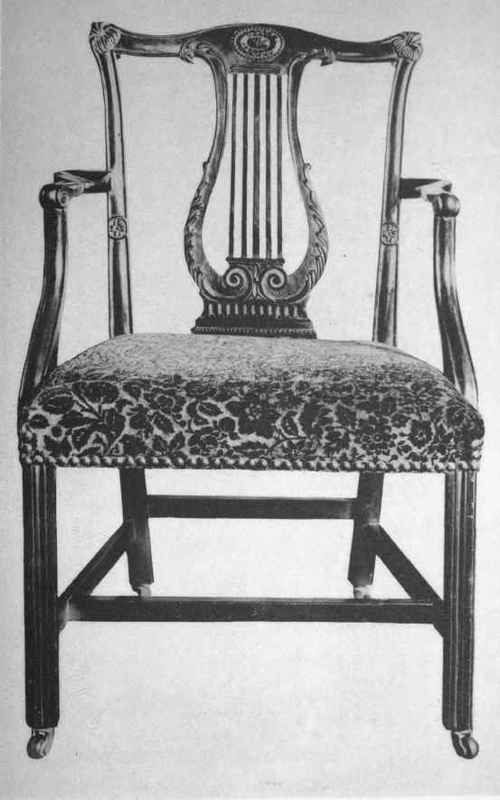
Plate CXXI. Lyre-Backed Chair, Mahogany
CXXI. Lyre-backed Chair, mahogany. One of a set. Adam (?). Augustus Spencer, Esq.
In the same year, 1772, there was designed a gorgeous bed for the Right Hon. Fred Thynne, all gilt, with urns, the anthemion and the short upright flute; and in January 1773 a 'sopha' for the Duke of Bolton, in the style known to us as Louis XVI., with swags, medallions, and turned and fluted legs.
Louis XVI. did not come to the throne till 1774, so that, allowing time for new French fashions to come to England, we may conclude that the style of Louis XVI. was well in vogue before the death of his predecessor. The appearance of these grand gilt beds may be judged of from that of Queen Charlotte, which is in white and gilt, a canopied four-poster with fine embroidered curtains, at Hampton Court Palace.
In 1775 we find a most ornate bed, and a 'counterpane' in 1776, 'for the bed at Osterley' for Mr. Robert Child. He keeps the Adams busy during these years with a work-bag for Mrs. Child of realistic flowers embroidered in a Greek vase, a fire-screen of the same design, and a tripod pole-screen in a Greek design, for the same lady. When commissioned to make an excursion into other styles, the Adams do not seem to have been comfortable unless they clung to at least a little of their classic ornament. The combination, as in the realistic flowers of the work-bag in their Greek vase, and in the wall decoration before-mentioned of mixed Chinese and classical motives, is evidence of an amusingly compliant, if scarcely correct, attitude.
In 1777 were designed gilt oval-backed chairs with sphinxes, which show that the Empire style had not the monopoly of that most frigid of all ornamental shapes. In 1778 it is the fashion to have a gilt mirror over a white painted commode, with gilt mouldings and lock furniture, and coloured urns and wreaths in green, blue, and crimson. This was for Sir John Griffin; while a picture-frame with a warlike trophy, consisting of a cannon, anchor, sail, spears, mace, and oars about a wreath with a shield centre dated July 28, 1779, is for Sir Abraham Hume.
We get some notion of the cost of these various objects, and of the reluctance of some clients to pay more than they were obliged, by occasional annexed estimates. A comparatively plain large glass in three compartments, with a classic frieze, containing figure subjects in grisaille on a dark green ground, and framing of light green, is for the 'one pair of stairs room at Mr. Weaver's.' Mr. Featham's (sic}) estimate on May 19, 1783, for this is: - Glass, £10, 15s.; frame, £5; painting, £1; ornament painting, £5, 5s. - total, £ 22. The size was about 6 feet high by 4½ feet across. Mr. Weaver appears to have objected, for on July 21st there appears another estimate of £21, 5s. 6d., which was a reduction not much calculated to satisfy a client. This was a small affair. For a pair of large pier-glasses for John Kenrick, Esq., with oval paintings in colour at the top, with sphinxes, urns, rams' heads, etc., 8 feet high by 4 feet broad, the price is £120. More elaborate alternatives cost £160 the pair, at the same date, October 1783.

Plate XCVIII.
1 - Upholstered Mahogany Easy Chair Chippendale
2 - Oval-Back Mahogany Chair Chippendale
XCVII. (1) Easy-chair, upholstered mahogany. Chippendale. Mr. Stephen Neate.
(2) Chair, oval-back mahogany. Chippendale. Messrs. Barker and Co.
Continue to:


My Books

