


Tudor And Renaissance Work
Description
This section is from the book "English Furniture", by Frederick S. Robinson. Also available from Amazon: English Furniture.
Tudor And Renaissance Work
There is considerable variety in the mouldings of the circular medallions of the Waltham panels, and the round-headed arch so characteristic of the Elizabethan and Jacobean periods appears in at least one case. The spandrels in this instance contain the usual leaf pattern. The practice of carving heads, often very probably portraits, in profile surrounded by medallions, was popular at the beginning of the sixteenth century, and lasted with gradual deterioration of execution for at least one hundred years. Attention is drawn elsewhere to a cabinet belonging to Sir C. Lawes-Witte-wronge entirely decorated in this manner. There is also reproduced in Shaw's Specimens of Ancient Furniture a little table with side-flaps which, he says • may be regarded as the earliest ornamented table after the revival of the arts' (Plate xix. p. 39). Upon its deep and heavy frame is carved a head in a medallion. This table was exhibited at Gore House in 1862, and then belonged to Mr. J. Swaby. A photograph of it was made, and should still be obtainable from the Board of Education.1
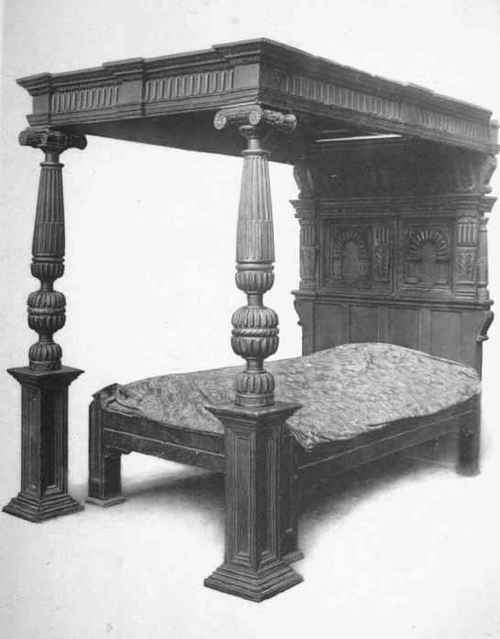
Plate XIX. Bedstead, Oak Dated 1593
XIX. Bedstead, oak. Dated 1593. V. & A. M.
(1) Bedstead, oak. Seventeenth century.
Dimensions : Height 75¾, Length 80, Breadth 55 inches.
(2) Head of the same bedstead. The cornice has been restored. J. E. Clifton, Esq.
No Gothic reminiscences affect the panelling (Nos. 4870-4881) from a room in an old house at Exeter, dating from 1550-1575 circa 2 In this example the ornament is confined to the frieze, pilasters, and stiles, the panels being plain, and, as Mr. Litchfield in his History of Furniture suggests, was probably made locally for the house. Where the decoration is on the opposite principle - plain framing and decorated panels - the ornament may have been brought from a distance and fitted in only by Devon workmen. There is no doubt that much woodwork was in this way used from abroad, and the jealousy of native carvers was freely expressed against those Italian and Flemish workmen who spread the Renaissance style over England. The moulding of the panel stiles is a very typically English one, but it is considered by some writers, amongst whom is Mr. W. Bliss Sanders, that the decoration was imported. He reproduces in his Half-Timbered Houses and Carved Woodwork two chimneypieces from Aubourn Hall, Lincolnshire, one of which, with planted arches, is rough and English, in his opinion. The other, with similarly disposed mouldings on its panels, but with finer carving, he considers foreign.
It is possible to go too far in claiming all that is uncouth as English, and attributing all delicacy to foreigners. A consideration of the execution of some of the Winchester Cathedral chantries, presumably by English hands, and the fact that the names of Henry viii.'s carvers at Hampton Court were very many of them English, is sufficient to give us pause.
1 It is now in the possession of Lord de Lisle and Dudley.
2 Plate xv.
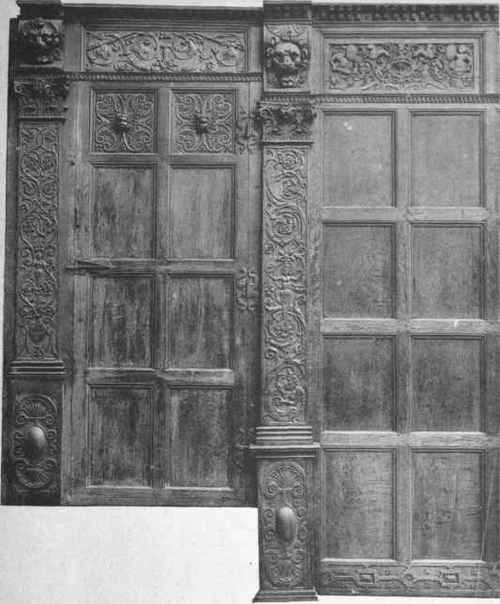
Plate XV. Oak Panelling From Exeter 1600 Circa.
xv. Oak Panelling, from Exeter. 1600 circa. V. & A. M.
Continue to:


My Books

