


Yorkshire Cabinets
Description
This section is from the book "English Furniture", by Frederick S. Robinson. Also available from Amazon: English Furniture.
Yorkshire Cabinets
The second of these cabinets (Plate xli), belonging to Miss Stirke, is smaller, and not so long for its height. On the cornice at the top there is a pattern of small semicircles, and below it a waved pattern with tulip-shaped flowers and rosettes. There is the same arrangement of upper panels as in the larger cabinet, but the outside ones are narrower. The hinges are of the opposed C shape. The shelf is narrow, and below it again appears the semicircle pattern. The panels of the lower cupboards have large semicircles, and the incised work of these is not entirely happy, being somewhat too thin for the size of the semicircles. It seems that the design of some of the panels is not quite suited to the narrowness of their shape, so that types which we are accustomed to see spread over an ample field are here rather squeezed. The same approximate date may be assigned to this as to the last. Both are first-rate examples of genuine provincial furniture made for a well-to-do yeoman class, and as typically English as they can be. The simple style of ornamentation must commend itself to those who consider that decoration should be subservient to construction.
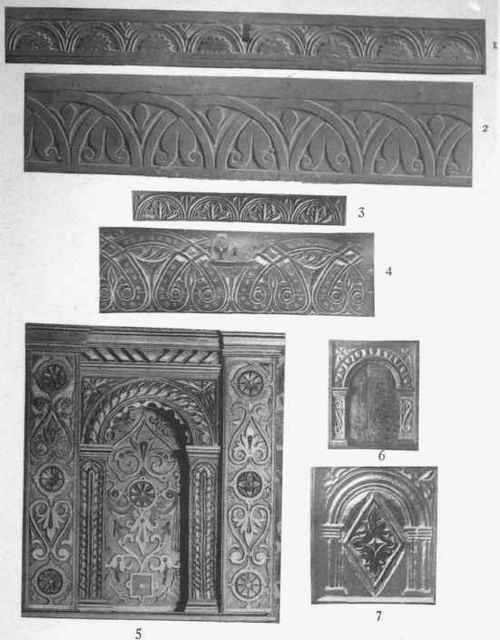
Plate IX. I To 4 - Variants Of The "Semicircle Pattern " 5 - The " Planted Arch " With A Version Of The " Upright Leaf ' On The Pillars, And The S Curve On The Stiles At Each Side 6 - Planted Arch, With S Curve On The Pillars 7 - The Arch Incised Specimens-The Guillochis And Typical Mouldings.
IX. Specimens of Semicircle and Arch.
(1-4) Variants of the 'Semicircle Pattern.' In (3) the pattern in the semicircles is known by some as the ' butterfly pattern.'
(5) The ' Planted Arch,' with a version of the upright leaf on the pillars, and the S-curve on the stiles at each side.
(6) Planted arch, with S-curve on the pillars.
(7) The arch incised.
The fan or semicircle pattern holds a large place in the last, and is prominent on the frieze of the next (Plate xlii.), which comes from Cheshire and is the property of Mr. E. Hockliffe. This is a pronounced instance of the habit of confining most of the ornament to the upper part, to which I refer subsequently in the chapter on solid-backed chairs. It is observable on the two Yorkshire cabinets, but is more marked in this one, the lower panels of which are perfectly plain. It is interesting to notice the difference of the hinges, those of the Cheshire example being perhaps a more elegant local variety than the Yorkshire type. The strap hinges on the upper cupboard of the Yorkshire cabinets are a special feature.
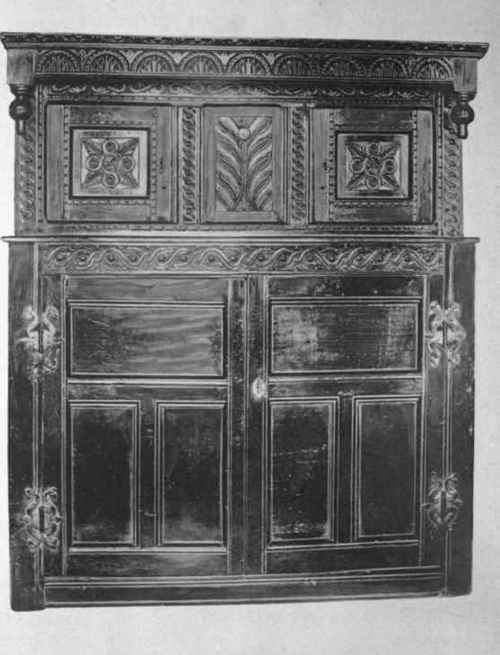
Plate XLII. Oak Cabinet 17th Century
XLII. Cabinet, oak, seventeenth century, from Cheshire. E. Hockliffe, Esq.
Dimensions: Height 67, Breadth 56⅝, Depth from front to back 20½ inches.
In Wales it is customary to find these cabinets with an upper story open in front, so as to serve for the display of pewter or pottery. In the example illustrated (Plate xliii.i), which is a plain one of late date, the property of the writer, the sides of the upper story, behind the turned pillars, are composed of flat laths.
Continue to:


My Books

