


Louis XVI. Period. Part 3
Description
This section is from the book "French And English Furniture", by Esther Singleton. Also available from Amazon: French And English Furniture.
Louis XVI. Period. Part 3
De Lalonde's first publications, in the Louis XVI. style, are addressed "to artists and persons who wish to decorate with taste"; and he assures them that everything is in the newest style. They include borders and frames, both square and round, feet for furniture, tables and consoles, doors, cornices, entablatures, girandoles, lustres, candelabra, trophies, soffits, vases, mantel-pieces, over-doors, ceilings and rosettes for ceilings, fire-places, locks and knobs for the use of doors and furniture, chimney-pieces and sconces. His thirteen books of furniture represent sofas, lits de repos, bergeres, duchesses, banquettes confidents, ottomans and other varieties of beds and sofas, fauteuils of both the square and gondola form, billiard and card-tables, desks of the cylinder and tomb shapes and desks with hind's feet, commode desks, commodes of marquetry, square commodes and commodes with hind's feet, corner-cupboards, screens, chiffonniers, bookcases with pilasters, little toilette commodes, demi-toilettes, flower-stands, etc., etc. Other books show numerous designs for the table service. The later publications of De Lalonde approach the new Classic taste.
In these there are numerous plates for the decoration of apartments, cornices, consoles, ceilings, doors, alcoves, windows, chimney-pieces, girandoles, lustres, sofas, canapes, fauteuils and beds, most of which are "in the antique taste." Among the chairs there is a chaise ren-versee a bergere, a fauteuil a griffon, a chaise elastique, a fauteuil a tete renversee, and a fauteuil a chimere antique. De Lalonde's designs were exceedingly popular. His beds and sofas a la duchesse, a la polanaise, a colonnes, a trois dossiers, a la turque, etc. are legion,, and his chairs, arm-chairs, bergeres, screens, tabourets, consoles, etc. appeared at Trianon and Fontainebleau, and many of them survived the Revolution. De Lalonde continued his work under the Directoire and so slavishly followed the fashion that his work leads directly into the style of the Empire as expressed by Percier and Fontaine.
De Lalonde is fond of the ribboned leg (see No. 3, Plate XLVI.) and the grooved leg; and his favourite ornaments are the quiver, the urn, the lyre, the garland, the burning torch, and, in his combinations of trophies, the ribbon plays an important part. Specimens of De Lalonde's works are shown on Plate XLVI., Nos. 1,2, 3, 5 and 7.
Ranson was particularly fond of trophies and flowers. He composed many designs and motives for the embroidery of arm-chairs. His books give all sorts of trophies and floral designs for various kinds of decoration. He also designed a great deal of furniture, particularly beds. Among the varieties exhibited in his plates are: Lit a Imperiale a colonnes, lit a chaire a precher. Lit a la Polonaise a tombeau, lit a l'antique, front and side view, lit a la duchesse, lit a la chinoise, lit a la Romaine,lite la militaire, lit a la Panurge, lit a la Polonaise a tombeau retrousse a la cbinoise.
Ranson was particularly fond of the pastoral accessories; and he groups large hats, shepherds' crooks, spades, trowels, and bird-cages, and throws around them garlands and ribbons. The round or oval frames of his chairs are generally surmounted by a garland of roses wherein doves sometimes bill and coo, or a quiver of arrows is set. An example of the latter design appears as No. 3 on Plate XLIV. Two sofas by Ranson are shown on Plate XLIV., Nos. 1 and 2. The first is a "sofa with drapery and cushions," the second is an "otto-mane a la reine."
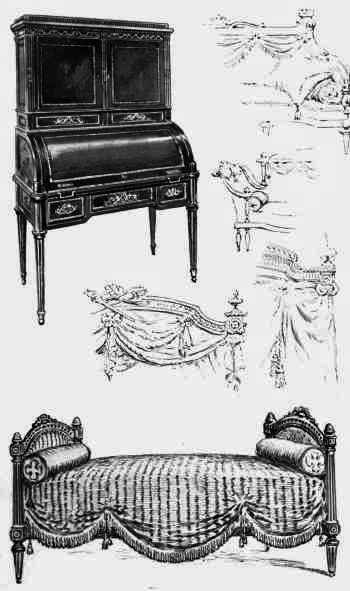
The cabinet-makers made a vast number of Ranson's designs.
Salembier's publications are chiefly devoted to the study of ornaments, particularly trailing foliage and arabesques, the acanthus and the thistle leaf. He designed no large pieces of furniture, but there are a few plates of consoles, gueridons, sconces, chandeliers, clocks, feet and corners of tables; friezes and panels for doors are also included.
In Salembier's designs, the foliage is not very luxuriant, and the acanthus leaf takes the place of the shell. The figures of Cupid that he uses are more like the Greek in treatment; and although his ornaments are plentiful, they grow slenderer. His arabesques are very ornate, although they are composed of light elements, mingled with branches, mosses and grass.
Petitot's best book contains many views and studies of a salon in the purest Louis XVI. taste. He also published sets of vases.
Jules Francois Boucher (b. 1736, d. 1781), the son of the famous painter, published various decorations for panels, elevations for alcoves, windows, buffets, details of armoires and commodes, libraries, drawing-rooms, cabinets, bath-rooms, dressing-rooms, boudoirs, bedrooms, dining-rooms, vestibules, etc. His work is particularly valuable; for the decorations, like those of Neufforge, give a more correct idea of the general ornamentation of the Louis XVI. period than the very rich and elaborate designs of Cauvet, Salembier and others.
Cuvillies (b. 1734, d. 1805) was for a time architect of the Bavarian court, and his stay in Germany greatly influenced his taste. His works deal chiefly with ornamentation, but designs for stoves, terms, vases and fountains are found among his drawings; and "niches in two Gothic styles" were published about 1770.
Marillier (b. 1740, d. 1808) chiefly designed flowers, trophies and cartouches. He also produced "new ornament composed in the most modern taste to be made in gold, silver, copper and other metals." These include trimmings for commodes, buffets and other pieces of furniture, besides lamps, candelabras, sconces for mantelpieces, hearth furniture, etc. Marillier's work shows the best characteristics of the Louis XVI. style.
Prieur's taste led him to arabesques, but, among his large collection of designs, one book is devoted to the decoration of apartments. Its six plates comprise a round dining-room, drawing-room, bedroom, boudoir, vestibule door and two ceilings.
Continue to:


My Books

