


The Empire Period
Description
This section is from the book "French And English Furniture", by Esther Singleton. Also available from Amazon: French And English Furniture.
The Empire Period

WE have already seen in the Louis XVI. period indications of the approaching Empire style; and noted that La-londe leads directly into the models of Percier and Fontaine. There was, however, a short transitional period covering the years 1795 to 1799, when, after the Reign of Terror, the Directoire endeavoured to restore order in France. It was but natural that a society that held in high reverence the memories of the ancient republics of Greece and Rome should develop the "antique taste "under the guidance of "philosophic artists."
As early as 1790, a writer exclaims: "We have changed everything; liberty, now consolidated in France, has restored the pure taste of the antique, which must not be confounded with the old Gothic taste. Hide yourselves, Boulle marquetry, knots of ribbon and rosettes of gilt bronze ormoulu, bright and shining! Hide yourselves, hide yourselves, marvels of Bernard! Now is the hour when objects must be made to harmonize with circumstances!" "The boudoir, - the very sanctuary of coquetry - became a political cabinet," says de Goncourt, who goes on to inform us that the charming pictures of Boucher, Fragonard, Lawrence, and Lagrenees had to give place to caricatures and revolting prints of the hour, while pictures of the destroyed Bastille supplanted graceful mythological subjects.
"France," he continues, "wished to dwell in the scenery of a tragedy, with a Spartan body, in Etruscan chairs made of mahogany whose backs were in the form of shovels, or two trumpets and a thyrsus bound together. After these chairs she reclined in antique arm-chairs whose framework was coloured bronze. She heard the hours strike from that civic clock representing the federative altar of the Champ de Mars with columns of marble and gilded bronze, and attributes of liberty. She slept in 'patriotic beds.' In the place of the bunches of feathers, caps were now placed on top of the fasces of lances that formed the bed-posts; beds represented the triumphal arch erected in the Champ de Mars * on the day of the Confederation. She also slept in the 'lit a la Federation? of four columns in the form of fasces grooved and painted in greyish white varnished, with the stems of the fasces gilded, as well as the axes and iron supports of the canopy."
Cafferi no longer designed the lustres and sconce-arms of or moulu; the candelabra were now of porcelain, and represented Apollo and Daphne. These figures were flesh-coloured. The body of Daphne was half covered with the bark of the laurel, her head with green leaves, and her two hands turning into branches supported two gilded sconces.
* Journal de la Mode, 1790.
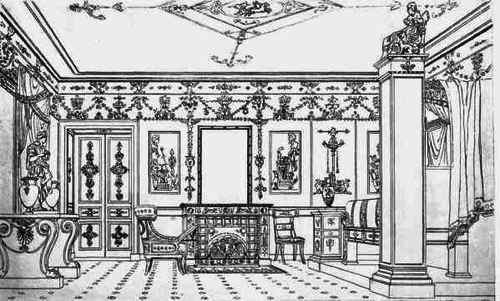
The geometrical panels of the new drawing-rooms were coloured that deep brown, mingled with several other colours, which received the name genre etrusque. Listen to these discords: "On the ceiling is a reddish-brown rosette in the form of a parasol; a sky-blue frieze is sprinkled with white cornucopiae. On the sides of the mirror, sky-blue pilasters are bordered with violet and white grape-leaves for ornament. Large and small light brown panels with violet borders are ornamented with little green parasols, and cameos with blue background with white figures and brown and red ornaments. And in that loud chocolate colour where some reds and greens try to recall to your mind the forsaken hues of the past are mingled three shades of rose, amaranth, blue, lilac, grey, emerald-green, moss-green, aventurine, citron, straw and sulphur. That gentle scale that sang so sweetly on the furniture and walls of by-gone days! that gentle scale that miserable taste has forsaken for the tri-colour, and for wall-paper printed with the distinctive signs of equality and liberty, from Dugoure's Republican Manufactory, place du Carrousel at the so-called Hotel de Longueville. Then the taste of the Revolution runs after the factory of the rue Saint Nicaise, place de la Reunion, to find some pictures with the civic inscription ready for each citizen to place above his door bearing these words: 'Unity, Indivisiblity of the Republic, Liberty, Fraternity or Death.' " *
*De Goncourt, La Societi Francaise pendant la Revolution. Paris, 1854.
The Parisian hotels that were remodeled and newly furnished for the newly rich could not suggest the slightest reminiscence of the aristocratic life that they had witnessed. The artists, therefore, were forced to go to Greece and Rome for their models and motives. After Napoleon's campaign in Egypt, the sphinx is frequent as a decoration, although it had long been familiar. The chairs, Nos. 1, 2, 3 and 5 on Plate LXVIII., are from a periodical of the Directoire period 1793 and 1796; also the couch No. 2, Plate LXV. These show that the so-called Empire style was in process of formation before Napoleon attained power.
The most important cabinet-maker of the period was Jacob Desmalter. He was the son of Georges Jacob, who, during the reign of Louis XVI., was famous for his furniture of gilded wood. His two sons worked together in the rue Meslee; and, in 1793, got the order to make the furniture for the Convention. This brought them into relation with Percier, who had been commissioned to furnish the designs. About 1804, the younger Jacob disappears from business and the elder added the name Desmalter to his own, and soon removed his workshop to the rue des Vinagriers. Desmalter's fame became wide-spread: he made furniture for the courts of Spain and Russia, and many pieces found their way also to England.
The famous workers in metal were Thomire, J. B. C. Odiot and Biennais:
The Recueilde Decorations Interieures, composed by C. Percier and P. F. L. Fontaine (Paris, 1812), is the recognized authority on the Empire style. The authors speak of the influence engraving has had in extending an acquaintance with styles, and say they will make use of it to exhibit "those of our works in the nature of furniture, which, by the importance of the places they were destined for, or the rank of those who ordered them, may be regarded as appropriate to attest the correct way of seeing things, composing them and ornamenting them at the present period. This style does not belong to us; it is entirely the property of the ancients and as our only merit is to have understood how to conform our inventions to it, our true aim in giving these to the public is to do all that is within our power to prevent innovations to corrupt and destroy the principles which others will doubtless use better than we. "The decoration and furnishing of houses are to houses what clothes are to people: everything of this nature becomes old, and in a very few years seems to be superannuated and ridiculous.
Continue to:


My Books

