


The Sheraton Period. Part 2
Description
This section is from the book "French And English Furniture", by Esther Singleton. Also available from Amazon: French And English Furniture.
The Sheraton Period. Part 2
He gives many directions, however, regarding the arrangement of rooms.
"As the entrance, or hall, of any well built house ought always to be expressive of the dignity of its possessor, so the furniture ought to be designed in a manner adapted to inform the stranger, or visitant, where they are, and what they may expect on a more general survey of every apartment.
"As the hall is a general, or ought to be a general opening to all the principal apartments, it should be furnished so as not to be mistaken for the most superb division of the structure, or where they may expect to meet the nobler person who resides in it. The furniture of a hall should therefore be bold, massive and simple: yet noble in appearance and introductory to the rest."
It is interesting to note that the Adam stucco-work has had its day and that there is a return to the Boucher treatment of the ceiling. Sheraton remarks: "Plastered ceilings are supposed to be more common in Britain than in other countries. The manner of finishing ceilings has been various, at different times, in this country.
A sort of very heavy ornamented plaster work was formerly introduced, together with pannelled work in heavy mouldings. Within about thirty years since, this kind of ceiling work has been composed in a much lighter style, and variegated with painted panels, often from the heathen mythology, or other poetical subjects. At present some of the most elegant rooms have no plastered ornaments in their ceilings, but are painted to imitate an open sky, with some faint scattering of clouds."
The walls were hung with paper.
The window generally reached to the floor, with small panes of glass, from four to eight in a sash. The window was also furnished with a blind. "The most fashionable blinds," Sheraton assures us, "are of wood painted green all except the frame which is of mahogany. The blind part is either composed of upright or horizontal narrow laths 1/8 of an inch thick painted a bright green and which move by means of a lever to any position for admitting more or less light"
The cornice was painted and japanned, or carved and gilded, and from it hung the draperies.
"Festoon window-curtains," says Sheraton, "are those which draw up by pullies, and hang down in a swag. These curtains are still in use in bed-rooms, not withstanding the general introduction of the French rod curtain in most genteel houses. A festoon window-curtain consists generally of three pulls, but when a window is extensive they have four or five."
An example of the French rod is shown on Plate LIX., No. 1, dated 1803. Sheraton says: "The French window rod is made of brass about 3/4 of an inch diameter, having a pulley at the left end and two at the right, one of which is fixed on a pin perpendicular to the rod. At present, they frequently make the French rods of satin wood two to a window to lap past each other about three inches in the centre; so that the curtain draws half on each side separately, or only half of it may be drawn at once; and when they are both drawn out they lap over each other." The chimney is invariably furnished with a glass. Sheraton says:
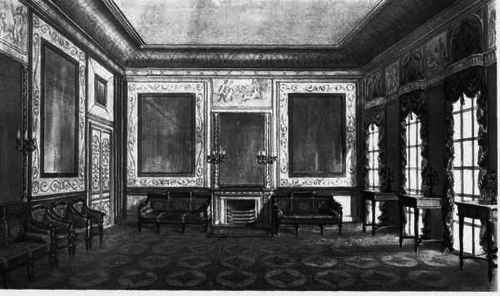
"In elegant rooms, the cbimney-glass is usually carried to the under side of the cornice of the ceiling; but to reduce the expense of the plate, sometimes a broadish panel is introduced at the top of the glass with a frieze and cornice above all, included in the frame of the glass.
"The most generally approved pilasters for chimney and pier-glasses are those of 3, 5, or 7 reeds, worked bold; but which, in my opinion, still look better by being parted with a ground one-third of the width of the reed which may be matted to relieve the burnished reeds. It is not unusual to have a twisting branch of flowers, or a ribband round the reeds rising upwards, and terminating in some sort of Composite, Corinthian, or Ionic capital. The panel above the glass is sometimes made quite plain and covered with silk as a ground for drapery, tacked under the cornice of the glass to match that of the windows."
"Glasses for chimney-pieces run various, according to the size of the fire-place, and the height of the wall above. To save expense, they are sometimes fitted up in three plates, and the joints of the glass covered with small gilt mouldings or pilasters. At other times with the naked joint only. When they are of one plate, the frame in general is made bolder and more elegant."
The floor is completely covered with a carpet having a border which has to be neatly mitred at the corners.
"The kitchen, the hall, the dining-parlour, the anteroom, the dining-room, the library, the breakfast-room, the music-room, the gallery of paintings, the bed-room and dressing apartments, ought to have their proper suits of furniture, and to be finished in a style, that will at once, show, to a competent judge, the place they are destined for.
"The library should be finished in imitation of the antiques; and such prints as are hung in the walls ought to be memorials of learning, and portraits of men of science and erudition.
"The music-room may be conducted in a more gay style; and the paintings or prints of the muses and masters of music may consistently make a part of furnishing; and chairs and stools of a richer variety of colours may be admitted with propriety."
"The ante-room is an introduction to the drawing-room and partakes of the elegance of the apartment to which it leads, serving as a place of repose before the general intercourse be effected in the whole company. Here may be placed a number of sofas of a second order with a pianoforte or harp or other matters of amusements till the whole of the company be collected.
"The tea-room, or breakfast-room, may abound with beaufets, painted chairs, flower-pot stands, hanging bookshelves or moving libraries and the walls may be adorned with landscapes and pieces of drawings, etc., and all the little things which are engaging to the juvenile mind.
Continue to:


My Books

