


Henri II. And The Second Half Of The Sixteenth Century. Part 2
Description
This section is from the book "French Furniture", by Andre Saglio. Also available from Amazon: French Furniture.
Henri II. And The Second Half Of The Sixteenth Century. Part 2
Hence the overloading of every engraving with superfluous detail, which no one, we should imagine, would be so unreasonable as to attempt to copy servilely.
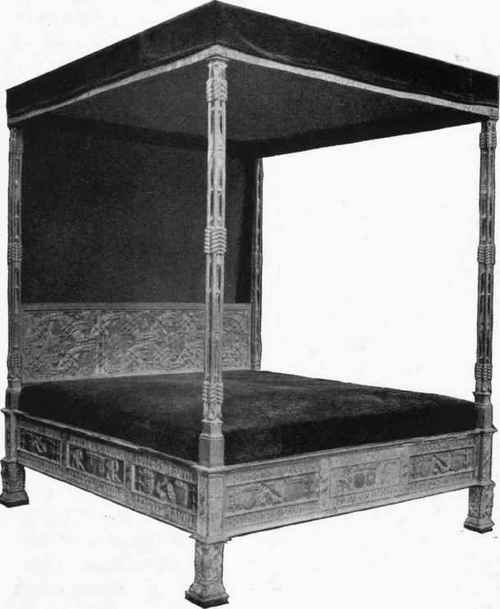
Plate XI. BED OF DUKE ANTOINE DE LORRAINE. XVI Century. Nancy Museum.
The examples we give of engravings by Du Cerceau, and the reproductions of designs for furniture inspired by him, will do more to enlighten the reader than pages of description of those ornate works. We will, therefore, content ourselves with naming some of the general principles of the master - principles adopted by his followers, and characteristic of the Henri II. style. The armoires generally have four folding-doors, two above and two below, separated from each other by pilasters surmounted with figures and greatly resembling an architectural facade, an effect sometimes increased by the addition of niches containing statuettes. The dressers are of three kinds - the first, a chest with folding-doors, is set up as in the old French style on a hollow base and finished off at the top with some architectural ornamentation; the second is divided into two compartments, both open at the back, so that all the decoration there is is on the columns or the frieze; the third has three such open compartments.
The beds are in two styles - some, of rectangular shape, have a so-called dossier, four balusters supporting a dais, and feet carved to represent griffins or chimaerae; others, shaped liked flat-bottomed boats, are narrower at the feet than at the head, they have a dossier and three balusters to uphold the dais, two at the head and one at the foot, representing a man or woman standing upright, the whole resting on a very lofty pedestal resembling the letter T. The tables are round or rectangular, but no examples of the former have come down to us; engravings in the "Album," however, represent them as upheld by two fan-shaped feet, the rays of the fans forming a star, the centre of the point of intersection being hollowed out to receive an ornament in relief, such as a vase or a palmette. A unique example of a round table is one with one foot only, carved into a succession of bulbs one above the other, which open out into coiling serpents, running beneath the top of the table so as to support it, whilst at the base is a symmetrical row of tortoises. Angular tables after Du Cerceau's designs are often met with.
They generally have two fan-shaped supports upholding the two ends of the table, or, to be more correct, of the inlaid or beaded cincture that leads up to it, and the narrow bases of the feet rest upon patens connected by traverses, from which spring pillars and arches, or intersecting rails, which add to the strength of the table - the lavishness of the decoration culminating in the supports, in which the designer gave the rein to his imagination.
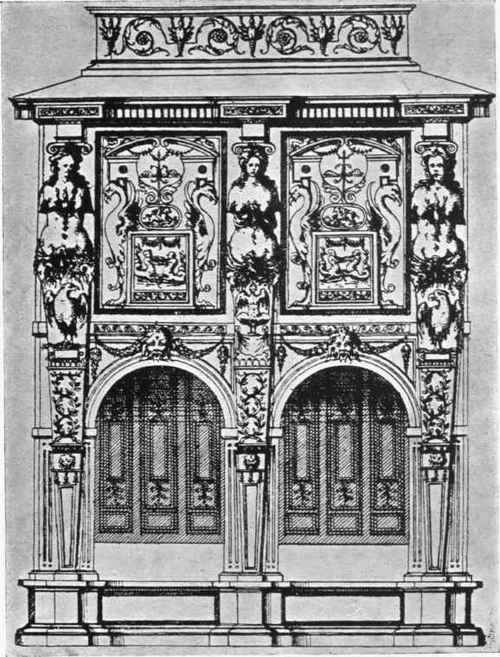
Plate XII. DRESSER. After an engraving by Jacques Androuet du Cerceau.
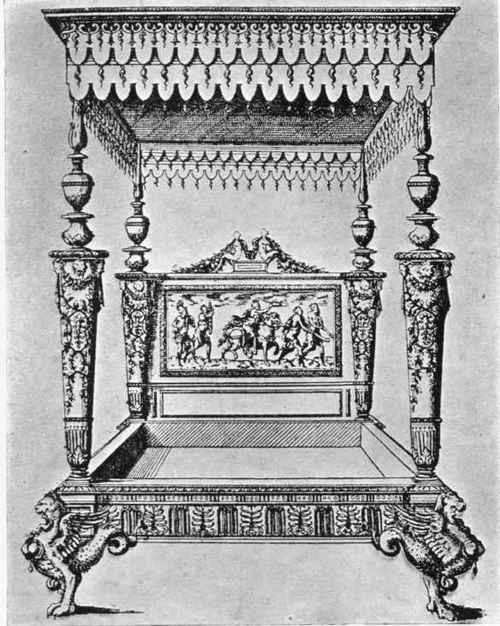
Plate XIIa. BED. After an engraving by Jacques Androuet du Cerceau.
Hugues Sambin, some ten years younger than Du Cerceau, was the son of a carpenter, and became a member of the Corporation in 1549. That he rose rapidly through his skill as an engineer and grip of the art of architecture, is proved by reliable documents stating that in 1558 he had charge of the "artillery" at Dijon, where he resided, that in 1560 he regulated the course of the river Suzon, was concerned in the supply of water for the public fountains of that town, was employed in 1572 by Leonor Chabot, Grand Equerry of France, to decorate his chateau at Pagny, superintended from 1574 to 1582 the works of the most important buildings of Dijon, the Palais de Justice, and Chambre des Requites, the walls of the fortifications and a communal building, returning at the latter date to his original profession, for he was the author of the exquisite sculptures of the choir-screen of the chapel of the Palais de Justice, those of the door of the Archives, and also probably of the outer entrance. Before his death, in 1602, this indefatigable and gifted artist designed the rood-loft of the Church of D61e, and superintended the works of defence at Salins. Between whiles he produced an album of designs for Caryatides, published a series of engravings under the title of "CEuvre de la diversite des termes dont on use en architecture," and executed a number of pieces of furniture, whilst he superintended the production of many others.
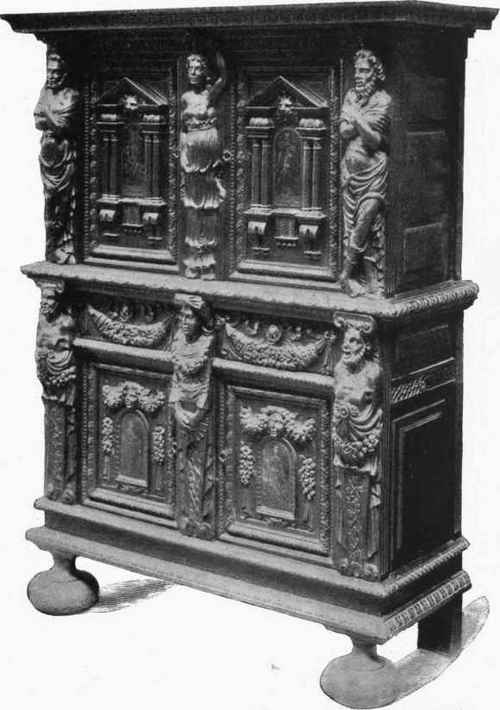
Plate XIII. CUPBOARD. By Hugues Sambin. Middle of XVI Century. Arconati-Visconti Collection.
In these minor works the Burgundian artist gave proof of a very prolific and powerful imagination. He lavished carvings of figures, fruit, and foliage on the surface of the wood with a view to giving a general impression of richness, whilst Du Cerceau gave more attention to grace of line, and relied for effect chiefly upon the wealth of beautiful, but often minute detail. The former delighted in carving lions' heads, eagles with mighty wings, voluptuous women, and muscular satyrs with merry faces. The latter was a fervent admirer of the long-limbed, elegant-looking goddesses which Jean Goujon borrowed from the Italian artists who worked at Fontainebleau, and which became widely popular through the work of the school that took its name from this favourite residence of Francis I. and Henri II. Moreover, whereas the Parisian master set the example of a French modification of Italian motives, to the Burgundian is due the credit of encouraging his disciples in a frank audacity and bold interpretation of those motives which really resulted in a revival of the beautiful craft of the cabinet-makers of the great mediaeval period.
Continue to:


My Books

