


Louis XV. Style
Description
This section is from the book "Furniture", by Esther Singleton. Also available from Amazon: Furniture.
Louis XV. Style
The long reign of Louis XV. is broken into two periods, - the Regency and the Louis Quinze proper. In the first, grace, fancy and caprice are charmingly united. The scroll-and-shell, the monkey and motives taken from, or suggested, by Chinese and Japanese screens and jars, vases and fans were beautifully and ingeniously worked up by Gillot, Watteau, Huet and others. The two chief designers of the Regency and Louis XV. Style were Gilles Marie Oppenordt (1672-1742) who became architect for the Regent in 1715, and Charles Cressent (1685-1768). Oppenordt influenced Cressent with regard to general design and form, though Cressent remained closely linked all his life - which was unusually long - to the period of Louis XIV. It is supposed that he was a direct pupil of the famous Boulle; and in many respects he is a follower of that great master, particularly in his great affection for the beautiful bronzes applied to the decoration of furniture, appreciating the splendid relief they give to the form and the great richness of decoration they bestow upon the surface.
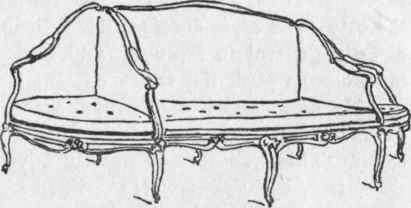
Canape Confident, By Radel, 1765
Cressent was much influenced by the styles of Claude Gillot and Watteau, who were also infatuated with le style chinois. Cressent always remained true to himself; and although progressive - he was always seeking for lighter and more varied forms - he was one of those artists who retarded in interior decoration the new Classic style (destined to be known as the style Louis Seize) that had dawned and was already influencing architecture.
The artist in whom style rocaille reached its greatest development was Juste Aurele Meissonnier (1695-1750), a native of Turin and a pupil of Boromini. When he crossed the Alps, the style rocaille, which originated in Italy, was already general in France; and Meissonnier was not the only one to push the fashion.
"He developed a style which was of Italian origin and very ancient, and the genesis of which was very complicated. This was already greatly advanced when Meissonnier arrived in France. He codified and strengthened these elements, thanks to his supple and charming genius, and to his talents as an architect; and he should not be held responsible for all the follies and weaknesses of his successors. However, it is certainly evident that around Meissonnier and two or three others - true masters of this genre - that a whole style of furniture and a whole system of decoration that held undisputed sway in France until about 1750 should be grouped." 1
1 Molinier.
Meissonnier was an architect, an ebeniste and a goldsmith. In his plates, which were chiefly engraved by Huquier, he gives plans and elevations for buildings and designs for furniture, lustres, candelabra, surtouts for the table, scissors, sword handles, knobs for canes and many studies for vegetables and foliage. The canape for the Count Bielenski and the salon furniture for the Princess Czartoryska are especially famous.
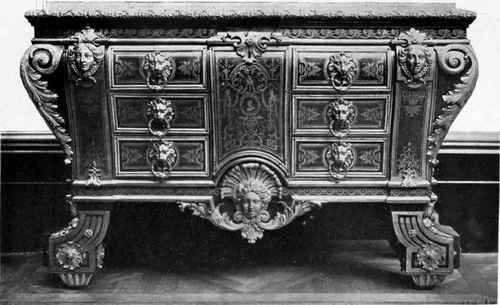
Plate XXVI - Commode by Andre-Charles Boulle Wallace Gallery
"The great Meissonnier had studied in Italy, and consequently was not one of us," says a writer of the day, "but as he had wisely preferred the taste of the Boromini to the wearisome antique taste, he had thereby come closer to us; for Boromini rendered the same service to Italy that we have to France by introducing there an architecture gay and independent of all those rules that were anciently called good taste. Meissonnier began by destroying all the straight lines that were used of old; he curved the cornices and made them bulge in every way; he curved them above and below, before and behind, gave curves to everything, even to the mouldings that seemed least susceptible of them; he invented contrasts, - that is to say, he banished symmetry, and made no two sides of the panels alike. Indeed these two sides seem to be trying to see which can deviate most and most strangely from the straight line." 1
After the death of Meissonnier, Antoine Sebastian Slodtz (about 1694-1726), son of an Antwerp sculptor, became chief designer to the King. Slodtz had worked in Versailles and married the daughter of Domenico Cuffi. It was natural, therefore, that the many sons of this marriage should inherit artistic talent. Some became painters, some sculptors and some were successively designers to the King. They are supposed to have worked together, had great influence on the styles of the day; and executed many pieces for royal palaces. They were followers of Meissonnier.
A large cabinet for medals and the encoignures now in the Bibliotheque Nationale, shows these brothers at their best.
These pieces were made by the cabinet-makers Gaudreaux, or Gaudereaux, and Joubert, respectively. The encoignures are particularly fine.
We now come to Jacques Caffieri, the fifth son of the Caffieri in the employ of Louis XIV., "sculpteur, fondeur et ciselear du roi" whose work was distinguished by grace and aristocratic elegance. Caffieri seems to have directed the making of a great deal of cabinet-work, and he made a great deal of bronze work for OEben.
"Some critics, struck with the comparative soberness of the earlier works of Jacques Caffieri, in which he seems to be an admirer of Robert de Cotte, and with the unbridled imagination of his later productions, in which he greatly exceeds the audacity even of Meissonnier, have conceived the idea that the latter may be attributed to Philippe and may have been produced during the seven years that he survived his father. It is perhaps unnecessary to go so far for an explanation that is founded on no document. The Italian birth of the ebeniste of Louis XIV. is quite enough to account for the eagerness with which Jacques Caffieri took up the style rocaille, which gave full scope to his extraordinary dexterity. In the end, he used completely to cover over the furniture he produced with brass decorations; his beautiful commode in the Wallace Collection is of an almost austere simplicity compared with the bureau in black lacquer of the Ministere de la Justice, the drawers of which are disguised in a complicated casing of copper, whilst the supports down to the very feet are nothing but drooping masses of flowers; or still more compared with the famous table with a set of pigeon-holes owned by the Metternich family of Vienna surmounted by a perfect pyramid of rocks and figures and with complicated supports without any wood in them at all. It would be impossible to go further in this direction; the art of Caffieri was the culminating effect, the final flare-up of the lavish style of decoration encouraged by the patronage of Louis XIV. and Madame de Pompadour, which charms in spite of its complicated extravagance." 1
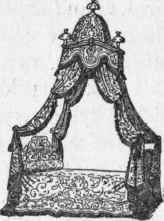
Louis XV. Bedstead

Plate XXVII - Mahogany and Gilt Mirror. Marot Style Metropolitan Museum
Continue to:


My Books

