


The Bed. Part 7
Description
This section is from the book "Furniture", by Esther Singleton. Also available from Amazon: Furniture.
The Bed. Part 7
The niche with its draped sofa-bed still continued popular; but the form of the bed changed. The grooved legs and posts were visible between the folds of the damask or velvet curtains; the canopy was generally circular, gilt or painted in light gray, and carved with garlands of flowers, rows of beads and rosettes, and brightened with lines of gold. The mattresses were soft, and the pillows and bolsters were down.
As a rule, the headboard and footboard of beds were alike if the bed was vu de face, that is to say, placed sideways against the wall, and of unequal size if vu de pied (seen from the foot), or placed in the corner. It is from this period that the latter kind, lit de coin, dates.
The head and footboard were left plain or covered. Sometimes they were painted or lacquered or of gilded wood or of natural wood ornamented with bronze gilt or moulu decorations. The use of veined woods gradually did away with covering the head and footboards.
The column seldom appears. When it does, however, it is very light (occasionally of iron) and covered with the same material as the curtains. The beds are draped in muslin, Persian, silk, etc., and trimmed with bows of ribbon, festoons, etc., etc. The canopies or baldachins are much smaller than the beds. Folding beds are not uncommon. In 1781, a bed in the form of a commode, garnished with copper, is offered; and in 1785 a French newspaper advertises "a pretty bed enclosed in a secretary made of mahogany, or moulu adornments, seven feet high and three and a half feet wide. In 1783 the Marquis de Vigean has a lit d'antichambre enclosed in a secretary, and in 1784 Madame Le Gras a "bed of crimson damask enclosed in an armoire en secretaire."
Sofas are so closely allied to beds that it is difficult in the last days of Louis XVI. to tell the difference between them. The draped sofa is described variously as lit de repos, chaise longue, duchesse, bcrgere, a la turque, a la polonaise, a la chinoise; and we even find plates labelled "sofa-bed a I'antique." The latter leads into the styles of the early Nineteenth Century.
The Cabinet des Modes from 1786 to 1790 gives examples of furniture that merge into the style of the Directoire. A bed in the form of a pulpit, and another called bed a la turque appear in the volume for 1786; and among the plates in the volume for 1790 there is a lit de la federation. At this period, when the boudoir had become a political cabinet, and the graceful pictures of Boucher and Fragonard had given place to coarse caricatures and prints and pictures for the destroyed Bastille, France reclined in antique armchairs and slept in "patriotic beds." The fasces of lances formed the bed-posts, and these were surmounted by the Liberty Cap. "She also slept," to quote from De Goncourt, "in the lit de federation of four columns in the form of fasces, grooved and painted in greyish white, varnished, with the stems of the fasces gilded, as well as the axes and iron supports of the canopy." The bed used during the Directoire period was larger than the Louis XVI. bed, but, generally speaking, it was somewhat low and supplied with a couple of mattresses. In some, headboard and footboard were of equal height; in others, only the headboard appeared.


Plate LXXXI - Seventeenth Century Italian Chairs and Sgabello Palazzo Mansi, Lucca
During the Empire, the beds were of mahogany ornamented with bronze trimmings (see Plate LXXVIL), or the frames were painted and decorated in imitation of bronze. Some of the beds were square, some were rounded and some were shaped like a boat and some like a shell. Some of them had pilasters that supported vases, busts, or statuettes. The typical bed, however, which lasted long into the century and which has never gone out of fashion, had a headboard and footboard of equal height and heavy scrolled ends. This is still known as the "French bed." The proper way to place it in a room is to have one side against the wall. At each end should be placed a bolster that follows the outline of the scroll. During the Empire period, curtains were hung from a canopy in the shape of a crown, or thrown with studied carelessness over an arrow. Sometimes the heavy curtains were draped over thin curtains of gauze or muslin.

Lit A Tulipe, Empire Style
Sheraton's beds are most elaborate. They include French beds, dome-beds, canopy-beds, state beds, alcove-beds, sofa-beds and field-beds, all in the latest styles in vogue on both sides of the Channel.
At first he follows the beds that were popular in France in the days of Louis XVI., and makes many varieties of the high-post and sofa-bed. The "sofa-bed" is, of course, the lit anglaise so fashionable in France, with its two ends alike and its two bolsters. "The frames of these beds," writes Sheraton, "are sometimes painted in ornaments to suit the furniture. But when the furniture is of very rich silk, they are done in white and gold and the ornaments carved. The roses which tuck up the curtains are formed by silk cord, etc., on the wall to suit the hangings; and observe that the centre rose contains a brass hook and socket, which will unhook so that the curtains will come forward and entirely enclose the whole bed. The sofa part is sometimes made without any back, in the manner of a couch. It must also be observed that the best kind of these beds have what the upholsterers call a fluting, which is done by a slight frame of wood, fastened to the wall, on which is strained in straight puckers some of the same stuff of which the curtains are made."
The lit a la duchesse he calls "Duchess, a kind of bed composed of three parts, or a chair at each end and stool between them. They are only intended for a single lady, and are, therefore, not more than about 30 inches wide. The chair ends, when apart, have the appearance of large arm or fauteuil chairs and the middle part may be used as a stool. The tester is made to fold. The arms of the chair part are dolphins and an acanthus spray ending in a scroll ornaments the back. The duchess is covered with a striped material, a square or round cushion is at each end, and the drapery is composed of two curtains falling from a kind of dome (ornamented by a pineapple or pomme) while a scarf is slipped through rings and forms a swag in front of the dome and two festoons at each side."

Bed By Sheraton, 1803
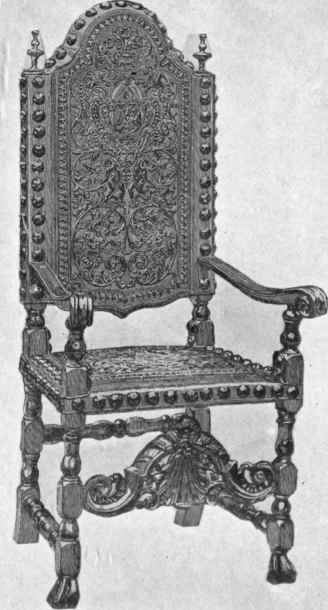
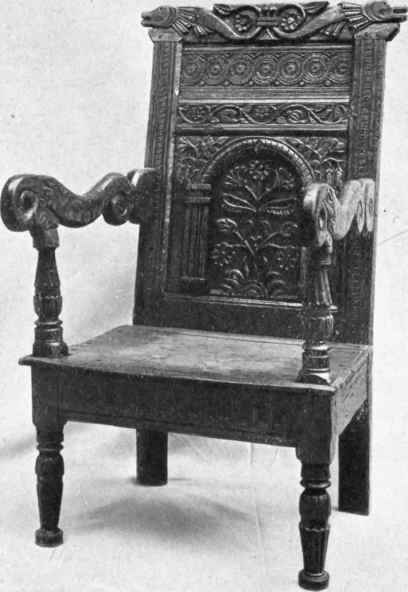
Plate LXXXII Seventeenth Century Chairs - Flemish Chair, covered with Leather, "Spanish Foot" Carved Oak, or Wainscoi Chair - Metropolitan Museum
Continue to:


My Books

