


XIII. Draperies For Bungalows
Description
This section is from the book "Home Furnishing", by George Leland Hunter. Also available from Amazon: Home Furnishing.
XIII. Draperies For Bungalows
ABOUT draperies for town houses almost everybody knows something; also about draperies for country houses that have windows of regular size and shape. But when it comes to bungalow draperies, uncertainty prevails.
Out of the hundreds of photographs of bungalow interiors that find their way into the editorial offices of Country Life in America, less than 5 per cent show draperies at all, and less than 1 per cent show suitable draperies. Evidently most people take it for granted that draperies are inconsistent with the simplicity that is supposed to characterize bungalows, or in searching for bungalow draperies have been unable to find anything they regard as suitable. Yet bungalows quite as much as any other type of residence need draperies to soften the hardness of wood and plaster and brick and stone, and to introduce the rich and warm and picturesque textures possible only in the products of the loom.
It is obvious that the Flemish, Arabe, Cluny, and Filet Italien laces appropriate for stately apartments, are out of place in a bungalow - even a pretentious one. A bungalow stands for informality just as definitely as does a log cabin. And just as the colors and the cut of golf and tennis and yachting costumes are less conventional than those of evening clothes, so in the clothes worn by the windows and connecting doorways of bungalows there is unusual opportunity for homespun and chintz effects.
I think every one will agree with me that bungalow draperies should be characterized by coarseness of weave and roughness of texture, as well as by strength and solidity and intensity of color. The bungalow is no place for French grays and pinks and pastel effects. It is a place for stained-glass and shadow (warp-printed) effects in iridescent tones that flash like a kaleidoscope, and glow like fires made with ocean driftwood. Above all, it is a place for warm tints and mellow colors.
Such effects are easier to describe and long for than to obtain, especially if the expenditure be limited. Such effects enable weavers and dyers of the newest school to ask and get prices that cause the merchandise dealers to wonder. Such effects take one back to the wonderful fifteenth century when tapestries and brocades were heavy with gold and silver, and rich with the individuality of the maker.
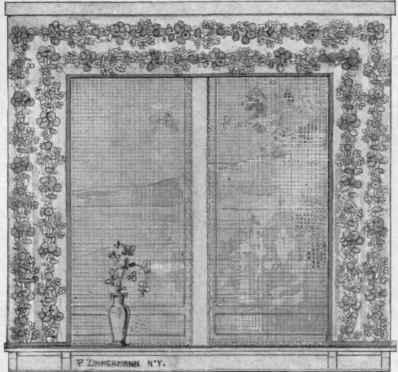
1. Treating two windows as one, by framing them in a luminous Dutch print.
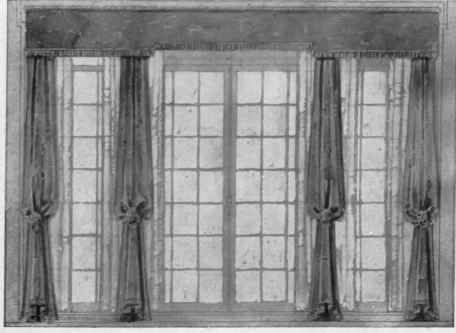
2. A group of casement windows, with over-draperies of silk monk's cloth and draw-curtains in striped net with diagonal mesh.
The nearest approach to such effects in cotton and linen prints are the reproductions of English eighteenth-century hand-blocked prints - reproductions printed from the ancient and original blocks in all-over patterns, where every inch of the surface is packed with fruit and leaves that glow with autumn golds and browns. They are expensive, but they come 50 inches wide and can be split for the narrow side draperies that suit many bungalow windows.
Still more expensive - $ 3.50 a yard - are the 50-inch shadow silks that excel in iridescence and drape back most gracefully where the introduction of curves is desirable. Other rich silk draperies are the grenadines and the tapestries. Less expensive silk draperies are the shikiis plain and broche, the brilliants plain and broche, the Colonial prints, and the Bagdads. One of the shikii type is Algerian silk, 50 inches wide, at $ 1.70. Shikii brocade in bold relief is $ 1.80 a yard. Kaneko stripe has a basket-weave ribbon on shikii ground - a most unusual contrast of irregular textures. Punjab silk is a crepe effect in splendid colors - especially the reds and browns. Tussah broche is $ 3.75 a yard. Monk's cloth, 50 inches wide, at $1.50 a yard, is what the name implies, a very rough, plain fabric - for some places superior to anything else woven. It must be seen to be appreciated. The Colonial prints, 31 inches wide at $ 1.40 a yard, are reproductions of the old black prints that had tiny figures - rosebuds and butterflies and little blossoms swarming thickly over the surface - another find for the person with individuality who is looking for means of expression in the form of individual draperies.
But some of my readers at this point, I fear, are beginning to say to themselves: "All these things are too expensive to be practical for our purpose. We want results for little money."
Of course, to the indictment I must plead guilty. I did start at the upper end, because at the upper end the range of qualities is wider. Thus I have been enabled to get a background against which to display very inexpensive textiles that, without such backgrounding, might seem tame and uninteresting.
Plain nets and scrims in ecru and coffee colors, and also in reds and greens and browns, make up into excellent bungalow draperies. But better still are the cross-bar and lattice-work effects - woven like the nets on the lace-curtain machine. One of the best is the simplest of all - just square lattice-work of tiny open rectangles, framed by-narrow intersecting bands of lace. Either in white or ecru 45 inches wide it is only 20 cents a yard - and a little more in color. Another of these lattice-work lace nets has diagonal meshes - 43 inches wide at 32 cents a yard; another oval meshes - 45 inches wide at 25 cents a yard; another with large diagonal meshes and half-inch vertical stripes, imported - 48 inches wide at 55 cents a yard; other imported ones from 31 to 60 inches wide in great variety of yarns and textures range from 65 to 75 cents a yard.
Continue to:


My Books

