


XVII. Domestic Tapestries
Description
This section is from the book "Home Furnishing", by George Leland Hunter. Also available from Amazon: Home Furnishing.
XVII. Domestic Tapestries
IN its broadest sense, tapestry includes all fabrics - woven, painted, printed, embroidered - used to clothe and adorn walls and floors. In its narrow and special sense, it denotes the product of high warp and low warp looms.
In this chapter the term will be confined to machine loom and jacquard drapery and upholstery stuffs, all of which it covers in a general way, though also employed especially to designate ribbed imitations of verdure and picture arras and gobelin.
During the past five years a great advance has been made in the manufacture of domestic tapestries. Once they were notable for ugliness and stuffiness. A generation ago chenille portieres and couch covers were the staple stock of shops that supplied furnishings for the home.
To-day the extra heavy weaves are a drug on the market, and at windows openwork weaves are taking the place of those impervious to light and air - especially in country houses, seaside cottages, and mountain bungalows, and most of all in city flats and apartments with their small rooms and scanty outdoor exposure. To-day there is less attempt to imitate in inexpensive materials the elaborate effects that are appropriate only for palaces. To-day both demand and supply are turning toward simple, unconventional patterns suitable for expression in cotton on machine looms, and for use by families of limited income.
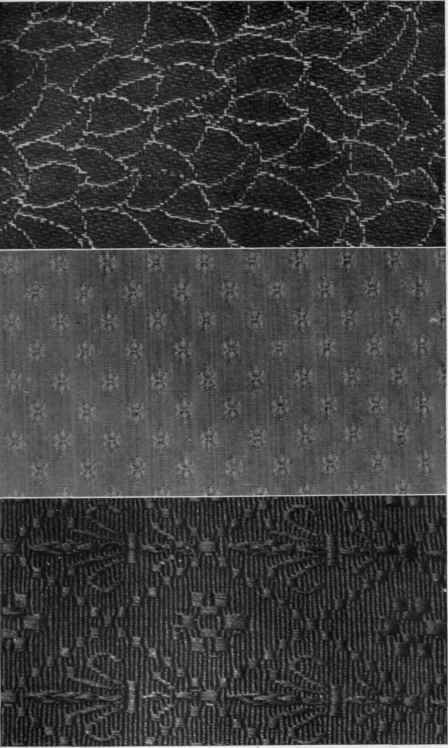
1. Tapestry at $ 1.00 a yard.
2. Armure at i.io a yard.
3. Armure at 1.70 a yard.
Probably the most important element in accomplishing the change has been the perfection of the mercerizing process, and the discovery that mercerized cotton can be dyed both sun-fast and tub-fast - fast against both light and water. As long as mercerized upholstery and drapery goods were sold merely as imitations of silk, it seemed impossible to surround them with a distinctive halo; but as soon as a Scotch firm began to advertise "sundour" madras and other cotton draperies, the bogie was stilled, and customers became willing to pay from 10 to 15 per cent more for mercerized than for unmercerized cotton. The silkiness and more attractive appearance of the mercerized stuffs have, of course, played an important part in changing the attitude of dealers and the public; but it is the guarantee given by the foreign and domestic makers which caused that attractiveness to become effective in producing sales. One of the guarantees reads:
"These goods are guaranteed absolutely fadeless. If color changes from exposure to the sunlight or from washing, the merchant is hereby authorized to replace them with new goods, or to refund the purchase price."
The tub-fast quality is quite as important as the sun-fast quality. It means that the laundress supplants the expensive dry cleaning process for unlined curtains and portieres. It means that dust and dirt lose half their terrors for the housekeeper.
Another change in domestic tapestries is the decline in the demand for made-up curtains and portieres. The introduction by architects of smaller windows, and of windows of irregular size and shape, calls for smaller draperies, and even on large windows and windows of conventional size and shape, the tendency is toward the use of narrower and shorter hangings. This is a matter of serious concern to some of the lace-curtain manufacturers, and it has even been suggested that they should appeal to American architects to construct windows easier to fit with ready-made curtains.
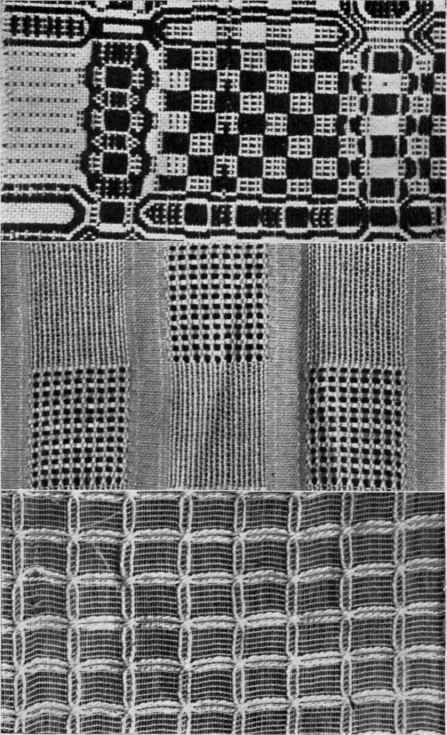
4. A Colonial couch cover for $6.00.
5. Ashley net at $ 1.50 a yard.
6. Russian net at .85 a yard.
Of the tapestry curtains now sold by the manufacturers, the common size is 50 inches wide by 8 feet 3 inches long (eleven quarters).
Particularly in madras, that shows to best advantage when the light shines through it, is sun-fastness desirable. It removes the chief defect that has always prevented the more general use of madras. The variety called Cerean cloth, in heraldic and modern designs, and in an extensive line of colorings, some with black and some with self-toned ground, sells at 80 cents a yard 32 inches wide, and $1.25 a yard 50 inches wide. The same cloth, plain, is from 50 to 80 cents a yard 32 inches wide, and from 80 cents to $ 1.25 a yard 50 inches wide.
Then there are sun-fast damasks at from $2 to $4.25 a yard; armures from $ 1.10 to $ 1.30; reps plain and moire from $ 1.20 to $ 1.35; tapestries from $ 1.90 to $2.25; velours strie at $ 3.50; double-faced flax velours at $2.60.
Among the made-up curtains are Venici damask at $ 12.50, and fancy velours curtains with armure back at $ 15. Interesting couch covers in needlework effects are those copied from the one in Paul Revere's bedroom, and sold 60 inches wide and 3 yards long at $6 each.
Among the open-work weaves of delightfully irregular texture are Russian net and Ashley net, the former at 85 cents, the latter at $ 1.50. The former has a madras ground (warp threads twisting in pairs around the wefts), with lattice work formed by pairs of very coarse threads. It comes in a range of colors as well as natural. Ashley net has open-work blocks on the madras principle, alternating with blocks in plain weave, and between-stripes also in plain weave but finer. It drapes most gracefully.
In some respects most interesting of all is Dutch linen at from $ 1.40 to $ 2 - a mercerized linen with detached broche figures in mercerized cotton that stands out boldly like embroidery. It is especially recommended for pillow and slip covers, but would also make up into bright and attractive summer draperies. The motifs are of the modern straight-line type. It also comes with broche stripes and in a Louis XVI rose basket pattern.
Continue to:


My Books

