


XXI. Art Pottery
Description
This section is from the book "Home Furnishing", by George Leland Hunter. Also available from Amazon: Home Furnishing.
XXI. Art Pottery
FASCINATING are the forms that clay assumes on the potter's wheel - forms that fire makes permanent. Fascinating, too, are the elusive colors with which accident and intention diversify the surface of pottery; and, when the opportunity for expression is seized by a master, the result is classic Wedgwood or modern Rookwood.
To some persons, art pottery is a term that designates the shapeless extreme and the amateur experiment. They associate it only with the exhibits of beginners and dabblers in the arts and crafts. They regard it as something that appeals peculiarly to the faddist and his followers, and are of the opinion that plain everyday people would do well to let it alone.
Art is a dangerous word. The ignorant use it too much: the cultivated use it too little. To describe anything as an art product introduces doubt into the mind of the connoisseur; so familiar are we with the art supplements of newspapers and magazines, and with art shops and the art departments of large stores. And the manufacturer who makes a bad copy of something good almost invariably tries to lift it from fake to fact by means of the prefix, ART. Such is always the fate of the genuine. The more worthy an object is of imitation, the more likely it is to be imitated; which is why we have retained the word art in the title of this article. Man makes many things that are not art. Utility often blinds him to the value of beauty.
The exigencies of machine construction seem to compel shapes that are ugly. Art implies skill and beauty. It is the raw material of nature, shaped and made individual by human hands. It is inspired craftsmanship, tapestry or carving or pottery that meant something to the maker and that means something to the owner.
Take Rookwood pottery for instance. The shapes are beautiful and grew out of the natural tendencies of the clay. This is an important point. It is of course possible to imitate, in clay, designs that the carver originated on wood, or the smith on iron. But the result is never more than imitation; it lacks spontaneity and character. It is no more real than is the mahogany made by staining birch with mahogany stain. Rookwood pottery is genuine through and through. Shape and surface, design and color, are produced in American clay by methods that conform to the nature of the material, and take advantage of all its possibilities.
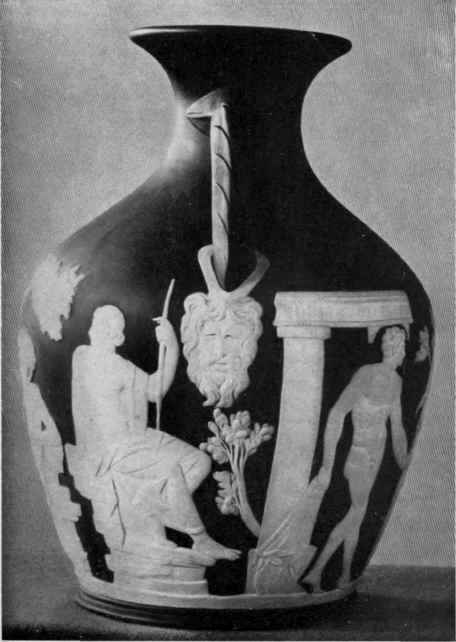
The most beautiful and valuable vase in the world, the Portland vase in the British Museum.
The illustrations indicate what the pieces themselves show definitely - that the designs are first, last and forever, clay designs, conceived and executed in terms of clay. The shape of a handle, the swell of a dome, the neck of a vase, the onlay of leaves and flowers in relief - all are done in the manner of the potter. If you would get hold of the full significance of this, watch the potter at work; or, better still, play potter yourself. What you create may be valueless, but what you learn will be invaluable. Herein lies the importance of the arts and crafts schools, and of arts and crafts in the public schools.
It is not part of my plan in the present short chapter to discuss mats and glazes, or by definition to separate porcelain from other pottery, or to discuss and differentiate the different makes. But I would call the attention of my readers to the wonderful colors and tints and shades that are attainable in clay. Peculiar to clay are many of these color combinations. There are gradations of tone that cannot be secured by workers in glass or metal or wood or wool. Mysteriously they lurk beneath the surface, revealing themselves partially and in infinite variety. They are born of clay, and in clay only can they be materialized.
Marvelous was the art of the ancient Greeks and Romans. In statuary and architecture they attained a pinnacle of perfection that we moderns have not yet reached, and may never reach. In the lesser arts they also excelled. Wonderful were their accomplishments in tapestry and embroidery and bronze and wood and pottery. To the classic arts were due not only the Italian Renaissance of the fifteenth and sixteenth centuries, but also the classic revival of the latter half of the eighteenth century, that was consequent on the excavations of Pompeii and Her-culaneum.
The single object that had the greatest influence on modern pottery Was the Barberini or Portland vase, so named from the families that successively owned it. It is now in the Gem and Gold Ornaments Room of the British Museum, and is not surpassed in beauty, or value by any vase in the world. It is about ten inches high and twenty-two inches in circumference, with figures in snowy cameo on a dark-blue ground.
In 1790, twenty-four reproductions of it were made by Josiah Wedgwood in his famous jasper ware, after four years of patient experiment. This period was of extreme importance in the history of Wedgwood's development, and in the history of art pottery.
According to Wedgwood, the Portland vase pictures the Eleusinian mysteries, and dates from the age of Phidias and Polyclitus - the golden age of Greek sculpture and relief work.
A facsimile of it in the original materials was made by John Northwood, of Stourbridge, England, in 1877. This facsimile is to be placed in the British Museum beside the original.
The beauty of the vase is striking, even in our illustration, that lacks color. So exquisite are the proportions and composition of the figures that it is no wonder the artist sought inspiration here. And if the modern artist works along other lines, it is because he cannot, along these lines, accomplish results that are equal. Not that the Portland vase represents the be-all and end-all of plastic design, far from it. In different countries, in different periods, thousands of types of pottery and porcelain have been produced, owing nothing to Greece or Rome, and yet perfect as forms of artistic expression. China alone has filled the world with the product of her potteries, and from Chinese porcelain came the inspiration that established royal manufactures of porcelain in the principal countries in Europe. From China and Japan, to-day, come shiploads of pottery and porcelain, much of which deserves the name of art pottery. This is true of the coarse and unglazed ware quite as much or even more than it is of the elaborately decorated and hard-finished pieces.
Continue to:


My Books

