


Brackets Hanging Shelves Fire Screens Beds
Description
This section is from the book "How To Collect Old Furniture", by Frederick Litchfield. Also available from Amazon: How To Collect Old Furniture.
Brackets Hanging Shelves Fire Screens Beds
Field Beds Sweeptops for ditto Tea Caddies Tea Trays Card tables Pier tables Pembroke tables Tambour tables Dressing glasses Dressing tables and drawers Candle stands Lamp stands Pier glasses Terms for Busts Cornices for Library cases Wardrobes, etc., at large Ornamental tops for Pier tables, Pembroke tables, commodes, etc.
In the plainest and most enriched styles with a scale to each, and an explanation in letterpress." It will be seen that this is a fairly complete list, and the designs themselves are in excellent taste.
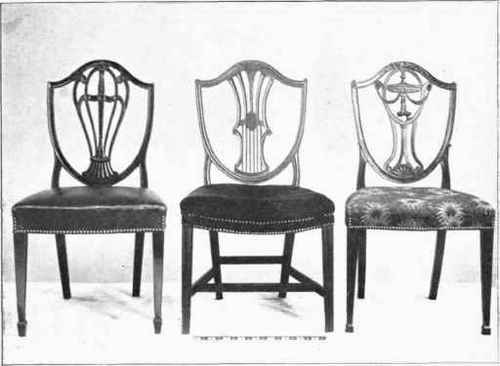
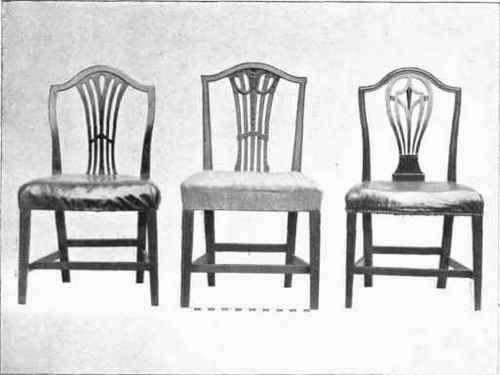
ENGLISH (HAIRS LATE EIGHTEENTH CENTURY.
The lines of chairs and sofas are restrained and dignified, neat but not effeminate, chaste and yet not severe. Where marqueterie is employed as a decoration, it is as a rich border to a plain centre, or an oval centre fan ornament with a festoon of husks or drapery. The drawings show that Hep-pelwhite was careful to use richly-figured veneers for his tables, wardrobes or bookcases, and other pieces having plain surfaces.
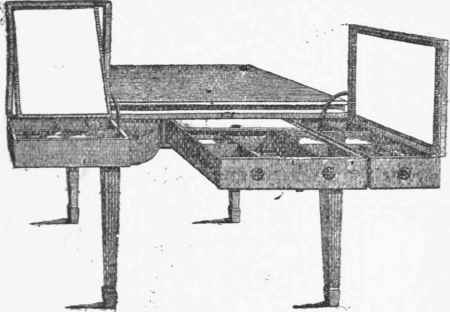
"rudd's table," by a. heppelwhite.
The illustration given above of Rudd's table, or "a reflecting dressing table" is fully described in Heppelwhite's book, as taking its name from a "once popular character" for whom it was first made, and will convey to the reader an excellent idea of the mechanical tables in fashion at this period.
Generally speaking, one sees that the furniture of Heppelwhite was designed for the houses built by Robert and James Adam, who at this time were designing some of the London streets, which remain as testimony of the good taste which marked their work. Stratford Place, part of Fitzroy Square, Adelphi Terrace, parts of Portman Square, Portland Place, and other important thoroughfares, can still be identified by the refined treatment of exterior as well as interior decoration.
Besides the furniture of mahogany, solid and veneered, and of satinwood and marqueterie, Heppelwhite also devoted considerable attention to making furniture in beech and birch woods for enamelling and painting, and in his book directions are given as to the best kind of covering for such furniture.
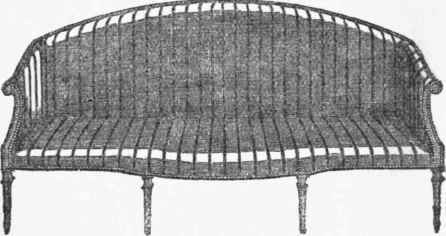
A COUCH, BY A. HEPPELWHITE.
Some chairs by this maker are in the Victoria and Albert Museum, andare reproduced in thefull-page illustrations of this chapter. Some of the smaller illustrations given in the text have been selected as showing a few of the many designs in his book.
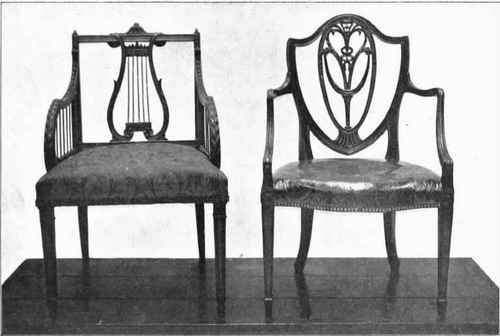
CHAIRS ATTRIBUTED TO HEPPELWHITE.
The couch illustrated on page 84 is in every respect an adaptation of a French Louis Seize design, while the window seat and the screens are dainty pieces of decorative furniture, characteristic of the period and the style of this firm.
The "eared armchair" was made by many other upholsterers and cabinet makers of the period, and under the title of a "grandfather's chair," has been much reproduced during the present revival of the taste for old English furniture.
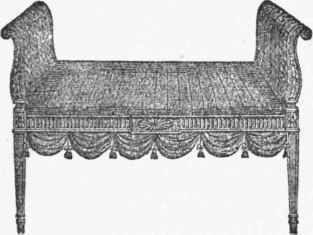
A WINDOW SEAT, BY A. HEPPELWHITE.
A. Heppelwhite and Co. style themselves cabinet makers on the title-page of their book, but it is curious that the name does not appear in the London directories of the time, and still more strange that, in what purports to be a complete list of master cabinet makers and kindred trades compiled by Thomas Sheraton and placed at the end of the "Cabinet Dictionary," which he published in 1803, the name of this firm is not included. Thomas Chippendale, Robert Gillow and Co., Mayhew and Ince, Snell, Seddon and Co., and a great many others are there, but not Heppelwhite. It almost seems as if they were like Sheraton himself, more theoretical than practical; or they may have worked exclusively for architects such as the Adams, and had no regular show-room for the public. Unlike Chippendale's book, which gives his address, and also includes in the preface certain personal statements as to his ability to carry out any of the designs illustrated, the Heppelwhites give no address, nor is there a single sentence which indicates a desire to secure increased trade by the publication of their designs.
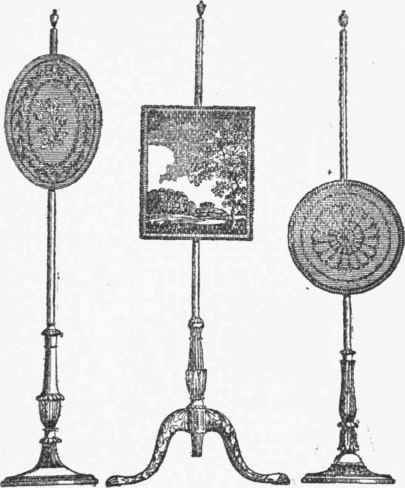
POLE SCREENS BY HEPPELWHITE.
The omission of the name in the directory I attach less importance to, than that from Sheraton's list, because the "London Directory" of the years referred to are very thin books of not much over half an inch thickness, and include what the compiler terms "eminent" bankers, merchants, and tradesmen, and many names in Sheraton's list are not to be found amongst the "eminent" ones of the directories.
Continue to:


My Books

