


Furniture Of The Renaissance. Continued
Description
This section is from the book "How To Collect Old Furniture", by Frederick Litchfield. Also available from Amazon: How To Collect Old Furniture.
Furniture Of The Renaissance. Continued
To the sixteenth century also belongs the cas-sone or marriage chest, of which there are some good examples in the South Kensington Museum, and just as the cabinet had its prototype in the classic temple or gateway, so was the Italian cas-sone an elaboration of the antique sarcophagus. In Venice it was richly carved in walnut wood with Raphaelesque scrolls, and ornamented with the armorial bearings of the noble family whose daughter was to be married, or it was carved and gilded, and on the gold ground was painted a reproduction of a classic frieze, or the representation of some historical event. In Milan it was of ebonized or brown wood inlaid with ivory; but whatever the form of enrichment and elaboration, the antique sarcophagus was the prototype.
Tables for the first time in the history of woodwork became more general as complete articles of furniture, made of wood, and elaborately carved and inlaid. In the fifteenth century, with few exceptions, the table for meals had consisted of an arrangement of boards and trestles, and we have some reminiscence of this movable kind of table in the expression, "a seat at the board," in our language of to-day. Some of the illustrations will show sixteenth-century tables of Italian workmanship, and in England we had the "drawinge" table, which in the chapter on Jacobean furniture has received more detailed description.
Until the sixteenth century was well advanced the chair had been a kind of throne or state seat used by the master of the house, the seigneur or lord, or for his honoured guest; in cathedrals, abbeys and churches for the bishop, the archbishop or the abbot, and in palaces for the king and queen. As we have remarked upon the expression of "a seat at the board," so that of "taking the chair " is clearly a survival of a time when the chair was the place of honour. Gradually the chair became an article of domestic furniture, and as rooms were of smaller dimensions and the life of the people more social, chairs became more numerous and more ordinary. The upholstered seat and back with padded arms were all of later date; in the sixteenth century they were made of wood with a loose cushion attached by strings.
Pictures were framed, and mirrors, which were now of larger size than formerly, became ornamental as well as useful articles of furniture in a house.
Rome, Florence, Venice, Milan, Ferrara, Urbino, and other Italian cities produced richly carved furniture, cabinets, tables, chairs, caskets, cassoni, mirror frames and bellows of elaborate design and beautiful execution.
In France under Francis I the Renaissance: movement found great encouragement. An Italian architect was employed to build the new chateau of Fontainebleau, and Leonardo da Vinci and Andrea del Sarto came from Italy to decorate the interior.
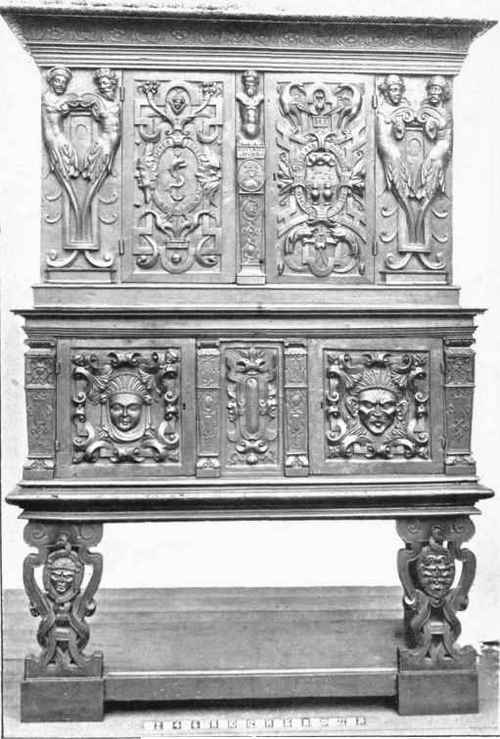
FRENCH RENAISSANCE CABINET IN OAK SIXTEENTH CENTURY (HENRI II).
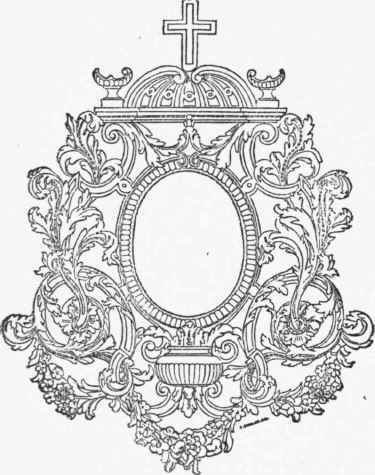
VENETIAN MIRROR, SEVENTEENTH CENTURY.
The courtiers and nobles followed their king's lead, and their chateaux were decorated in the new Italian style. Chimney-pieces, which in the preceding century had been of stone, were now made of oak elaborately carved with columns and pilasters, arched recesses and armorial bearings. The Prie-dieu chair, which had formerly been used only in the private chapel of the castle, became more common, benches or sieges and bancs were carved and ornamented, and with the buffet and armoire, formed part of the furnishing of a nobleman's residence. The Musee Cluny contains numerous examples of French furniture of the Renaissance period.
The Netherlands and Spain followed suit. The Flemish craftsman excelled in the art of carving; both he and his Spanish contemporary added a realistic effect by colouring the faces of their figure-work with colours au naturel. In the Netherlands, as in France, oak was the favourite wood, but ebony, cypress, cedar and other woods were used; while in Spain chestnut was the more usual vehicle for the carved design. Inlaid patterns were enriched by plaques of ivory, agate, and rare marbles, and hinge and lock plates, with elaborate keyhole mounts of beautifully wrought silver and steel, were added.
In England the adoption of the Renaissance was of slower growth. Holbein and John of Padua came to England under the patronage of Henry VIII, and were apostles of the new style, but the Gothic died hard in this country, and during the transition period, which lasted until the time of Queen Elizabeth, we had a mixture of Gothic ornament and Renaissance design which has come to be known as the Tudor style. The older portions of Hampton Court Palace built by Cardinal Wolsey, (not the later portions designed by Sir Christopher Wren in imitation of the Palace of Versailles), and the fine Halls of Oxford, were erected about this time, and show the mingling of the Gothic and Renaissance styles. The oak panelling, which we to-day know as the linen pattern because it represents in carved wood the convolutions of the linen napkin, is of this period.
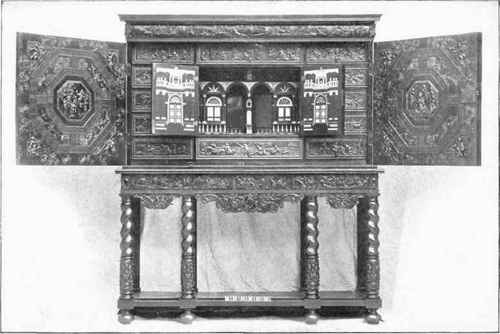
FLEMISH RENAISSANCE CABINET CARVED IN EBONY LATE SIXTEENTH CENTURY.
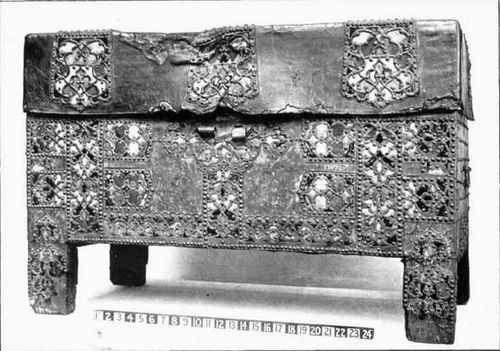
GERMAN RENAISSANCE COPPER SIXTEENTH CEN TURY.
Written descriptions of furniture are difficult to make clear and intelligible, but some of the illustrations selected will serve to show the kind of Tudor woodwork which was in favour during the reign of Henry VIII.
What are known as "Livery cupboards" were first made in England in the early part of the sixteenth century. They were service cupboards used for drinking cups, which were hung on hooks, and a ewer and basin were part of the equipment for the cleansing of vessels after use.
As the century advanced, and during the reign of Elizabeth, all trace of the Gothic influence vanished, and carved and ornamental woodwork became more ambitious, less restrained, and even riotous. We find the large acorn-shaped ornament as a member of the leg of a carved table, or the pillar of a four-post bedstead; the high oak carved chimney-pieces are full of ornament, and the panelling of rooms is enriched by fluted pilasters with carved capitals. A favourite design was the interlaced riband or "strap work," much used in stone, in the exterior ornamentation of houses, and also adopted by the carver in his work on panelling and furniture.
This over-elaboration of ornament during the latter part of Elizabeth's reign in England corresponds to the later Renaissance in France in the time of Henri Quatre, where a similar decadence from the canons of good taste took effect, as a falling away from the purer style of Francois Premier and of Henri Deux.
There are in London several excellent examples of Elizabethan panelling which, although of easy access, are seldom visited, and these are well worth the reader's attention. The Hall of Gray's Inn with its minstrels' gallery, the magnificent Hall of the Middle Temple just out of the Strand, also that fine old monument of Elizabethan days, and the reminder of Thackeray's dear old Colonel Newcome, the Charterhouse, in Aldersgate Street. These valuable relics of sixteenth-century work can all be seen without trouble or expense by any London resident or visitor, and will give a better idea of the oak-work of the Renaissance in England than pages of written description.
Throughout Europe the latter part of the sixteenth century showed' deterioration from the commencement of the great Renaissance movement, as designers moved farther away from their original classic types, and allowed ornament to become less restrained, less subsidiary to lines of construction, more fanciful and less reasonable.
To the period of late Renaissance belongs the manufacture of silver furniture. This was made in Spain and Italy for the churches, and in Germany, at Augsburg and other cities, where the silversmith flourished, and executed the commands of ambitious German princes. The famous folding-chair of wonderfully wrought steel, which is now at Longford Castle in Wiltshire, belongs to this type of furniture, and was made at Augsburg.
The fine table and pair of torcheres at Knole are of solid silver, and bear the hall-mark of the reign of James II.
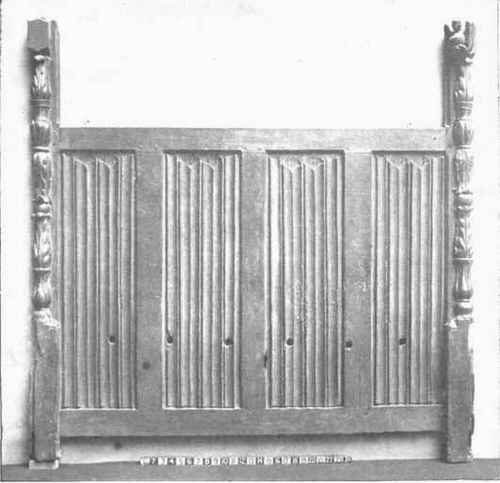
ENGLISH, END OF BEDSTEAD IN OAK.
(SHOWING LINEN PATTERN panels).
SIXTEENTH CENTURY (EARLY TUDOR STYLE).
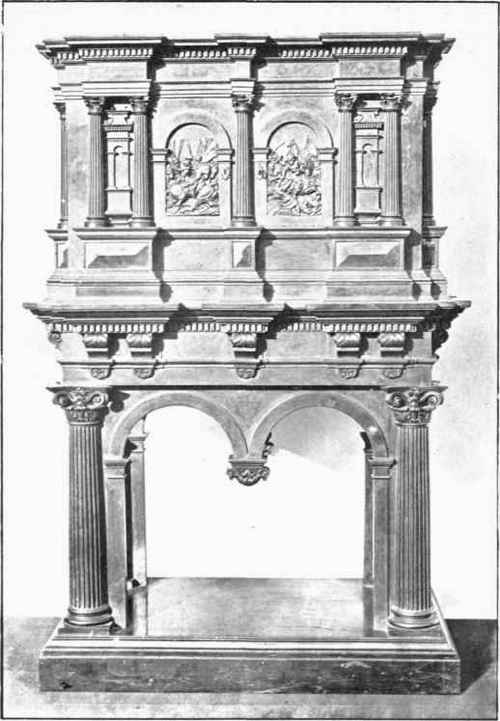
ENGLISH RENAISSANCE CABINET SIXTEENTH CENTURY.
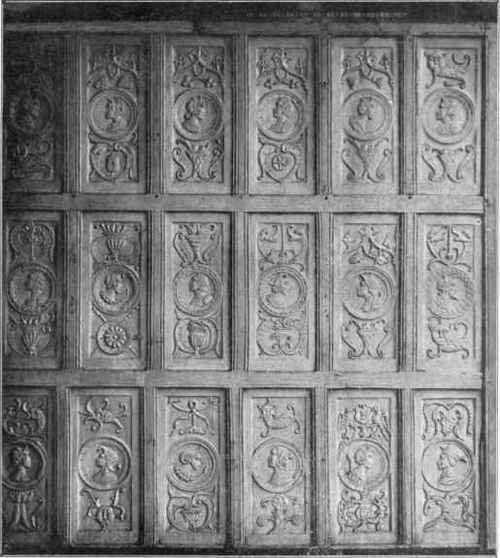
ENGLISH RENAISSANCE PANELLING OK CARVED OAK.
FROM AN OLD HOUSE AT WALTHAM SIXTEENTH CENTURY.
Continue to:


My Books

