


Chapter II. Archaic Rarities
Description
This section is from the book "Old Oak Furniture", by Fred Roe. Also available from Amazon: Old Oak Furniture.
Chapter II. Archaic Rarities
WE know very little of the earliest methods of the construction and decoration of wooden furniture and domestic appliances. England, perhaps from the corroding nature of her climate, possesses fewer archaic rarities of this kind than most other countries. Some fragmentary specimens of Anglo-Saxon workmanship that survive give us a fair, though imperfect, insight into the arts and crafts that were practised before the Norman Conquest. The earliest of these is probably the coffin of St. Cuthbert, which is to be seen in the Cathedral Library at Durham. The history of this coffin is an interesting one. It is known that the Northern saint was buried in a.d. 688, and his body disinterred eleven years afterwards, in order that the remains might be deposited in a wooden coffin to be placed in a shrine within view of the public. In later times the Anglo-Saxon church in which the shrine stood was superseded by a Norman structure of greater pretension, and in 1104 the coffin and remains were translated thither. This building was the earliest stage of what we now know as Durham Cathedral. Several particular descriptions by Norman writers of the coffin and its appearance have been preserved.
From the day in which these accounts were written until the time of Henry VIII. the bones of the saint lay undisturbed, and were worshipped reverentially by thousands of pilgrims.
In the year 1542 the visit of the Royal Commissioners caused the monastic treasures to be scattered, and the coffin of St. Cuthbert was opened by desecrating hands for the purpose of gazing on the body of the saint. The remains, with the fragments of the Saxon coffin, were then enclosed in a large iron-bound chest and buried beneath a marble slab, around which may still be seen the grooves made by the constant wear of pilgrims' knees.
In the year 1827 the slab was again raised by the order of the Dean and Chapter, when, in the stone grave beneath, and almost filling up the space, the iron-bound chest, made in the time of Henry VIII., was found. Within it were two more coffins, the innermost of which bore runic inscriptions and rude representations of saints, and contained, amongst other things, a skeleton habited in the decayed remains of vestments of the church, some sacramental relics, and a gold cross, which are actually mentioned in the Norman description already referred to. The chain of evidence is very remarkable, but too long to enter into here. As described and followed up by Dr. Raine, who was a witness to the proceedings in 1827, it affords one of the best authenticated records which could possibly be cited. A new coffin was made after this latter examination, the bones of the saint being placed therein and reinterred. The cross and other ornaments were preserved in the Chapter library, but the coffin, which is perhaps the most interesting of all the relics connected with the saint, was put in a cupboard and forgotten!
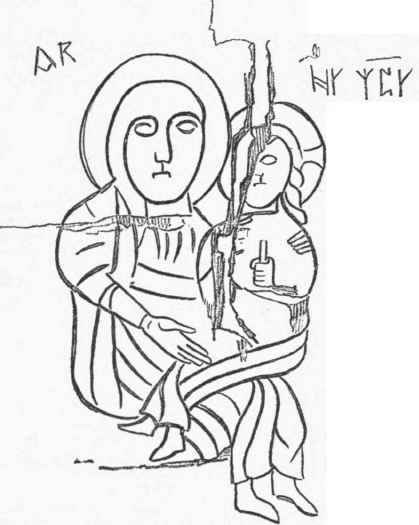
INCISED CARVING OF VIRGIN AND CHILD ON ST. CUTHBERT'S COFFIN, DURHAM.
Some few years ago an examination was made of the contents of the cupboard, and among a heap of decayed wood, which somewhat resembled coarse snuff in its consistency and colour, were found fragments of the Anglo-Saxon coffin. At first the reconstruction of these seemed a hopeless task, runic inscriptions, heads crowned with the nimbus, and portions of figures being mingled in apparently inextricable confusion, but, fortunately, a resident in the city, Mr. W. G. Footit, an architect, and an antiquary of great intelligence, had both the ability and the patience to grapple with the difficulties, and undertook the task of piecing the fragments, with the result that a fairly perfect reconstruction of the coffin on its original lines may now be seen. We possess amongst our archaic treasures certain horn and whalebone carvings of approximately the same date, but St. Cuthbert's coffin is probably the only carving in wood of the seventh century remaining within the length and breadth of the land. It may be added that the sixteenth-century iron-bound coffer which contained these relics is placed in the castle buttery, where it may still be seen by the curious.
The Venerable Bede died at Wearmouth a.d. 735, and in the church at Monkswearmouth is a decaying chair of rude workmanship which is said to have belonged to him. The workmanship is so barbarous, there is such an absolute deficiency of detail, that it is well-nigh impossible to assign a date to it, but the slope of the crumbling arms suggests a likeness to the coronation chair in Westminster Abbey, and it may be within the range of possibility that the Wearmouth chair is only the rough production of a country carpenter, while the other specimen is the work of the accomplished craftsman of the city, both belonging to the early Gothic period. People are very apt to attach a circumstantial history and a spurious date to pieces of furniture which remain in the haunts or dwellings of the great departed. As an instance of this absurdity it is only necessary to refer to the celebrated Wycliffe chair at Lutterworth Church, Leicestershire, in which the reformer is actually said to have expired.
Wycliffe died in 1384, while the chair is unmistakably a seventeenth-century Jacobean production ! Such popular fallacies regarding noted pieces of furniture are not confined to the more archaic examples, but extend to every period and every type, and of this some very pertinent instances will be detailed in a subsequent chapter.
To return to Anglo-Saxon antiquities, there is a whalebone box in the British Museum which is perhaps one of the greatest treasures of the kind. About this box much discussion has taken place. It is ornamented with carvings, surrounded by inscriptions in runic, which George Stephens, the well-known authority on Scandinavian antiquities, and the late Rev. D. H. Haigh, have deciphered. This inscription points to the box having been made at Ferry-hill, in county Durham. It is worth while remarking that, while Roman letters occasionally appear amongst the runes incised upon St. Cuthbert's coffin, the inscription on the whalebone box is wholly runic. The carvings on this relic represent scenes of Christian history strangely mingled with pagan tradition; but what should be noticed is the nasal-shaped conical helmet and tegulated coats of mail which appear upon some of the figures, and indicate Northern influence. Though this casket is made of whalebone, and not of wood, it is expedient to refer to it to indicate what may have been done in the way of decoration in its day.
Of wooden Anglo-Saxon coffers, or, indeed, of Norman, we have now no known specimen remaining. Several receptacles of the kind known as 'dugouts' exist in different parts of the country, notably one in Wimborne Minster, and are popularly assigned to Saxon times; but in several cases small details of ironwork tend to prove that these are not nearly so ancient as supposed, and belong most probably to the sixteenth century. The popular misconception that an article exhibiting very crude workmanship or excessively worm-eaten and dilapidated must necessarily be of venerable age should be carefully guarded against, for it is a fruitful source of error. The connoisseur who gives sufficient attention to small details, both in woodwork and its iron attachments, will often discover obscure evidence which will enable him to date approximately the object.
These 'dugouts,' which are constructed from the solid log, roughly squared with the adze and hollowed with the gouge, no doubt have an extremely ancient origin, but most of the specimens which remain to us can be proved to have no very great antiquity. The chest of St. Beuno, an ancient British saint, in Clynog Church, Carnarvonshire, is one of the most ancient, and is probably the earliest coffer of that or any other kind in the whole kingdom.* In the case of this receptacle, the lid (of small size) is made to fit into an opening in the upper surface of the log, whereas in other specimens the lid is mostly formed of the half longitudinal section of a tree, the convex surface being uppermost when the coffer was closed. The modern word 'trunk' no doubt had its origin in the practice of using a portion of the trunk of a tree, hewn out so as to form a receptacle for the safe-keeping of goods, a strength and rigidity being thus secured which could not otherwise be readily obtainable. We still see the survival of the circular form of the tree in the convex lid of the modern packing-trunk.
* It is said that when search was made for the burial-place of King Arthur, during the reign of Henry II., the bones of the British warrior were discovered some 16 feet below the surface of the ground, enclosed in the hollow trunk of an oak. See Camden's 'Britannia.'
Though we have no actual specimens surviving of Anglo-Saxon tables or chairs, we are enabled in some sort to surmise what their decoration was like, but of their constructive form the illustrated manuscripts of the period give us but the scantiest knowledge. Almost the first attempt to represent, with distinctive accuracy, the shape of any particular piece of furniture is to be seen on the Great Seal of William the Conqueror, where the monarch is represented as enthroned upon a round chair without any semblance of a back. That this was one of the earliest forms of chair in England the frithstool at Hexham Priory, which dates from the twelfth century, still remains to testify; but whether these were carried out in wood as well as in stone we have no means of knowing. In the Leicester Hospital at Warwick is a three-legged chair, bearing decoration in the shape of incised zigzag ornamentation, which, together with the baluster shape of its uprights, has led local tradition to assign the chair to Saxon times.
This I believe to be quite a fallacy, the form of the chair, as well as its ornamentation, being precisely the same as others which were made in Holland and Scandinavia as late as the seventeenth century. In some of Teniers' pictures chairs bearing a similar outline may be seen, while it is well known that this curious incised species of Scandinavian decoration diffused itself over Europe at various periods, notably the thirteenth, the fifteenth, and the seventeenth centuries, being found so far south even as Spain, where it sometimes is associated with reminiscences of Moorish forms. In the museum of Christiania University, among other early objects are two chairs carved in pine-wood, which are stated to be Norwegian work of the ninth or tenth century. One was formerly in Tyldalen Church, in Oestadalen, the other formerly in use in Blaker Farm, in Lorn, Gudbrandsbaten. There is nothing in the decoration of either of these chairs to negative the approximate dates mentioned; but the Scandinavians are well known for their intense conservatism in decoration, porringers, bowls, and other utensils being made till recently that have little to indicate that they may not have been designed many centuries ago.
But the bare idea of a white pinewood chair, of not exceptionally strong make, surviving the use of 1,000 years, is not prima facie credible, and the probability is that these chairs were made by a craftsman of unusual ability residing in the vicinity of some church or building, whose details suggested the decoration to him.
Continue to:


My Books

