


Chapter XV. Foreign Influences
Description
This section is from the book "Old Oak Furniture", by Fred Roe. Also available from Amazon: Old Oak Furniture.
Chapter XV. Foreign Influences
THIS chapter cannot pretend to give more than an outline of the changes of style and construction which have taken place in Continental oak furniture. The subject, if treated at all fully, would suffice to swell out several volumes, and reference can only be made here to some of the prominent features appertaining to countries which were in the most direct communication with England, special attention being paid to certain styles which exercised an immediate influence on our home productions.
Of all European countries, France undoubtedly exhibited the greatest fertility of graceful design and delicacy of handling, Many of the quaint conceits which adorn. Continental furniture generally had certainly their origin in France, though trimmings of a different nationality may have been added, which, to use an heraldic term, charged them with a difference. Even the new style of the Renaissance, the pseudo-Greek and Roman, was brought across the Alps by the French and disseminated throughout Europe in its own translated form. It is, therefore, a tribute due to our Early English craftsman, and one which should not lightly be overlooked, to remember that his individuality in greater part was unaffected by French designs and methods. In the thirteenth century differences between French and English furniture had not asserted themselves to any great extent. The iron-bound coffer in the Hotel de Carnavalet, in Paris, might be an English production of the same date for aught that can be noted to the contrary.
But, when the thirteenth century had closed, a period of three hundred years rolled by in which the line of demarcation between French and English furniture was drawn pretty sharply, and it was not until the advent of the Renaissance, with its classic arcades, its arabesques and dolphins, that any appreciable degree of similarity recurs. During our Perpendicular period architecture reached the very highest limit of technical skill, but even then, while such church fittings as choir stalls and screens were being carried out with the greatest elaboration, domestic, and even monkish, furniture was often crudely constructed and roughly carved. France, on the other hand, produced during the fifteenth century innumerable articles of intricate design, pieced together with excellent joinery. The Flamboyant style, which corresponded in date with our Perpendicular, is, in its way, a sort of secondary Decorated, but, nevertheless, so distinctive in its character that by a connoisseur it can never be mistaken for English work. The few Flamboyant twists which we get on certain of our east coast Gothic pieces only tend to prove how wide was the difference between the methods of the two countries.
Supremely-beautiful at its best, the Flamboyant style, towards the close of its reign, frequently degenerated into an excess of floridity. The irritating restlessness of its over-development is clearly exhibited in such late Gothic buildings as the church of St. Maclou, at Rouen, and a precisely similar tendency may be seen in the decoration of furniture. This degeneracy, indeed, has its counterparts in nearly all departments of art; in so many things is perfection the sign, or, at least, the forerunner, of disappearance.
It should always be borne in mind, when comparing English and foreign productions of approximate dates, that changes of style were arrived at earlier on the Continent, and in France especially, than in England.
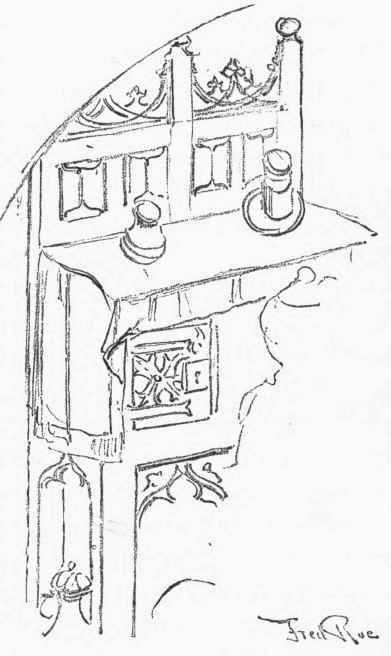
CREDENCE, SCULPTURED ON THE STALLS OF AMIENS CATHEDRAL.
Thus the influence of the Renaissance was manifested in France perhaps a quarter of a century before it took effect in England. In the Cluny and Orleans museums many cabinets and credences may be seen belonging undoubtedly to the close of the fifteenth century, which, had they been made in England, would scarcely have exhibited such unmistakable signs of the new style before the reign of Henry VIII. had advanced some little way. As regards constructive outline, French cupboards and hutches of the time of Francis I. and Henri II. often exhibited a great resemblance to English work of the corresponding periods. The credence, or raised cupboard, with its recessed base, frequently bore a remarkable similarity in structure to its English prototype, but it is in the lighter build, more refined proportions, and differences in such details as mouldings, that the distinction must be looked for.
During the later Renaissance English work was but little affected by French methods, and it is worthy of remark that during the second half of the sixteenth century English work more than held its own. French furniture of a time approximating to our Elizabethan period, although slightly finer in such details as figures, is often lacking in repose; cabinets and buffets were frequently covered with a superabundance of ornament. A quaint lingering of old Gothic methods continued till a very late period in Brittany, where the Middle Ages lasted longer than in any other part of civilized Europe. Many a chest or food locker decorated with Gothic arches or portraits enclosed in medallions, bearing a fictitiously early look, may be proved on examination to be of Breton origin, and to date no earlier than the close of the seventeenth century. These Breton pieces are almost all coarse in execution and vulgar or grotesque in detail. The Frenchman knows this degenerate work well, and, indeed, the knowledge is not confined to the connoisseur.
There is more intelligent appreciation of design at the present day amongst the lower classes in France than elsewhere, the periods being understood by many people in humble station to a surprising degree.
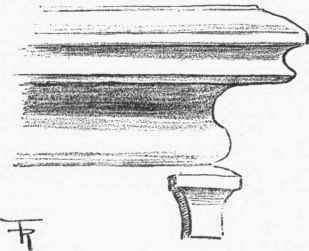
MOULDED CORNICE ON FRENCH CABINET IN THE PEYRE COLLECTION, SIXTEENTH CENTURY.
Continue to:


My Books

