


Oaken Chairs And Stools From The Thirteenth Century To The Renaissance. Part 3
Description
This section is from the book "Old Oak Furniture", by Fred Roe. Also available from Amazon: Old Oak Furniture.
Oaken Chairs And Stools From The Thirteenth Century To The Renaissance. Part 3
Again, I cannot help emphasizing the fact that, whilst in the museums and other collections in France there are very many specimens of furniture of the fifteenth century, or even earlier, in England the number of examples of such age remaining is exceedingly scanty, a circumstance attributable in some measure, perhaps, to the comparatively small production, which in its turn was due to the long state of internecine war. As has been already remarked, the representations of chairs to be seen in medieval documents are frequently so exaggerated that little idea can be obtained of their actual form, and the ignorance of perspective manifested in the earlier pictures no doubt contributes to this appearance of impracticability. But we also find that the extravagance of decoration is such as to have rendered these curious pieces of furniture - if, indeed, they ever existed - practically unusable.
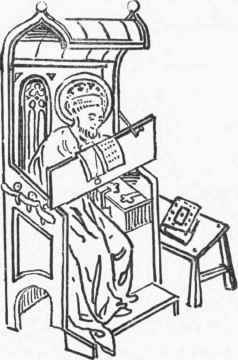
SCRIBE'S CHAIR, FROM LATE FOURTEENTH-CENTURY MS. IN THE BRITISH MUSEUM.
The thrones depicted in the psalter of Jean fils du Roi meme nomme,' in the Bibliotheque Nationale in Paris, are good specimens of this class of exaggeration - in fact, the early illustrators seem to have possessed no idea of proportion, and were in the habit of overlaying the structure with such a profusion of crockets and pinnacles as must have made the occupant of the seat exceedingly uncomfortable.
The early Gothic chairs which actually remain to us are very beautiful specimens of art, exhibiting none of the exaggerations of the miniaturists. As a good example of the free treatment which the early illustrators were accustomed to employ, mention may be made of the well-known representation of the coronation of a King - either Edward II. or Edward III. - in an English manuscript of the fourteenth century in the library of Corpus Christi College, Cambridge. The coronation chair here depicted bears but a faint resemblance to the actual object; indeed, the sides of the chair are not proportionately balanced, one arm being entirely omitted; and although the outline of the pointed and crocketed back is fairly correct, the details are evidently filled in from memory, and are most incorrectly rendered. It is a question, to my mind, whether the chair in which Richard II. is represented as sitting in the famous picture in Westminster Abbey is not a fanciful and perhaps mutilated representation of the coronation chair, into the arms of which the artist has introduced singular unmeaning horns.
There is a very excellent representation of a Gothic arm-chair in the MS. of the 'Romance of Alexander' in the Bodleian Library at Oxford, but even here the crockets which terminate the arms are monstrously overdone.
There may possibly be another reason to account for the exceeding scarcity of Gothic chairs in England, inasmuch as for ordinary purposes chests were frequently used as seats. In the Harleian MSS. in the British Museum there is an early fifteenth-century illumination representing David and his choir, in which the King and his attendant musicians are all seated upon chests carved with windows filled with Gothic tracery. An illustration depicting the surrender of Troyes, in the Bibliotheque Nationale at Paris, also shows the King and Queen seated on a long coffer, over which is an improvised canopy.*
I have alluded to the scarcity of furniture in the earlier part of the Middle Ages. So scanty seem to have been the appointments of many households that tables and chairs and even glazed window-casements were carried about by wealthy travellers from place to place for purposes of comfort. This custom no, doubt gave rise to the folding or rack-chair, which was prevalent throughout the greater part of Europe during the fifteenth century, and which, as its name implies, was constructed in a manner convenient for carriage from place to place. Several of these remain in Continental museums, and among the delightful sculptures in basrelief which decorate the stalls in the choir of the cathedral at Amiens may be seen the representation of a scribe seated upon one of these folding-chairs, and using a linen-panelled chest as a table.
* MS., No. 5,054, date, 1484.
Fortunately, although the number of chairs of the Gothic period remaining is exceedingly scanty, we yet possess some examples of what is still known as the joint-stool. These stools are popularly supposed to have been used solely for the purposes of supporting coffins during the last service for the dead, but I cannot help thinking that this idea is erroneous, for we find joint-stools of all dates in numbers in old country houses. The Charterhouse possesses numerous exceedingly curious specimens. The long, heavy benches such as one sees in the halls at Guildford, Ockwells, Penshurst, and other places, ranged along, beside the great oak tables, were difficult to move, and were supplemented by smaller pieces of furniture of the joint-stool type. I am inclined to the theory, therefore, that, so far from the joint-stool being a strictly ecclesiastical device, its use as a rest for coffins was only a secondary one, and in further support of this argument I may refer to Douce's MS., No. 195, where there is an illumination representing a domestic interior of the fifteenth century.
On the hearth beneath the hooded fireplace stand the twisted andirons, and before the fire which burns upon the hearth is a good example of the Gothic joint-stool.
One of the very best stools of this type - perhaps the most beautiful of all, and an English example to boot - is in the collection of Sir Charles Lawes-Wittewronge. The whole construction of the framework exhibits that simplicity which is one of the admirable characteristics of the fifteenth century, and the surface of the wood on the sides is carved with a delicate pattern of late Gothic tracery and the conventional bunches of grapes and vine tendrils common to the period. A stool of similar construction, but without the surface carving, may be seen in the Saffron Walden Museum, and another, still more art5 - 2 fully keyed together, but with shorter buttresses, is in my own collection. All of these stools are in a very fine state of preservation. These stools, no less than much larger pieces of furniture, illustrate the need of a knowledge of architecture for those who wish to assign dates to them. It has been mooted by some people that, from the shape of the arch which appears upon the sides and ends, these stools have an Eastern origin, but a reference to the barge boards on many houses of the fifteenth century in England will show that this idea is hastily formed and fallacious, and that this type of arch was a common form of decoration.
Continue to:


My Books

